Under a resolution of the National Institute of Seeds (INASE), the purchase and sale of cannabis seeds is now legal in Argentina.
Resolution 260/2022 , which was published this Tuesday, July 5 in the Official Journal of the Nation, establishes that “The organs of propagation of plants of the identified class of Cannabis sativa L., must bear a mention of the cultivar on the label in a mandatory manner from from the date of entry into force of this resolution. »
Thus, the regulations allow not only the sale of seeds, but also that of cuttings and plants.
In addition, only varieties registered with INASE may thus be sold: “the introduction and/or dissemination on national territory, for marketing purposes, of seeds of the species Cannabis sativa L., cannot be carried out only after registration of the variety or varieties of the said species in the national register of cultivars”.
Article 3 warns that INASE will not process any import of cannabis seeds whose variety has not been previously registered in the National Cultivar Registry or is in the process of being registered. Priority will thus be given to the development of Argentine genetic material.
Only research projects approved by the Argentine Ministry of Health will be exempted from the obligation to legally register varieties.
To be able to sell cannabis seeds, any growshop will be able to register with the national register of trade and seed control on the dedicated platform. The procedure is chargeable and takes about a week, the costs depending on the category in which the person registers. The sale authorization will last for one year.
Safety label for the marketing of cannabis seeds
The resolution also stresses that “propagation organs must be marketed using the INASE safety label”. This label must include the following specifications:
Name and address of the identifier and registration number in the national seed trade and control register
Common and botanical name of the species
CULTIVAR name
Class “IDENTIFIED NOMINATE”
net content
Country of origin, in case of imported material
Harvest year
Minimum percentage of germination, in the case of botanical seeds
Percentage of physico-botanical PURITY
“TREATED SEEDS – POISON”: in red letters if the seed or organ has been treated with a seed treatment
Finally, a legend should also be included stating: “With respect to germination, Supplier is responsible to Buyer within FORTY-FIVE (45) days from date of shipment of goods or within the deadline set by mutual agreement between the parties. »
However, the cultivation of cannabis without authorization is still prohibited. However, the country has just authorized associations to cultivate for their patients.
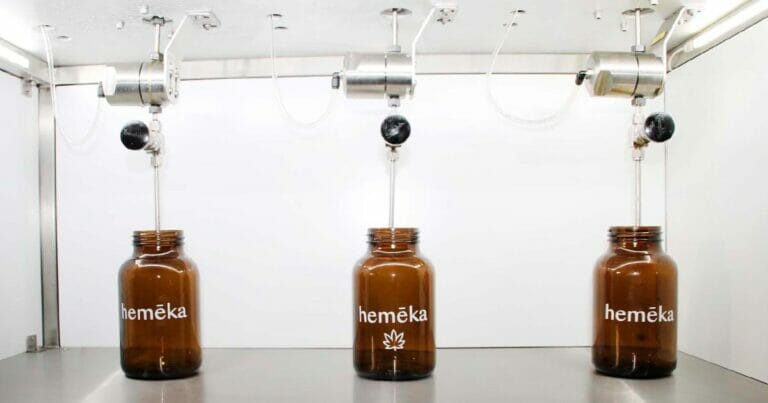
Today, hemēka® announces the first supercritical CO2 hemp extraction made in France from French hemp.
100% everywhere!
After months of research and development, the first 100% French CBD extracts are finally coming out of the extractor. A 100% Full Spectrum, 100% traceable and 100% local raw material which will make it possible to offer the very first 100% French CBD oils.
More than a year of research and development
To be able to offer such a product, it took more than a year of research and development, testing, analysis, hundreds of hours on the phone, but above all a meeting. Indeed, this extract is the result of a meeting between Anthony, co-founder of hemēka®, with François, manager of Alliance CBG and who set himself the challenge in early 2021 of being able to offer CO2 extraction in France.
From an innocuous meeting was born a friendship and a solid partnership between two people and two companies who have the same vision and the same values.
CBD extraction by Hemeka
A raw material for the French market
hemēka® has always advocated Made in France CBD products with the desire to democratize CBD in France. The extract they offer will be available in different forms and for different uses. The goal is to be able to offer it to both individuals and professionals in the sector.
For individuals, initially, in the form of CBD oil where the extract is accompanied by an organic and French hemp seed oil of course.
For professionals, the extract will be available as a raw material for their creations, whether to make their own oils or other products such as edibles for example. It’s up to professionals to let their creativity speak!
Impeccable transparency
In a CBD market in France where transparency in the origin of products and raw materials is still very opaque, hemēka® offers a high-end and unique product!
“Today, thanks to our network of several dozen hemp growers in France, we are proud to be able to offer CBD Full Spectrum extracts with supercritical CO2 made in France for a top-of-the-range product, 100% local, 100% French and 100% transparent » gives us Anthony Rebillot, co-founder of hemēka®.
About hemēka®
hemēka® is the brand created by Anthony and Fabien, founders of the flavors-cbd.fr website. From their launch in 2018, the 2 partners wanted to be able to offer products made in France, in short circuit and above all to bring transparency in the creation of products on the CBD market in France.
In its annual report on drug addiction, the Italian government stressed the need to encourage decriminalization, review the current law and abandon the repressive model.
The 556-page report sent by the government to Parliament fully incorporates the discussions held at the National Conference on Addictions in Genoa last fall, commissioned by Minister Fabiana Dadone, responsible for anti-drug policies.
And the report’s findings, while not a direct statement, leave little doubt about the government’s support for the cannabis decriminalization bill currently before the Italian Assembly.
On page 516 of the report, marked with Wired Italyone can read how “the need to implement initiatives” aimed at overcoming the social stigma due to years of repressive policies towards consumers, increasing the integration of skills between health professionals and authorities , develop the participation of all actors interested in the phenomenon to reduce the risks associated with the use of substances, increase the flow of information to develop better policies, implement processes for evaluating the effectiveness of actions , identify the resources needed to solve the problem and, above all, “encourage decriminalization”.
The report even gives the method, namely “to revise the current law by moving from a repressive model to a model of governance and social regulation of the phenomenon, and by exempting from criminal prosecution certain illicit behaviors, envisaged by article 73, while re-examining the system of sanctions and excluding the mandatory nature of arrest in flagrante delicto. »
Riccardo Magi, president of the Più Europa party, explains to DolceVitaOnline that “these words follow, with all due respect to Salvini and Meloni, the objectives of the bill that I first signed on home cultivation”.
“In reality, the report’s suggestions even go beyond our text, providing for example for the decriminalization of the sale of small amounts when it takes place for non-profit purposes. From now on, the right has no more excuses, Parliament can and must take up the issue and vote. The discussion in the hemicycle will resume in the coming days, it’s the moment of truth. Voters will finally be able to understand who is using this theme for propaganda purposes and who is seriously fighting for change.”
Supporters of the project for the legalization of self-cultivation hope that it can be voted on by the Chamber of Deputies before the summer to continue in the Senate in September when parliamentary work resumes.
Every 10 years since 2002, the Senate updates its study of comparative legislation on the decriminalization and legalization of cannabis. The third edition has just been updated and published on the Senate website.
The updated study presents the evolution of the legal framework relating to the consumption, possession, sale and cultivation of cannabis in the 8 countries of the initial study (Germany, Denmark, Spain, the Netherlands, Portugal, United United – England – and Switzerland) and widens its scope to countries that have legalized cannabis on all or part of their territory: Canada, the United States with California, Uruguay and Malta.
Similar to the 2013 study, the particular patterns of consumption and sale of cannabis for therapeutic purposes are not investigated.
What do we learn in this note?
Regular Newsweed readers won’t learn much, especially if they’ve read the latest Augur report on cannabis legalization in Europe. The note nevertheless recalls that all the countries bordering France have decriminalized cannabis and that most have started a reflection towards a form of legalization.
Thus, the Netherlands, after several decades of imposed cannabis tolerance, will conduct a production experiment to supply the coffeeshops of ten cities. 10 production licenses are being awarded to ensure the supply chain.
Switzerland has launched its pilot projects for the controlled distribution of cannabis. Each project can integrate 5000 participants who will be limited to 10g of pure THC per month, i.e. 50 grams of cannabis at 20% THC. The pilot projects will be monitored by universities to measure the impact of legal cannabis on the participants and on the surroundings of the distribution areas. They can last up to 7 years. In parallel, which the Senate report does not say, the slow parliamentary work towards legalization began with the approval by several parliamentary committees of the need to control the “cannabis market for better protection of young people and consumers”. .
Malta has become the first European country to end cannabis prohibition. Consumption, possession and cultivation for personal purposes is authorized within certain limits. The distribution will be ensured there a priori from the end of the year by Cannabis Social Clubs limited in number of members and which will be able to cultivate for the latter.
Spain has decriminalized the consumption and possession of cannabis in private places. Possession in public is still prohibited. The distribution is ensured by Cannabis Social Clubs which, if they are authorized under the exemption from penalization in private places, struggle to find a legal framework at the federal level.
Portugal decriminalized all drugs over 20 years ago. The note tells us that the consumption of all substances is lower there than in the average for European countries, even if the use of cannabis has increased gradually in all age groups.
The UK has implemented decriminalization by law enforcement and some counties now regard the criminalization of simple use as the lowest priority. Some Cannabis Clubs are also supported by the police. A reflection has been initiated by the Mayor of London to examine the legality of cannabis.
Germany, now considered to have the most complex legalization project, decided to legalize cannabis. Expert hearings are currently underway on a variety of topics and the bill is expected to be introduced in the second half of 2022. Few details are yet known but the discussions seem to be moving closer to a Canadian-style model.
We will add to the Senate note that Luxembourg is going to legalize the self-cultivation of cannabis, with no market model other than seeds, and that Denmark has begun its reflection on a five-year legalization experiment, like the one that she leads on medical cannabis.
Well known in the world of smokers, the ST Dupont brand is also famous for small leather goods and writing accessories. This year, the house celebrates its 150th anniversary, the opportunity for us to present to you this French luxury brand with century-old know-how.
Luxury for 150 years
The brand was born in 1872 S.T. Dupont. For the record, its creator is none other than the photographer of Napoleon III, passionate about aesthetics and leather goods. Simon Tissot Dupont then decided to open his leather goods workshop in Paris at the age of 25.
Very quickly, his travel trunks became popular with the European elite. He then became a supplier to prestigious Parisian stores, but also made unique models on request. Empress Eugénie, for example, liked to order from her in order to obtain a tailor-made travel kit.
A know-how transmitted from father to son
ST Dupont had 2 sons who learned everything from their father. Naturally, they took over the business in 1919 and transferred the Parisian clothing workshop to Haute-Savoie, to Faverges. In order to gain a little more notoriety, the two brothers claim the purity of the place of manufacture for even more luxurious products.
The advantage of future generations lies above all in innovation since it is often thanks to them that products evolve. Thus, from 1930, a new technique of tanning with diamond powder offers a leather of much better quality and more resistant to temperature variations. In 1935, ST Dupont called on an expert in Chinese lacquer on metal to vary its products a little more. Since then, ST Dupont has continued to manufacture ever more innovative luxury products and sometimes even unique pieces, such as the Rivera handbag designed for Audrey Hepburn.
150 years in color
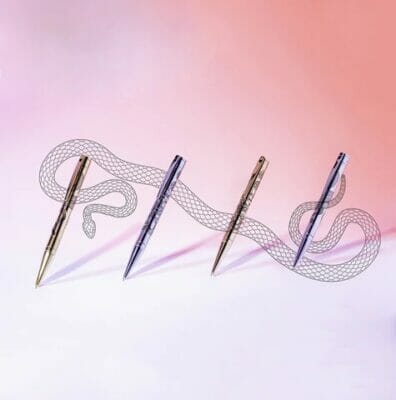
In 2022, the house celebrates its 150 years of know-how with a colorful range of products. Pastel pens, lighters and Mexican ashtrays as well as flashy notebooks, the 150th anniversary of the brand is a sign of celebration!
Comment About ST Dupont celebrates its 150th anniversary Below ..
Following the European Food Safety Authority’s (EFSA) controversial decision to halt the processing of Novel Food applications for CBD last month, the regulator addressed the industry in a virtual public forum last week.
As part of what EFSA called an effort to engage in “an open dialogue with stakeholders”, the “briefing session” sought to shed light on the reasoning behind its decision, which seen dozens of European applications for CBD products end up in regulatory limbo.
While a panel of experts from EFSA and the European Commission answered many questions posed by the CBD industry directly, they did not provide any concrete information on two key points: the likely duration of the process and the design of human trials.
Like its UK counterpart, the Food Standards Agency (FSA), which published the final version of its public list of CBD products just days after the speech, EFSA pointed to the wrong quality of many of its claims as a key reason for what could be a long delay in regulating the sector.
Where are the demands for CBD in the EU?
As Susanne Caspar, CEO of Swiss herbal extraction company Linnea, explained last week, many companies have already waited years, sometimes more than a decade, for their products to be approved under the European novel food process.
In the wake of this recent statement, many in the CBD industry are now eager to find out if it will push back regulatory deadlines even further, and by how long.
Panel host Ana Afonso did not provide a forward-looking timeline and offered little hope that the process could be completed in the near future.
“What this panel needs before expressing its opinion on the safety of these products is to have sufficient data to ensure consumer safety.
“This is the main principle on which EFSA operates. The question of time is less relevant, even if it is not unrelated to our commercial operators and to the innovation that we want to promote on the European market. But our main concern is safety. »
“It would be difficult to answer this question. There is no timetable, it is about having enough data. What we can assure you from the EFSA side is that we will continue to work very hard with our panel of experts. We are also counting on the public to contribute to the success of these studies so that we can make a final decision. »
Another point of confusion for those who will be tasked with filling these “gaps” is exactly how these human studies must be structured for EFSA to consider them valid.
Again, the panel was unable to provide much clarity, with Dr Inge Mangelsdorf saying EFSA was “still in the developmental stage for what we think we need”.
She added: “We are sure, or rather we admit, that it will be a very complicated study and a huge study. »
Professor Harry McArdle, who is a member of both EFSA’s Novel Foods Task Force and the UK’s Advisory Committee on Novel Foods and New Processes (ACNFP), was able to provide some clarification on the length of the studies required by EFSA, explaining that “the studies that have been done were short term, and we need long term data”.
“We’ve thought long and hard about what constitutes long-term data, and I think six-month data would answer most of the concerns we have. »
The panel added that it expects the production process between synthetic CBD and naturally-derived CBD to “impact the final product,” so “each will be evaluated separately.”
Asked whether stopping CBD applications will impact other food applications of novel cannabinoids for compounds such as CBG and CBC, EFSA replied that it would depend on whether whether they will be supplied alone or mixed with CBD, adding that this is a “very complicated” consideration.
She also explained that, although she does her best to “work on many files simultaneously”, requests are not processed on a “first in, first out” basis, but on the quality of the data. submitted.
Why was the statement made?
Professor McArdle said the decision to suspend applications indefinitely was taken following “extensive research” into the current scientific literature.
This literature, which consists of numerous toxicological studies conducted on animals and humans, has often been carried out with “wide variety mixtures” of CBD, containing different compounds and other cannabinoids.
He explains that this became a “real problem when it became clear that the contents of these other components and their identities are rarely described, at least in sufficient detail for us to understand their contribution to the problems”.
Professor McArdle adds that it is very important to understand the “interactions between these chemicals and the human body”.
The few studies that focused on the effects of pure CBD in humans, such as those conducted with GW Pharmaceuticals’ Epidyolex, were also of little use for EFSA’s purposes, as they were conducted in patients who used drugs. additional.
“This really complicates our assessment of the effect of CBD. This became so important when we looked at the efficacy of Epidyolex, where adverse effects were sometimes observed but tolerated, where we could not derive any NOAEL (no-observed-adverse-effect level). »
Additionally, EFSA said there was little data on whether these “complex” interactions would still occur at expected dosage levels when CBD is taken for wellness use, rather than in a clinical setting.
Finally, Catalina Manieu, EFSA’s Chief Scientist, addressed issues relating to the quality of the applications she has already received, a reason repeatedly cited by the FSA for delays in its own process.
After assessing more than 40 applications as part of the initial suitability check, Ms Manieu said applicants often fail to fully identify the new food that will be placed on the market, specifying whether the compound is a “simple mixture or a complex mixture”, or whether the formulation is a crystal or an oil.
She added that EFSA received dossiers in which only 10% of the novel food had been characterized, while other important information such as the identity of the raw material, the geographical location, the taxonomy, the details of the production process and identity verification according to international methodologies were “often missing”.
Hemp has long been part of the medicinal and spiritual practices of various cultures throughout history. One of the religions that valued cannabis was Taoism in ancient China. The Chinese even had a guardian for this herb: Magu.
Considered in ancient East Asia as the equivalent of the divine ambrosia of the Greek gods, hemp has long been called the “elixir of life”. The association of the goddess Magu with cannabis lies mainly in its use as a medicinal plant.
The majority of Magu’s mythological stories revolve around how she helped the poor and sick, either as a goddess or as a priestess of an unnamed healing deity. In ancient Korean literature, Magu plays a more distinctly divine role, but the essence of her personality remains relatively the same.
Magu’s story
In China, Japan and Korea, Magu (or Ma Gu MaKu, Mako) is depicted as a beautiful young woman in her twenties. Her youth and beauty are symbols of the health and healing of the universe she is meant to protect.
Magu is the guardian of vitality throughout East Asia, not only in the mortal world but also in the cycles of the earth. Magu is regularly considered to discount winter in favor of flora and fauna. In Korea, Magu’s role is elevated from goddess to creator god, and her abilities are extended to the creation of the world and mankind.
Several versions clash on his earthly life. The most consistent states that Magu lived a poor life in the war-torn 5th and 6th centuries CE, and worked as a seamstress. One day, Magu received a peach from one of her customers. But instead of taking the peach home, she gave the sweet fruit to an old woman and decided to prepare a bowl of porridge for her.
When she returns, her father, furious that she has given up, locks her up. When Magu is finally freed, she goes in search of the old woman she intended to cook for, but she only finds the pit of the peach where the woman was.
Legend has it that Magu planted this peach pit, which grew into an incredible tree, bearing healing fruits, which she used to heal the sick and infirm in her village. This is how Magu was immortalized as a goddess possessing the elixir of life.
The goddess who healed with cannabis
Although this tale is only one of many recounting Magu’s existence, it reveals the main strengths of her cult: namely, caring for the sick and poor and cultivating the natural world.
Here, Chinese writers depicted her “elixir of life” in the form of peaches, as evidenced by Magu’s symbols in ancient Chinese art, but Cannabis has also been closely linked to her healing abilities, although on a spiritual plane rather than a physical one.
Records of Taoist practices mention that eating hemp seeds protects against demonic possession and increases “second sight”, while burning the seeds was performed in purification rituals. Often it was Magu who was invoked during these times, associated with Mount Tai on which hemp grew in abundance at the time, as if the gods handed the plant directly to the priests and priestesses of the Taoist religion.
The implications of Cannabis use in ancient Asia may not yet be definitive, but it is evident that the plant has long played an important role in East Asian history. Hemp was used in the decoration of ancient Taiwanese pottery as well as on the Shinto staffs of the first Japanese priests. A recent study also suggests that Cannabis was domesticated 12,000 years ago in China.
This incorporation of the plant into these other activities reveals the great value that hemp has evidently had in Asian cultures since very early times.
At a time when herb magick was common and gods were believed to roam the natural world, the association with the “powers” of hemp and the goddess of healing align effortlessly. Only a highly esteemed goddess would be entrusted with the care of such a powerful and transcendent herb.
In a request for information (RFI) published last week, the US military said it wanted to explore alternative materials to improve the uniforms used by snipers for camouflage. Hemp and jute are among the materials that the military says could be used as a backing for “Operational and Individual Garments for Ghillie Camouflage (IGS)”.
“The interest is specifically in a yarn used to break the silhouette of snipers, made from jute, hemp or similar natural fiber,” the notice reads.
The division of the army in charge of the management of the products for the clothing of the soldiers and the personal equipment is “looking for a yarn of jute, hemp or a similar natural fiber, of a weight of 48 lbs, 3 ply, natural color,” the review continues. “Current demand for jute/hemp yarn is 400,000 yards” or 366 kilometers.
“The IGS is a new and improved concealment system developed to meet the concealment needs of snipers. The IGS features changeable camouflage materials (e.g. jute, hemp, or similar natural fiber) that can be used to change the appearance of the sniper. Jute, hemp, or other natural fiber from the IGS will help conceal the sniper and scout during missions, allowing them to go undetected near enemy forces. »
Hemp has been federally legalized in the United States under the 2018 Farm Bill. And while many have come to associate the crop with its derivatives like CBD oil, there is growing interest in its other industrial applications, particularly due to its unique durability, versatility, and low environmental impact.
Now the US military wants to see if this culture has the potential to better camouflage its snipers. The RFI specifies that hemp yarn can be spun in the country or imported from other countries, unlike jute which must be spun in the United States even if the fiber comes from a foreign source.
“The material must not present a risk to the health of the soldier and must show its compatibility with direct and prolonged contact with the skin”, specifies the text. Also, the material cannot “add a significant amount of weight” to uniforms. Responses to the request for information are expected by July 27.
In Barcelona, Cannabis Clubs cling to a new hope to keep their doors open: to be governed by a “private social club” license.
Last July, the Superior Court of Justice of Catalonia (TSJC) decided that only the Spanish central government had the power to regulate cannabis clubs. Since then, the Cannabis Clubs in Barcelona, accused by the TSJC of being spaces “likely to encourage the commission of crimes”, have been in danger of disappearing.
Last October, the Guardia Civil also began an inspection of the Clubs in anticipation of the closure of some of these premises.
A legal response for Barcelona’s cannabis clubs
However, as reported elDiarioARthe CatFAC (Confederation of Federations of Cannabis Associations) which represents the Clubs with the municipality has found a way to keep the Clubs open.
By registering under a “private social club” license, establishments will be able to continue their activity without meeting the previous requirements (distance from schools, ventilation, etc.).
Addressing elDiarioAR, Eric Asensio, spokesman for CatFA explained that “the current scenario is a throwback, similar to when this activity was not regulated in the city. We know that new premises are opening that do not meet the requirements previously requested by the City Council”.
What specific changes will cannabis associations face? They will not be able to offer cannabis visibly, display prices, or anything that may “promote” its use.
And, while members can source cannabis from clubs, they will need to do so in a “less obvious” way.
For its part, the town hall of Barcelona warns that it will strengthen the controls.
“The monitoring of cannabis associations and clubs will be reinforced. As well as the capacity for inspection and administrative intervention to ensure compliance with the regulations that concern them and prevent nuisance for neighbors or public health offences,” she warned.
2022 is halfway through and cannabis micro-cultivation licenses continue to be the most popular type of license in Canada.
Initially, the Canadian Cannabis Act regulated large-scale cannabis cultivation facilities. This first draft established a standardized and simple authorization process, but the cost of the process prevented small businesses from joining the new legal cannabis market.
To address this issue, Health Canada has segmented licenses into different categories: standard cannabis licenses, micro cultivation licenses, nursery licenses and hemp cultivation. Micro-cultivation licenses allow licensed producers to cultivate up to 200 square meters of cannabis and an annual maximum of 600 kg of dried cannabis for processing license holders.
Micro-cultivation licenses in Canada also take into account that small businesses operate with reduced budgets and fewer employees. Storage and monitoring requirements are reduced and regulatory costs lower.
Micro-culture attracts
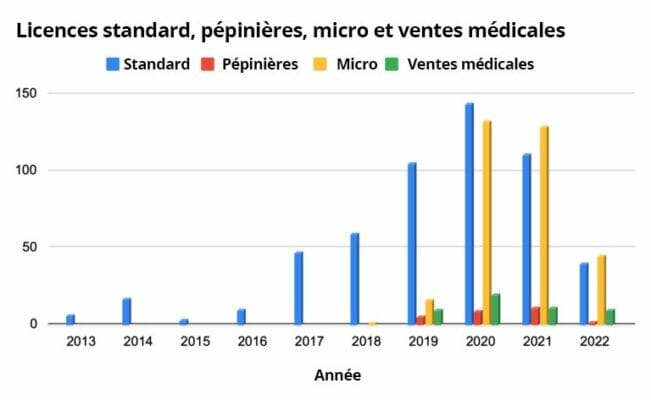
In line with the 2021 trend, micro-cultivation and processing licenses continue to be the most common license category granted in Canada, with 45 of the 97 licenses issued so far this year being micro-licences.
Another 40 licenses issued this year were standard licenses (cultivation and/or processing), as well as 10 medical sales-only licenses and 2 nursery licenses. 1 license for sale for medical purposes only (VMM) allows its holder to operate an online sales platform without ever possessing cannabis.
In 2021, 262 new licenses had been granted; 130 of these were micro (cultivation and/or standard) while 108 were standard cultivation and/or processing licenses, as well as eleven medical sales-only licenses and eleven nursery licenses.
This is a slight change from 2020, when there were 144 standard licenses, 132 micro, 20 licenses for sale for medical purposes only and 9 nursery licenses.
There are currently 309 micro-licenses in Canada, out of a total of 859 active licenses. Of these, 28 are nurseries, 39 are sale-for-medical-only licenses, and 483 are standard licenses.