Home Blog Page 99

Belize: Legalization of cannabis expected in mid-April, the Church opposes it

The last kilometers are often the most difficult. This is the case for the bill to legalize cannabis in Belize, a small country in Central America. the Cannabis and Industrial Hemp Control and Licensing Act wanted by the Prime Minister is ready. It is due to come into force on April 18. But the Church exerts all its weight to delay it.

The National Evangelical Association of Belize wants a referendum, hoping the “no” wins. For this, a petition must receive the signature of 10% of the electorate, or about 18,000 people in this country of 350,000 inhabitants.

“The people of Belize should be able to have their voices heard in such a radical change to the morals of our society. It must be up to the people to decide if an illegal drug becomes legal, with horrible ramifications for the future of our country”, asks this Christian organization in a press release. Moral arguments reminiscent of those used by the Mormon Church in the United States.

Church must find 18,000 signatures by April 18

The Church therefore plays the “democratic denial” card, even if it does not specify that the current government was democratically elected in 2020. Its leader, Prime Minister John Briceño has been promising since 2018 that he wishes to legalize cannabis in the event of access to power.

Since then, the bill has (with difficulty) passed the stages of the House of Representatives and the Senate. “I am surprised that this request for a referendum comes so latetackles the Minister of Economy Kareem Musa during a debate on television. We have worked with the churches, with the social partners throughout the last year. And it’s only when the law has passed the House and the Senate that they call for a referendum. »

The Church will have to find 18,000 signatures to trigger a referendum before April 18, an almost impossible mission. After this date, the government will sign the text of the law to bring it into force.

The law provides for the establishment of licenses, so that shops can legally sell cannabis. Consumers, on the other hand, will have to obtain a “cannabis identity card” from the government to buy their favorite products in stores.

Maryland will vote for or against the legalization of cannabis

On November 8, 2022, the people of Maryland will vote to elect their governor… and to legalize – or not – recreational cannabis. This is the result of a law, approved by the House of Delegates and then by the Senate of this state located not far from the capital Washington DC

If Maryland’s 6 million people vote “yes,” cannabis will be legal as of July 1, 2023. Adults over 21 will be able to possess up to 42 grams of cannabis. It will also be possible to grow two cannabis plants at home. Criminal records for possession of cannabis will be expunged. And people in prison for consuming or selling the plant will be free.

At this stage, the law does not yet provide details on store licenses or the level of taxation. Deputies and senators will only provide these details if the law is passed. For opponents of legalization, Maryland has put the cart before the horse.

66% of inhabitants for legalization

“First, we need to be sure to remove barriers for some people, such as expunging criminal records. Then we will solve the problems related to taxes and licenses »is justified the democrat deputy Luke Clippinger, at the origin of the law.

The “social justice” dimension of cannabis legalization is very important in Maryland. Indeed, it is one of the American states where there are the most blacks. 30% of residents are African-American, the fourth state with the highest proportion. And in the United States, blacks are the most affected by the laws against cannabis.

Will residents vote for or against legalization? A recent poll shows that 66% of Marylanders are in favor of such a measure. Even if the margin of error of this study is 4%, the result seems almost acquired. A recent report predicted legalization in Maryland in 2023. If so, it would become the 20th state (out of fifty) to authorize the plant.

55% of Western Europeans for the legalization of cannabis, according to a survey

The “for” outweighs the “against”. For a majority of people in eight Western European countries, the legalization of cannabis would be a good thing. 55% of respondents from France, Germany, United Kingdom, Switzerland, Italy, Spain, Portugal and the Netherlands are in favor of it. This is the result of a survey commissioned by the cannabis industry.

Results vary across the eight countries. In seven of them, a majority of people would like to legalize the plant. Only the inhabitants of the Netherlands are a minority (47%) to support such a reform. In France, 52% are in favor, 27% opposed, 18% do not decide.

Opposition to cannabis reforms (legalization of sales, establishment of social clubshome cultivation) in France is higher than in all the other countries surveyed”note the pollsters.

“No legalization in the immediate future in France”

In Germany, as the country prepares to legalize recreational cannabis, support is not overwhelming. “Only one in two Germans supports the legalization of cannabis sales, two in three oppose it. It will be interesting to see how public opinion evolves when we know the details of legalization.”adds the document.

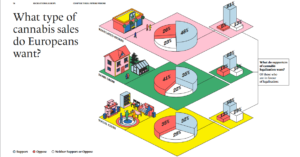
The authors of the study also wanted to know which model Europeans prefer. Results : ” State-regulated stores are by far the most popular (and least controversial) model for cannabis legalization. Home cultivation encounters the strongest opposition. »

This rejection of self-cultivation is particularly strong in France and the UK, according to the study. She explains this position by the fact that “the public is concerned about the nuisance or disgust of being exposed to the use of cannabis in others”.

55% of Western Europeans for the legalization of cannabis, according to a survey

Finally, the poll tries to predict the future. Without a crystal ball, but by analyzing the latest events. For our country, the specialists “do not expect reform on recreational cannabis in the immediate future”. Elsewhere, the results are more encouraging. In the United Kingdom, a country where consumption is already almost decriminalized, support is mounting for legalization. In Italy, an upcoming reform is “possibly”. In Portugal, there is a “dynamic”.

Study funded by industry players

However, all these encouraging results still need to be (slightly) qualified. Indeed, this opinion study was funded by industry players, who are rubbing their hands at the idea of ​​possible legalization in Europe.

The benefactor of this study is the American giant Curaleaf. Coincidentally (or not), its director is very confident about the forthcoming legalization of cannabis in Europe. To carry out this survey, he also called on the British firm Hanway Associates.

This does not mean that the results are rigged. On the contrary. The methodology seems serious. It is also signed Savanta ComRes, one of the largest polling institutes across the Channel. Between mid-February and mid-March, pollsters interviewed 9,000 people, “representative samples” over 18 in each country.

Cannabis food (finally) available in Quebec

This is a very first. Quebecers have access, since Tuesday, to ready-to-eat cannabis products. The stores of the Société Québécoise du Cannabis (SQDC) now offer blackcurrant and cinnamon bites, from the Solei brand. They contain a THC:CBD ratio of 1:2, with 5mg of THC to 10mg of CBD.

Since legalization in 2018, the company that has the public monopoly on the sale of cannabis in Quebec had nothing on the shelf that could be eaten directly. She offered exceptional or pre-rolled flowers,… but none edible, as English speakers call them. Reason given at the time: these products can be “attractive to minors”.

She now assumes that she has changed her mind, to attract even more consumers to the legal market. “With this product, we are offering one more option that is less risky for the health of consumers since no combustion is necessary to consume it”justifies Fabrice Giguère, spokesperson for the SQDC, in the Journal of Quebec. New products of this type could arrive in the coming months.

Products don’t have to be pretty or good

To land in the 75 SQDC stores, edible products must comply with a few rules. They are not as beautiful and good as a cake in the window of a pastry shop. Indeed, the SQDC obliges Solei, the producer, to manufacture a product that is not really attractive “by reason of its shape, colour, texture, taste or packaging”adds the spokesperson.

A journalist from Quebec newspaper also took a photo of them. And the result is not fantastic.

THC Solei cakes

It is a strict regulation… and very different from the neighbors of Quebec. For example, Ontario sells edible products that look like a drop of water like candy. Same thing in the United States, where Wana Brands offers products that make you want.

Despite these constraints, the Solei brand, owned by the giant Tilray, remains delighted. “We are proud to have collaborated with the SQDC to develop and market a new edible product. Together, we remain committed to pursuing the development of a responsible and safe legal cannabis market, while delivering innovative new products that resonate with consumers.”rubs his hands Blair MacNeil, president of Tilray Canada, in a press release.

Colorado Auctions Cannabis-Related License Plates

Would you like a license plate marked “BLUNT”, “WEED”, or even “420”? It is the subject of a very official auction, organized by the very official State of Colorado. Americans have a problem – sorry, an obsession – with the license plates on their cars. And the first US state to legalize cannabis has understood this.

Small bonus: the money raised will go to a fund in Colorado to help people with disabilities. “For nearly a decade, Colorado has been a leader in the cannabis world, with businesses bringing cheeky, innovative and creative initiatives to our state. This allows us to celebrate this reputation and fund projects to help the disabled community.” justifies Governor Jared Polis in a press release.

This auction is to celebrate the 420. Moreover, motorists in Colorado have until… April 20 to bid. A date obviously not chosen at random, since the four twenty is International Cannabis Smokers Day.

A vanity plate is a sign of humor

Plus, each auction starts… at $420. For now, the most requested plate is the WEED plate. 7 people from Colorado have placed a bid, the last bid is at 2620 dollars.

Last year, an auction on the theme of South Park, a series produced in Colorado, had already raised 45,000 dollars. The state had put up for sale the “TEGRIDY” plate, in reference to this episode which makes fun of the cannabis company MedMen.

In the United States, having a vanity plate on your car is a sign of humor, of being someone cool. Unlike France, it is possible to choose your plate almost from A to Z. All you have to do is pay a small supplement to the State. Thanks to this system, you can admire superb “HODOR”, “UMADBRO” or even “IM LATE” on the roads.

Passing through Montreal? 4 cigar lounges to visit!

If you are heading to Montreal in the next few days and you are a cigar lover, this article is for you. Discover the best cigar bars.

What is a cigar lounge?

Better known as cigar bars, cigar lounges are typical places where you can smoke your cigar among amateurs and accompany it with a delicious spirit. Since the 90s, these establishments have seen their popularity skyrocket, because smoking in public places is prohibited.

While some cigar bars are totally independent, others are an integral part of establishments such as restaurants or bars, in which a room is dedicated to cigar lovers and cigar accessories.

The best cigar lounges in Montreal

Here are the 4 must-see places we have chosen for you.

Passing through Montreal? 4 cigar lounges to visit!

Chez Alexandre et fils

In addition to serving very good French gourmet dishes, the floor is reserved for cigar smokers. This lounge can accommodate about twenty people and opens its doors at the end of the service, around 11 p.m. You can buy your cigars on site or bring your own. Whiskey and Porto are also offered at the bar to accompany the swirls.

Rib N Reef Steakhouse and Cigar Lounge

This Steakhouse restaurant is very refined. The wine cellar is very rich and the cigar lounge is also comfortable. At the bar, Martinis, Whiskeys, Vodkas and other spirits from around the world can accompany your favorite cigar. You do not know which one to choose ? The sommeliers of the establishment will guide you with pleasure.

Stogies Cigar Lounge

Canadian aficionados know that the best cigars in South America can be found there, any day of the week. It is therefore important to book before you come! Come and taste your cigar by pairing it with the many alcohols available at the bar, such as Whiskeys, Scotches and other spirits.

Whiskey Coffee

This 3-in-1 establishment is a bar, a cigar room and a lounge all rolled into one. A favorite of Canadian cigar lovers, but also of well-known actors and sportsmen, it offers a range of 700 spirits and no less than 40 cigars from South America.

Colombia authorizes the export of medical cannabis

Almost a year after having set foot in the export of cannabis, Colombia is setting its second foot. The government has just published Resolution No. 539, to authorize Colombian cannabis growers to export seeds, plants and even dried flowers. Some companies are already in the starting blocksready to send their production all over the world.

Concretely, Colombians will be able to export “ seeds for planting, plant compounds, live cannabis plants, cannabis, cannabis derivatives, and finished products”. This cannabis can be “psychoactive” Where “non-psychoactive”. They can send it “from the national territory anywhere in the world, once they have completed the necessary authorizations”specifies Article 21.

A capital precision: this cannabis will have to be used “for medical or scientific purposes”. Colombian companies will therefore be able to target countries that have legalized medical cannabis. This is the case of many American states, but also of some European countries such as Germany or the United Kingdom.

Exports to Germany in a few months

Before putting their products on a boat, producers must comply with very strict regulations. First, the green light from the VUCE, the government body responsible for foreign trade. Then they will need to obtain a stamp from the Ministry of Foreign Trade.

In this country where the climate is ideal for growing cannabis, companies are almost ready. Clever Leaves, for example, announces that it will export its first high-THC cannabis flowers in the third quarter of 2022. We have prepared for the regulatory change planned by the Colombian government, we now hope to supply flowers to our markets in 2022″rejoices his boss Andrés Fajardo, withEl Tiempo.

The company already plans to export to Germany, in particular thanks to its subsidiary present in Hamburg. In the newspaper InfobaeClever Leaves also announces that it is the first Colombian company to obtain the label Good Medical Practices (GMP), necessary to sell drugs.

Switzerland will “distort” CBD oils to prevent their consumption

The Swiss Confederation will force manufacturers of CBD oils to add a product “denaturant at an appropriate concentration” for discourage excessive oral ingestion”. In short: they will have to make their oils almost unfit for consumption. Products already on the market can stay there for another six months. After this date, they will become unsaleable.

This decision already appears in the Federal Letter, the equivalent of the Official Journal in France, proof of its seriousness. One major unknown remains: will the “denaturants” make the oil unpalatable, or just give it a bad taste?

Until now these products were classified as “chemical products” in Swiss regulations. And not as a “food product”. The health authorities discovered the pot-aux-roses. If these oils are classified alongside soap and detergent, why is there an eyedropper?

“Switzerland will not directly ban these products, but will make them impossible to consume”analysis for Newsweed Simon Anderfurhen, Swiss independent researcher, specialized in drug regulation. For him, the federal government will “allow the consumption of CBD oil in a therapeutic, medicinal setting”.

Highly dosed Swiss oils

A logical continuation for this specialist based in Geneva: This is the result of a marketing pitch from the CBD industry that advanced therapeutic claims for their products. » Now, the authorities want to regain control, and pass cannabidiol for a drug, sold in pharmacies. And who says pharmacy, says strict quality controls.

Especially since the last few months have not worked in favor of the CBD industry. A February study by the Association of Swiss Cantonal Chemists showed that most oils were dosed too high. Scientists were alerting to a “dismal statement”. They were pointing the finger at companies that “do not at all respect the self-monitoring to which they are required”.

As a result, the partial ban on CBD oil appears as a sanction from the health authorities. “If you want to be an industry, you have to behave like onesays a Swiss boss wishing to remain anonymous. Self-control is a beautiful utopia, but unfortunately it is never enough. When it’s not the regulator that puts us in the way, it’s the industry itself. »

$2 million worth of cannabis sold on day one in New Mexico

Legal cannabis sales are off to a strong start in New Mexico. With 1.96 million dollars of products sold, the state of the American Southwest can even boast of having ” beaten “ Colorado figures. Cannabis has been officially legal since Friday, April 1, and adults can shop at 250 stores.

During the first weekend of legalization (Friday, Saturday and Sunday), merchants recorded more than 87,000 transactions. Over these three days, sales of recreational cannabis exceeded $3.5 million. All these figures are proudly put forward by the governor of New Mexico. Michelle Grisham even went to a store on the first day of legalization.

“The start of recreational cannabis sales is one of the most successful, maybe even the most successful, of any US state.congratulates the elected Democrat in a press release. Plus, we beat Colorado’s first day sales numbers! It is clear that cannabis will be a contributor to our economy. »

The Cannabis Control Division is also pleased not to have experienced a shortage for the first days of opening of the dispensaries. “Customers and patients were able to buy the products they wanted or needed”assures his boss, Kristen Thomson.

300 million sales for the first year

In 2014, Colorado residents bought $1 million worth of cannabis on day one. That’s twice as much as New Mexico. But it’s not a record either. In 2020, Illinois hit hard, surpassing $3 million in a single day. Nuance: the state of Chicago has almost six times more inhabitants than New Mexico.

This state now hopes to sell $300 million for the first year of legalization. To reach these figures, he relies in particular on his Texan neighbors. Indeed, the 30 million inhabitants of this state have no access to medical or recreational cannabis.

For example, the small town of Sunland Park has 11,000 inhabitants but it received… 30 license applications to open a cannabis business. It is not a coincidence. The town is only ten kilometers from El Paso, one of the largest cities in Texas, with 2 million inhabitants, the size of Paris.

Argentina: NGOs authorized to cultivate cannabis for 150 patients

Argentina’s health ministry announced in late March that associations will now be able to legally grow cannabis plants for medical purposes for their members.

A resolution now published in the Official Journal allows NGOs to be incorporated into Reprocann, the register of users and growers managed by the Argentine Ministry of Health, which will therefore have the authorization to produce cannabis legally.

Easy access to medical cannabis

Five years after the adoption of Law 27350, which legalized the medical use of cannabis in Argentina but which, until last year, did not guarantee access to this substance, the Ministry of Health has accepted the request of the Reprocann advisory board (composed of doctors, activists, scientists and national civil servants) and now authorizes associations to cultivate for a maximum of 150 patients.

Organizations will be allowed to cultivate on 15 square meters in different outdoor premises and up to 6 square meters in indoor cultivation per person, as long as they are duly authorized. Within this area, a maximum of nine flowering plants may be held per user.

Consumers who are members of NGOs will also have to register with Reprocann and be linked on the platform to the doctor authorizing the indication, as well as to the corresponding organization, in the role of third-party producers.

The rules for organizations mirror those established for individual consumers. This is the same authorized cultivation area, the same number of plants and the same authorization to transport flowers or oil inside Argentina: between one and six 30 milliliter bottles or up to ‘to 40 grams of dried flowers. The novelty in this case is that permission has been included to move with plants, always in the amount allowed per person represented.

One of the internal discussions that took place within the Advisory Council on this issue was specifically about the limit on the number of patients per organization. It was agreed that the limit should be 150, but there is a window for groups that exceed this number (some already do) to obtain an administrative permit from the National Program for the Study and Research of Medicinal Use of the cannabis plant, within the Ministry of Health.

Mamá Cultiva Argentina, one of the main associations that was already growing cannabis for its members, celebrated the decision: “NGOs, who supported the request, will be able to come out of hiding and we know that this success is the fruit of our struggle . As always, it’s a step further. We are not satisfied, the struggle is useful and we will seek more, but we think it is a good start for our work to be recognized, and our work for all these years, with the risk of criminalization,” said the representative of the organization, Valeria Salech.

According to official estimates, 110,000 patients are on the national register, and some 55,000 have already been approved. This register does not limit the authorized pathologies, contrary to the initial letter of law 27 350, voted at the end of March 2017, which limited its use – without offering forms of access – to patients with refractory epilepsy. In this case, only a medical indication and validation on the official registration page of the health professional are sufficient.