Home Blog Page 100

Cannabis and the presidential election: what are the candidates proposing?

A few days before the first round of the presidential election, a look back at the positions of the French candidates for the presidential election vis-à-vis cannabis. And if the subject comes up at each election, the European context has changed a lot over the past 5 years.

On the medical side, France has (a little) advanced on the subject, by launching an experiment where 1,500 patients are treated with cannabis. On the recreational side, legalization is progressing in several countries. Malta has legalized and the German and Luxembourg neighbors are preparing for it.

Even if a legal advance around cannabis could come through a path other than politics – in particular through the courts – Newsweed helps you see things more clearly. Let’s take stock of the program of the twelve candidates for the presidential election.

4 candidates to legalize, 4 for more sanctions, 2 for a debate, 1 for the status quo, 1 to decriminalize

Let’s start with an overview. Four candidates for the presidential election want to authorize the sale of cannabis: Jean-Luc Mélenchon (La France insoumise), Yannick Jadot (The Greens), Jean Lassalle (Resist) and Philippe Poutou (New anti-capitalist party).

Emmanuel Macron (La République en Marche) wants to maintain the current legal status, but give more resources to police and gendarmes to stop trafficking.

Four candidates want them to strengthen criminal penalties for consumers and sellers: Valérie Pécresse (Les Républicains), Nicolas Dupont-Aignan (Debout la France). Marine Le Pen (National Rally) and Eric Zemmour (Reconquest).

Two candidates want to give themselves some time. Anne Hidalgo (Socialist Party) wants to organize a “consensus conference” with the mayors; Fabien Roussel (Communist Party) foresees a “democratic debate”.

One candidate stands out by providing for decriminalization: Nathalie Arthaud (Lutte Ouvrière). To make the difference with legalization, it’s here.

Legalization and decriminalization: a quasi-monopoly of the left and far left

Three left-wing candidates (Mélenchon, Jadot, Poutou) therefore want to legalize cannabis in France. In their projects, this measure takes several forms. We can also count on Jean Lassalle, the only pro-legalization candidate who does not belong to the left. Finally, Nathalie Arthaud does not want to legalize, only to decriminalize.

Jean-Luc Mélenchon: legalization with “state monopoly”

In his programme, Jean-Luc Mélenchon leans towards a “state monopoly”, like Quebec or Uruguay. For the candidate La France Insoumise, the French State will have to supervise the whole chain. Thereby, “the consumption, production and sale of cannabis” would be a public monopoly, a bit like La Poste in mail.

For him, the taxes collected by the sales of cannabis will have to aim “programs to fight against addictions, especially in schools”. Finally, Mélenchon wishes “entrust the management of the drug policy to the Ministry of Health and no longer of the Interior”.

Yannick Jadot: legalization with “supervised” companies

Yannick Jadot, he wants a more liberal model. He plansproducers and strictly supervised distributors”. Even if it is not written in black and white, we guess at the environmentalist candidate a license model. In this case, a company must obtain an agreement from the State to produce or sell cannabis. This is the case in many US states.

Regarding taxation, the candidate is considering “five to six billion euros” collected from sales, in an interview with Konbini. He wants this money to go to health and prevention policies for drugs “. Like Mélenchon, the ecologist is consideringa public health rather than a police approach […] to deal effectively and with dignity with the subject of drugs”.

Note that Béchir Saket partly wrote the “health” section of Yannick Jadot’s program. He is the co-founder of the L630 association with Yann Bisiou, and is very committed to the legalization of cannabis.

Philippe Poutou: for “legalization”

Philippe Poutou simply speaks in his program of “legalization of cannabis”without giving further details.

Jean Lassalle: “strictly supervised” legalization

Jean Lassalle is the latest candidate to want to legalize cannabis. In his project, he says he wantsstrictly supervise its sale and dedicate a large share of proceeds to the fight against addiction ». It denotes, firstly because the deputy for Pyrénées-Atlantiques is not on the left, rather center-right. He is above all a defender of rural communities. Like his colleagues from Creuse, he sees in cannabis an opportunity to restore neglected territories.

Nathalie Arthaud: “decriminalize to put an end to repression”

On the other side, Nathalie Arthaud is the only one to provide for decriminalization. That “would end the repression against consumers and resellers” said the Lutte Ouvrière candidate for the site VIH.org. She does not want to go any further and legalize cannabis, given the “financial challenges in this sector”especially “those who want cannabis legalized are those who want to sell it legally”.

The status quo, Macron’s will

He is the only one in his hallway. Emmanuel Macron is walking on a wire. He does not want to strengthen criminal penalties for traffickers, such as right and extreme right; nor does it want to legalize or decriminalize. For the outgoing president, what is needed is a more effective police and gendarmerie against trafficking.

Emmanuel Macron: “not in favor of the legalization of cannabis”

The program of the outgoing president does not contain a proposal around cannabis, proof of his desire not to change the law. ” I am not not in favor of the legalization of cannabis. If we legalized [les trafiquants] would move towards other forms of crime”justifies Emmanuel Macron during the presentation of his program to journalists.

The candidate does not want to change the law, but takes up the words of his Minister of the Interior on the “harassment of deal points” of cannabis. If he is re-elected, he wishes “a quarter to a third of the additional security forces dedicated to the fight against drug trafficking”.

Finally, Emmanuel Macron wants ” to augment ” the fine of 200 euros imposed on cannabis consumers. This fine could soon target “watchers and traffickers”.

Note that the outgoing president has evolved a lot on the subject. In September 2016, a few months after founding En Marche, he saw a “form of efficiency” in the legalization of cannabis.

More sanctions against traffickers, catchphrase for the right and far-right

Valérie Pécresse: “minimum sentences” for traffickers

Word “cannabis” does not appear once in her program, but the president of the Île-de-France region mentions the “traffickers” Many times.

Valérie Pécresse wishes to impose “minimum penalties”that is to say minimum, to “narcotics traffickers”, without giving more details. She also plans “to exclude” access to social housing people “convicted for trafficking”.

Nicolas Dupont-Aignan: “five years” minimum prison for traffickers

Like Valérie Pécresse, the word “cannabis” does not appear in the Debout la France project. Like Valérie Pécresse, he proposes “significantly strengthen the repressive arsenal”. For him, it is necessary to target the traffickers, by imposing a “minimum sentence of five years’ imprisonment”, while the “average” sentence for a small dealer is one to two years in prison.

Also, Nicolas Dupont-Aignan wants “systematically disqualifying dual nationals and expelling foreigners guilty of drug trafficking”.

Marine Le Pen: fine or prison term

The program of the candidate of the Rassemblement Nationale is not very clear with regard to cannabis. She also talks about it by mentioning the ” drug traffic “, but does not give more details in his presidential project. In the “security” section, Marine Le Pen evokes the end of the “reminder of the law” for the “possession of narcotics”, who is according to her a “encouragement”. For her, two types penalties can betaken by the delinquents and the criesminels: fines and prison closed “.

To find out more, listen to Marine Le Pen in the media. On France Bleu Vaucluse, she considers that legalization is not “obviously not the solution”, and offers ” to adapt the sentences of the dealers according to the kilos or grams of drugs they hold”.

Eric Zemmour: a “ferocious” policy… then legalization possible if it does not work

The candidate is also not very verbose on his measures related to cannabis. The plant is, here too, associated with the drug trade that Eric Zemmour wants “annihilate”. For this, the former polemicist wants to create a “fonational race bringing together police services and justice, customs and tax administration, in particular to increase seizures against trafficquant ».

Like Valérie Pécresse, he wishes “eautomatically xpulse trafficdrug quants and their families from public housing”.

But the position of the far-right candidate is not frozen in time. “We must first ferociously apply a repressive policy against drug trafficking (…) only then, if it really fails, do we have to think about what to do next”, he declared during a conference in Béziers. An originality for his political family.

A great absentee: therapeutic cannabis

It’s not for lack of looking. Our highlighter was ready to color all the words related to the “medical cannabis” or “therapeutic”even concerning “experiment” ongoing since spring 2021. Woe! We found nothing. Not a line, surprising as it may seem. Even among the two most advanced candidates for the legalization of cannabis – Mélenchon and Jadot.

None of the twelve candidates says whether the experiment, supposed to end in the spring of 2023, should continue. Nobody specifies whether he wishes to do new scientific research on the subject.

There are quite a few media statements. “Cannabis is also a means of care in a certain number of cases” for Jean-Luc Mélenchon at Konbini; “For the legalization of therapeutic cannabis” says Marine Le Pen on BFMTV; “An extremely interesting tool in the treatment of cancers and a number of diseases” according to Yannick Jadot visiting LaFleur.

Problem: these declarations are never present in black and white in the program. So what is the political value of a media position?

United States: the House of Representatives approves federal decriminalization for the second time

The United States House of Representatives last Friday approved the MORE Act, a bill to decriminalize cannabis at the federal level, for the second time.

After an hour of debate on the Marijuana Opportunity, Reinvestment and Expungement (MORE) Act, the House voted 220 to 204, mostly on a partisan line, to end federal cannabis prohibition and promote social equity in the industry.

A nearly identical version of the MORE Act passed in 2020, but it stalled in the Senate.

Jerrold Nadler, the Democratic representative carrying the bill, opened Friday’s debate by calling the MORE Act “long overdue legislation that would reverse decades of failed federal policies based on the criminalization of cannabis.” »

The MORE Act would remove cannabis from U.S. controlled substances law, allowing states to legalize cannabis markets without fear of federal interference. It includes provisions for expunging or re-sentencing individuals with non-violent federal cannabis-related convictions.

It would also promote diversity in the cannabis industry at the state level and help repair the disproportionate damage caused by the US War on Drugs. According to a recent analysis of Congressional Budget Officethe law, if passed, would increase tax revenue by more than $8 billion over a 10-year period and would also drastically reduce federal prison costs.

Two relatively minor amendments to the MORE law were adopted at the same time:

  • Representative Josh Gottheimer has offered to allocate $10 million to the National Highway Traffic Safety Association (NHTSA) to research “technology and methods law enforcement can use to determine if a driver is under the influence of marijuana”
  • Representative Conor Lamb called on Congress to conduct a study on “the impact of state legalization of recreational cannabis in the workplace. »

The bill is now heading to the Senate where it needs 60 votes to advance, including 10 Republican votes. There is currently no similar bill in the Senate, but Majority Leader CHuck Schumer, along with Senators Booker and Wyden, are expected to introduce a comprehensive cannabis reform bill within the next month. If the text was voted on in the Senate, Joe Biden would then have to sign it for it to become law.

The MORE Act isn’t the only federal legalization project underway. Senator Nancy Mace notably introduced the Reform of the States Act (States Reform Act), who may have a better chance in the Senate.

Brigitte Macron grows hemp at the Elysée

The secret was well kept but the inquisitive eye of one of our readers ended up revealing the pot-aux-roses. Brigitte Macron, a big lover of roses, took advantage of the installation of a vegetable garden at the Elysée Palace to plant some hemp seeds for her kitchens.

Contacted by us, the press department confirmed and specified that hemp was used to make edible oil for the private use of the President and his wife. We publish their response below.

From hemp to the Elysée

However, we were not told whether the hemp flowers are thrown away or used. For example for the first batches of Darmanhaze CBD?

Emmanuel Macron cannabis

Emmanuel Macron enjoying Republican hemp (artist’s view)

A year late, FSA publishes first list of ‘legal’ CBD products in UK

After a delay of exactly one year, the Food Standards Agency has released the long-awaited list of validated CBD products in the UK.

It shows that around 3,500 products are still authorized for sale in the UK – and “several thousand” more are now no longer authorized.

The original deadline for publishing the list was March 31, 2021, although FSA Director General Emily Miles claimed at a press conference yesterday that the list was ‘not overdue’ and that the delay was due to the poor quality of the applications.

Some statistics

The FSA says it has received more than 900 applications for approval of novel CBD foods. 680 of them were rejected. 42 others were withdrawn by the plaintiff.

Seven applications have progressed to the risk assessment phase and 175 applications are at the pre-validation stage.

Of these, 65 claims are pending, with the FSA awaiting further information from claimants.

This leaves another 110 requests that are not on the public list. The FSA explains that this is because they were submitted after March 31, 2021 or they were unable to prove to the FSA that the “demand products were on sale before February 2020” .

Ensure compliance

Ahead of the publication of the list, the FSA held a press conference on Wednesday 30 March with various members of the national and trade press, the central theme of which was the need for enforcement by retailers and local authorities. .

To ensure compliance and remove the “thousands” of products that have failed, the FSA will rely on retailers large and small across the country.

Ms Miles said: “Tomorrow we will publish the confirmed list of CBD products on the way to approval. »

“We call on industry, retailers and local authorities to bring the CBD market into compliance by prioritizing the removal from sale of products that are not on the list.

“Although inclusion on the list is not a guarantee of clearance, we wanted to take the initiative to publish the list so that local authorities, retailers and consumers can make informed judgments about what they store and buy, in order to bring this rapidly growing market into compliance with the law. »

While many large retailers will be able to quickly align their products, the closure of online CBD brand websites will pose more challenges and there is great doubt as to the ability of local councils to enforce the demand of the FSA.

During the appeal, the FSA acknowledged that it did not expect a ‘big bang’ of enforcement, but rather that local authorities craft their responses ‘proportionately’ and ‘ prioritize appropriately.”

Nonetheless, this development puts the UK at the forefront of the development of a regulated CBD industry, a point echoed by Mariam Zamaray, CEO of Pure Functionals, a developer and producer of CBD products.

She said: “This is a major milestone in the regulation and certification of CBD products. The publication of this list is a long-awaited recognition of a consumer need for standardization and trust in products on the market, allowing people to make informed decisions about the choices available, as well as demonstrating the role growing CBD in their daily health and wellness routines. »

A “not late” list

When answering BusinessCann’s questions about why the release was a year late, Ms Miles chose to refer to industry failings.

“The big story here is that the quality of applications we received was not very good. Normally, it would take a few weeks to go through the validation phase, but it took much longer. »

“In my opinion, we have been quite generous. What we have is a set of claims for which we are still awaiting evidence. »

“They showed they had a strong chance of presenting that evidence before the end of the year… I wouldn’t say we were late. We gave these companies the opportunity to provide evidence and we were fair to them. »

During the press conference, BusinessCann also asked the FSA why it was necessary to pursue this course when there are few to no reports of adverse effects from CBD use.

Is CBD safe?

Ms Miles said the FSA relied on evidence provided by its scientific advisers, the Toxicity Committee, and that since it was unable to determine a clear risk from the assessment safety, the FSA needed to craft a “proportionate response” to protect consumers.

Therefore, in February 2020, when she set the initial deadline of March 31, 2021 for applications, she also advised healthy adults to take no more than 70 mg of CBD per day.

This has led many CBD companies to undertake expensive animal testing to determine the safety profile of CBD, with these results to be considered during the FSA’s risk assessment phase.

Late requests

Since products in the ‘pending’ section of the list still need to be validated and then subjected to a risk assessment, it may be at least another year before the FSA finally has a list of fully compliant CBD products. Suppliers whose products do not satisfy regulators will be removed from the list.

Regarding the 110 applications that were filed too late or whose products were not on the market by the February 2020 deadline, the FSA says these products should be withdrawn from sale.

“These cannot be included on the public list because the application was not made by our March 2021 deadline. Therefore, this also means that while the application can move forward in the process, the company must withdraw its products from sale and must only put them back on the market if its application is finally authorized. »

“We will therefore continue to accept applications for the marketing authorization of a new CBD food, but products linked to these applications should not be placed on the market until the application has been authorized, which is the usual mode of operation of the novel food system. »

Portuguese cannabis exports explode by 566%

Cannabis exports from Portugal increased by 566% in 2021, the Journal de Notícias.

According to information from the Portuguese national medical authority Infarmed, “the quantity of dried flowers with a moisture content equal to or less than 10% exported in 2021 reached 30 tons”, exceeding the 4.5 tons of 2020, i.e. a increase of almost 600%. The markets to which the flower was exported are not mentioned.

The Portuguese newspaper reported that “the value of exports is expected to be exceeded this year”, as Portugal’s cannabis exports between January and February have already reached 10 tons.

Currently, almost all of the cannabis produced by the 18 companies authorized to cultivate in Portugal is exported, with only one cannabis derivative on sale in pharmacies in addition to Sativex.

Since the legalization of medical cannabis in Portugal in 2018, only Tilray has managed to obtain authorization to sell flowers with 18% THC for the Portuguese market.

Furthermore, there are currently only two MCA (marketing authorization) applications for cannabis-based substances, one for the dried flower for spray inhalation and the other for an oral solution. .

Infarmed told Cannareporter that both requests are pending responses from the requesting entities, without specifying whether they are for CBD, THC or both.

To date, Infarmed has authorized 18 companies to cultivate medical cannabis, but is awaiting the request for inspection of the premises of 80 others, which in the meantime have already obtained a pre-license to build their cultivation units.

Dutch legal cannabis cultivation experiment postponed again

The Dutch experience of regulated cannabis cultivation is again postponed. The trial will not start until the second quarter of 2023, Public Health Minister Ernst Kuipers and Justice and Security Minister Dilan Yeşilgöz-Zegerius said in a letter to parliament. The original plan was to start selling regulated cannabis in 2020. This was later delayed to the second half of 2022 and now to next year.

According to the ministers, it is taking longer than expected to get to the point “where the quantity, quality and diversity” of legally grown cannabis is sufficient to provide participating coffeeshops with sufficient supplies. They expect that point to be reached in the first half of next year at the earliest.

The selection of growers “is taking longer than expected, and many of them are having difficulty finding a location”, the ministers wrote. So far, eight of the ten producers participating in the experiment have been selected. “It is expected that the ninth and tenth producers will also be selected shortly.”

Ministers now hope to begin the “transition phase” of the experiment in the second quarter of 2023. During this phase, participating coffeeshops will sell both regulated cannabis and tolerated cannabis.

Six weeks later, the experience will begin in full, with participating coffeeshops only selling cannabis from designated growers. The experiment will last four years.

Mauritius starts a trial on therapeutic cannabis

Four months after having taken note of the report of the Technical Committee on cannabis for medical use, the Mauritian government has given its agreement for the start of a trial on therapeutic cannabis. Mauritian doctors will first undergo training with an American foundation, the Society of Cannabis Clinicians (SCC).

Each regional hospital on the island will have to integrate a therapeutic committee which will validate each prescription for cannabis. Cannabis-based medicines will be distributed free of charge to patients presenting to public hospitals.

Last January, the Mauritian government gave the green light for the use of medical cannabis. This treatment will only be offered to patients suffering from cancer and who require chemotherapy, epilepsy and multiple sclerosis, among others. The drugs will be imported and must have been validated by the Food and Drug Administration (FDA), the United States Medicines Agency. We guess between the lines that it will therefore be Sativex or Epidiolex.

The island does not currently plan to grow cannabis on national soil.

The Mauritian law governing the possession of cannabis will have to be amended so that drugs whose content does not exceed 30 milligrams of cannabidiol per milliliter and 30 milligrams of delta-9-tetrahydrocannabinol per milliliter can be used, by inhalation, vaporization or ointment. .

The use of therapeutic cannabis in Mauritius has been considered for several years.

Cannabis legalization soon to be introduced in Rhode Island

A committee of the Rhode Island House of Representatives on Tuesday discussed a bill to legalize cannabis in the state, as well as a separate budget proposal from the governor’s office, both of which include provisions aimed at ending the criminalization of cannabis and creating a regulated market.

“I’ve been in favor of legalizing cannabis for a number of years,” Democratic Rep. Scott Slater told fellow lawmakers at Tuesday’s hearing. “I just think it’s the best public policy” and is “long overdue.”

Referring to states neighboring Rhode Island that have already passed legalization, he called Rhode Island “a kind of prohibition island, surrounded by legal cannabis around us.”

“We are already dealing with this situation,” he said. “We might as well take the revenue that should be ours” by legalizing the sales.

The project from the representatives, however, already seems to be blocked on one point, unlike that of Governor Dan Mc Kee: it does not provide for an automatic amnesty for old cannabis-related sentences which would no longer constitute a post-legalization offense.

“The proposed scheme has yielded much less effective results in states that have adopted this model, with less than 5% of eligible claimants receiving relief,” said Jordan Goyette of Reclaim RI, a pro-legalization association. . “The economic impact of erasing as many criminal records as possible should alone be reason enough for automatic processing. »

“People who have been harmed by the wars on drugs and specifically cannabis prohibition should not be placed on another burden,” he said. “No person should be penalized disproportionately to the magnitude of an offense that will soon be regulated similarly to any other controlled and legal substance. We don’t need to reinvent the wheel of the failed policy of prohibition. We have to break this wheel”.

As presented, the legislation would require people with previous convictions for possession of up to two ounces (about 60 grams) of cannabis to petition the courts to have their records expunged.

It would also allow adults 21 and older to purchase and possess up to one ounce (28 grams) of cannabis. They could also grow up to six plants at home, three of which are flowering. The authorized possession limit for cannabis stored in a given household would be capped at 10 ounces.

The governor’s proposal for legalization does not provide for self-cultivation.

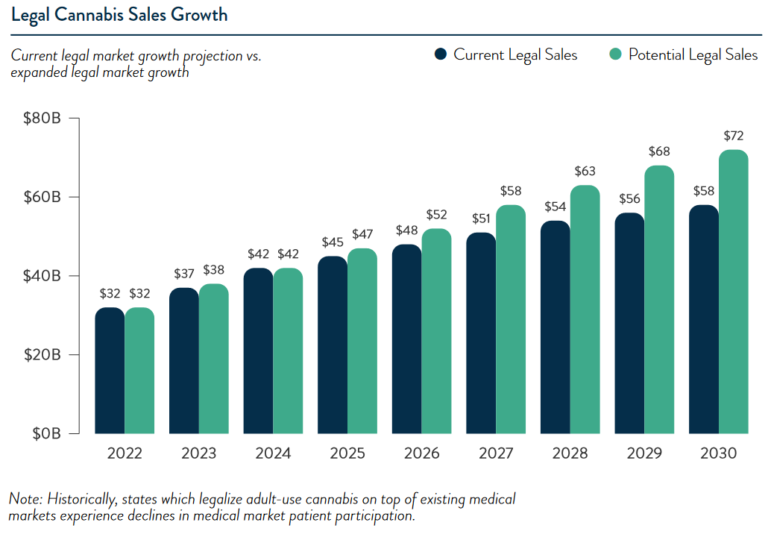
United States: 57 to 72 billion cannabis sales in 2030

It’s a gold rush… green. The American Cabinet New Frontier Data predicts a rain of dollars for the cannabis industry. According to his calculations, published in a recent report, Americans will buy 57 billion dollars worth of cannabis in 2030. For now, it is sold “only” 32 billion each year.

For analysts, the sum of sales could even rise to 72 billion if the 18 states that have started a legalization process go through with it. The firm attributes this solid growth to a “normalization” and an “recognition of the therapeutic virtues and well-being of the plant by society”. He is not even waiting for legalization at the federal level, as the bills are so bogged down.

“The profound change in public perception around cannabis is partly explained by the fact that more and more Americans have access to legal, regulated markets”, explains the CEO of the firm in the press release. One in three Americans has legal access to cannabis, either for all adults or for the sick.

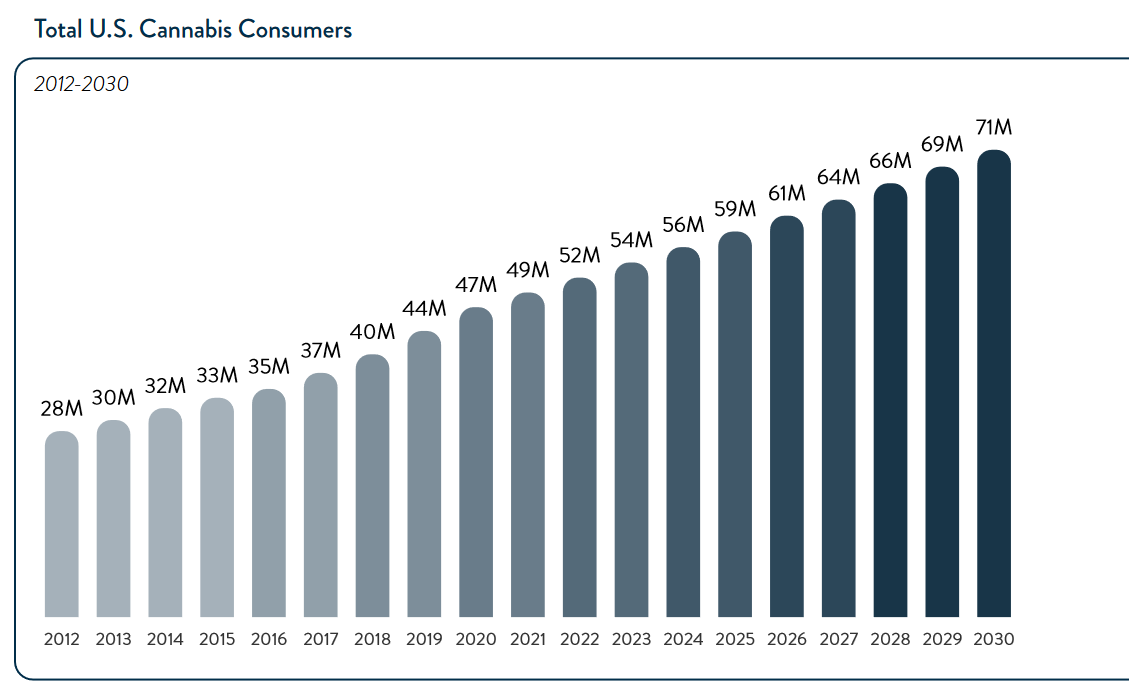
From 47 million consumers today to 71 in 2030

Logical consequence of this acceptance: the number of consumers should increase. The New Frontier firm estimates it at 47 million in the United States in 2020. It should increase to 71 million in 2030. Two nuances are still to be added to this calculation.

First, the report calls “consumer” a person who has taken cannabis at least once in the year. Next, “five of the ten states with the most users are still years away from legalizing recreational cannabis.” In any case, the number of consumers will be interesting to follow, as the experts are divided on the question.

United States: 57 to 72 billion cannabis sales in 2030

To arrive at all these figures, the firm tries to determine the growth in the existing markets… but also when the next States will legalize. With a very interesting graphic to the key. For example, Kentucky, which passed a law a few days ago to authorize medical cannabis… should not finally legalize it before 2030. We will have to be patient.

United States: 57 to 72 billion cannabis sales in 2030

On the other hand, this year 2022 should be the year for New Hampshire and Maryland. In the first state, successive bills have now failed to pass all stages for four years. In the second, the first texts were born in 2017. Proof that it takes time to legalize cannabis.

United States: The law for the federal legalization of cannabis is back

This is the sequel to a (very) long political soap opera. The bill to legalize cannabis throughout the United States – that is, at the federal level – is coming back before the House of Representatives. It will be presented to the 435 congressman and congresswoman next week, says the Congress website.

This is the second try for the so-called MORE law – Marijuana Opportunity Reinvestment and Expungement act. This text had already received the green light from the House of Representatives at the end of 2020. But, at the time, it had not passed the second stage, the Senate being controlled by a Republican party hostile to legalization.

This law provides for a “decriminalization” cannabis at the federal level. Clearly, the plant will no longer appear in the list of “controlled substances”, that is, what the US government considers to be drugs. Currently, cannabis is in the list of category 1 drugs, alongside LSD, ecstasy and heroin. Cocaine is in category 2.

With the MORE law, cannabis will therefore not be “legalized” at the federal level. It will be up to each state to authorize or not its trade, as is already the case in 19 American states. But this decriminalization should make things easier for the sector, in particular “access to bank loans and capital“, notes the bill in its introduction.

Democrats have a majority in the House, not the Senate

The passage of this law in the House should not be a problem. The Democrats have 222 seats, against 210 for the Republicans. But the path will not be finished. Indeed, for the bill to become law, it must also receive the stamp of the Senate, then that of President Biden.

At the time, the senators had said no to the MORE law. The text had remained stuck in committee, the parliamentarians never voted in plenary session. But since then, the situation has changed. The upper house of Congress has gone from red – Republican color – to Democratic blue.

Joe Biden’s party now has a very narrow lead. Even though Republicans and Democrats both have 50 senators, the vice president of the United States votes in the event of a perfect tie. And that person is Kamala Harris. She has previously expressed support for the legalization of cannabis at the federal level.

Moreover, if the MORE law fails, another could take up the torch. In the Senate, the leader of the Democratic majority has been preparing a text for several months. But President Biden opposes it.