Home Blog Page 92

Zimbabwe inaugurates a cultivation of medical cannabis worth €25 million

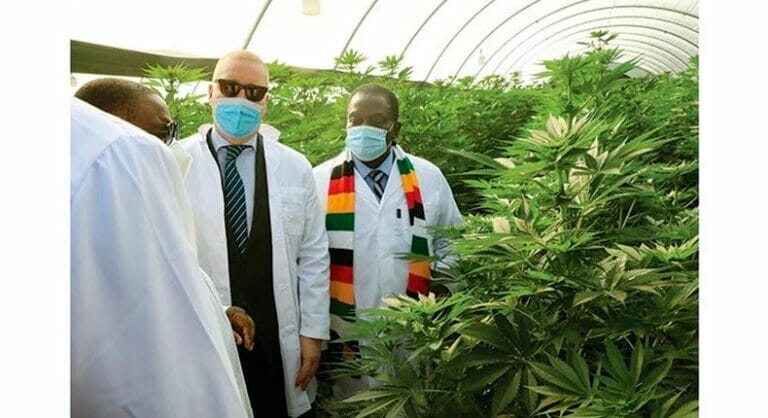
The President of Zimbabwe has inaugurated a site for the cultivation and processing of medical cannabis worth €25 million.

Business Insider reports that President Emmerson Mnangagwa has “commissioned the medical cannabis farm, and processing plant at Mount Hampden set up by Swiss Bioceuticals Limited in Western Province, Zimbabwe…to produce cannabis (mbanje or dagga) for medical and scientific purposes”, stating in a speech that “the rapid development of the processing site, which adds significant value to the culture, testifies to the success of the government’s commitment policy and the confidence of the Swiss companies and investors in Zimbabwe and its economy”.

President Emmerson Mnangagwa inaugurates a cannabis cultivation site

President Emmerson Mnangagwa inaugurates a cannabis cultivation site

“I extend my sincere congratulations to Swiss Bioceuticals Limited for this timely investment in the $27 million medical cannabis farm, processing plant and value chain,” Mnangagwa said in a speech on Wednesday, as quoted by Business Insider.

Business Insider reported that the president “added that investors should follow the company’s lead and open up their business to support the ‘Zimbabwe is open for business’ mantra and be prepared to generate foreign currency for the country.”

A way to revive the country

The inauguration of this production site comes nearly three years after the country scrapped its laws banning the cultivation of cannabis as it sought to produce a new crop for export. A year earlier, in 2018, the country legalized medical cannabis.

The repeal of the ban is part of a concerted effort by Zimbabwe to pivot from its main export product, tobacco, of which it is the continent’s largest producer.

With tobacco exports bringing much less money to Zimbabwean farmers and growers than before, many industry players in the country have turned to cannabis production.

United States: legal cannabis sales exceeded those of Starbucks in 2021

The deployment of the legal cannabis industry is often compared to that of well-known brands such as Mac Donalds or Starbucks. A report by the analysis firm ArcView estimated in 2017 that legal and illegal cannabis sales exceeded those of Mac Donalds and Starbucks combined.

It now appears that legal cannabis sales in the United States have exceeded the coffee giant’s North American sales by at least a third, according to the MJBiz Factbook 2022.

This is despite the fact that coffee can be sold in all 50 US states while only 39 states and the District of Columbia have legalized at least one use of cannabis.

Growth in favor of cannabis

The cannabis industry enjoyed greater growth than Starbucks between 2020 and 2021. Where Starbuck’s annual revenue in North America grew 25% in fiscal 2021, the Cannabis industry saw sales jump 30% over the same period to $27 billion.

The report states, “As the flower continues to dominate legal sales nationwide, non-combustible products may represent an innovative and potentially more socially acceptable way for consumers to enjoy one of their favorite plants. For potential consumers considering trying cannabis, non-combustible products represent a lower barrier to entry. These products are more closely related to products that individuals often already enjoy. »

The report also compares cannabis revenues to those of other major revenue-generating sectors, such as cigarettes, over-the-counter drugs, opioids or salty snacks. While cigarettes and over-the-counter drugs, with $52.8 billion and $36.5 billion respectively, exceed legal cannabis sales in 2021, their growth is weaker. 2021 was nevertheless the first year in 20 years that cigarette sales increased in the United States.

Cannabis sales will continue to outpace Starbucks for years to come, not least because of a huge untapped market. In the 11 US states where cannabis is still not legal live more than 20% of the country’s total population. Legalization efforts in these countries would be a boon, which Starbucks will struggle to keep up with.

So who will be the next weed Starbucks?

Bermuda: The governor blocks (for now) the legalization of cannabis

Rena Lalgie, the governor of the territory of Bermuda, has decided to reserve her assent to the legalization of cannabis in the archipelago.

She, however, urged officials in Bermuda to work with the British government to find a compromise and respect United Nations conventions. The legalization project, the Cannabis Licensing Act 2022seems to him to be incompatible with the obligations relating to the said conventions.

She added: “I therefore have no choice but to reserve assent to the Bill under Section 35(2) of the Constitution and notify the Secretary of State for Business. Foreign Affairs, Commonwealth and Development. »

David Burt, Prime Minister of Bermuda, had previously made it clear that if cannabis legalization did not gain royal assent, it would “destroy” relations with London. Canada had received royal assent for its legalization project on June 21, 2018, a few months before the regulation was put in place.

Ms Lalgie said: “I hope Bermudian officials will work together with UK officials to find a solution, which will not lead to lifelong criminal records for consumers of small amounts of cannabis and which will unlock business opportunities. , while maintaining Bermuda’s excellent reputation for upholding the rule of law. »

The Governor added: “The UK has supported, and is currently assisting, certain Crown Dependencies and other Overseas Territories to develop an approach in line with the relevant conventions.”

A spokeswoman for the Bermudian government said: “We have received correspondence from the Governor regarding her decision to reserve the sanction of the Cannabis Licensing Bill 2022, pursuant to Section 35(2) of the Constitution, and to notify that decision to the Secretary of State for Foreign, Commonwealth and Development. »

“We are awaiting the position of the Secretary of State for Foreign, Commonwealth and Development on this matter. »

The Cannabis Licensing Bill was passed by Bermuda’s parliament on March 30, but the more than a month’s delay in sending it to the governor for consideration was called “unusual” by the former premier of Bermuda. One Bermuda AllianceCraig Cannonier, who said he heard behind-the-scenes negotiations with London were taking place over the matter.

Study: Cannabis legalization leads to a decrease in the consumption of alcohol, nicotine and opiates

Cannabis legalization is associated with lower non-prescription alcohol, nicotine and opiate use among young adults, a new study finds.

Researchers from the University of Washington analyzed trends in substance use between 2014 and 2019, and found that people aged 21 to 25 were less likely to use more dangerous drugs after cannabis was legalized in the state.

The study, published in the Journal of Adolescent Health last week looked at “six annual waves of cross-sectional survey data,” analyzing data from 12,694 adults.

“Contrary to concerns about spillover effects, the implementation of the legalization of non-medical cannabis has coincided with a decrease in alcohol and cigarette consumption and the abuse of painkillers,” the summary of the report states. ‘study.

“The weakening of the association between cannabis use and other substance use among 21- to 25-year-olds requires further research, but may suggest an increased importance of disease-specific prevention and treatment efforts.” cannabis,” the study continues.

The study also found that rates of past-month e-cigarette use increased in this age group after 2016.

Confirmation of previous studies

Another recent study concluded that the legalization of cannabis was associated with a decrease in the use of prescription drugs for the treatment of conditions such as anxiety, sleep, pain and seizures.

Last year, a study found that medical cannabis use was associated with a significant reduction in dependence on opioids and other prescription drugs, as well as an improved quality of life.

A meta-study published in 2020 also indicated that cannabis was a promising treatment option for chronic pain and could serve as an alternative to opioid-based painkillers.

Researchers published a study that year that found that cannabis can ease the symptoms of opioid withdrawal.

Another study from 2020 indicated that alcohol consumption decreased when medical cannabis was legal.

Guernsey: Cannabis legalization proposal tabled

The Guernsey Health and Welfare Committee has submitted its cannabis legalization plan for review. The proposal forms part of the Government Work Plan (GWP) which sets out priorities for the States of Guernsey during his tenure which runs to 2025. It will be debated next June.

Committee chairman Al Brouard said: “There are very different opinions on this politically, some would like to look at it sooner and some never. »

Home Affairs Committee Chairman Rob Prow said he would not support the plans.

Limited resources

In a letter sent on behalf of his committee members, he wrote: “We are convinced that its inclusion would be contrary to the spirit of GWP. »

MP Rob Prow said its inclusion “only raises the expectation of change and risks absorbing limited resources”.

He said the commission was “disappointed” that the Health Commission had not awaited the results of the working group on non-punitive approaches.

The latter aims to develop a legal framework, which includes a review of the legal status of cannabis, alternative approaches to drug possession, the rehabilitation of offenders, restorative justice and a review of criminal sentencing law.

MP Neil Inder, Chairman of the Committee for Economic Development, voiced his support for the proposal: “Prohibition has never worked and I have never believed that citizens should be criminalized for small amounts of recreational products. »

Guernsey has so far issued a license for the production of medical cannabis.

What are the risks of possessing CBD?

At first glance, it is difficult to distinguish a CBD flower from marijuana. However, CBD is a totally legal substance. But then, what does a CBD consumer risk if he is checked by the police? Decryption.

The lack of knowledge around CBD

If you ask the question around you, few people will be able to explain to you what CBD is. Some will tell you it’s a drug, some will tell you it’s a drug, and some will tell you they’ve never heard of it. Among the police, this observation is also topical! On the other hand, it is almost impossible to distinguish CBD from Cannabis.

So, what happens in the event of a police check?

If you get caught in possession of CBD, you will normally not be worried as long as your flower is packed in a sealed container with an identification tag. You will also need to be able to provide your product invoice. In this case, unless specific instructions have been received from the authorities, you will have no problem.

However, if you can’t prove the origin of your CBD, you could find yourself having your loot confiscated. And if in addition, you have a liability in narcotics, in this case, this detention could work against you. If in doubt, law enforcement can seize your CBD and subject it to analysis, as well as the CBD you vape.

Canine brigades also warn that dogs cannot tell the difference between Cannabis and CBD. So an elderly person who uses CBD to relieve certain pains can be controlled like any drug dealer. Be careful too, because during a roadside check where you are asked to blow into the balloon, you must not exceed 0.2% THC!

Tolerance is not synonymous with freedom

However, the police would like to point out that France tolerates CBD. Having one on you with a proper invoice does not make the consumer an outlaw. However, if you smoke your CBD flower on the street, law enforcement will confiscate your loot.

Comment About What are the risks of possessing CBD? Below ..

Cannabis Japonica: an exhibition retracing the links between ancient Japan and hemp

the Hash Marihuana & Hemp Museum from Barcelona presents its latest exhibition: Cannabis Japonica.

Open until February 26, 2023, this breathtaking collection offers a journey through Japan’s cultural ties to the Cannabis plant.

Despite the current extremely strong crackdown on cannabis, hemp is an integral part of Japanese culture.

“Cultivated hemp was the family’s main source of fiber for weaving fabrics and was also an important source of income, as merchants in the city bought the finest hemp fibers,” reads the website. museum.

“This silk-like hemp was used to create the most precious garments, from summer kimonos to samurai weapons and the robes of Shinto priests. Every aspect of hemp work, from planting to weaving, was done by women. This practice continued during the Meiji era, when Japan quickly became an industrialized empire. »

Admission to the exhibition, organized to commemorate the tenth anniversary of the institution, is free.

What are the current cannabis policies in Japan?

Despite its millennial relationship with this plant, Japan currently has extremely restrictive cannabis policies.

On the Asian island, both recreational and medical cannabis remain illegal. Cannabis possession carries a five-year prison sentence, while cultivation carries an even stiffer sentence of seven years behind bars.

In addition, the Japanese Ministry of Health recently set up an expert group to review cannabis laws, apparently in response to rising rates of cannabis use among the Japanese population.

The group will examine in particular the possibility of imposing a severe sanction for the simple fact of having consumed cannabis. If the proposal is approved and implemented, cannabis users could be jailed for traces of cannabinoids in their bodies.

Free cannabis oil will be provided to Thai hospitals

Thailand’s Ministry of Public Health announced last week that three types of cannabis oil have been added to Thailand’s National List of Essential Medicines, (NLEM). Now that cannabis is on the “essential medicine” list, public hospitals can freely prescribe cannabis extract oil to patients under certain circumstances, according to Thailand’s Government Pharmaceutical Organization (GPO).

The first type of cannabis oil contains a higher percentage of tetrahydrocannabinol, or THC. The second type has a higher level of CBD, or cannabidiol. The third solution has equal levels of THC and CBD, according to Dr. Nathakan Suwanpiddokul, pharmacist for the GPO.

The oil will primarily be used by cancer patients, especially those who suffer from the side effects of chemotherapy treatments, such as nausea and vomiting. The oil will also be used to relieve pain in terminally ill patients, especially those who have trouble sleeping or eating.

The addition of cannabis oil to the NLEM will also make this drug much more accessible in Thailand, with the government covering the costs for anyone who is prescribed cannabis oil in a public hospital.

Nationwide, doctors in 893 public hospitals can now prescribe cannabis oil to patients. In total, there are now 1,173 cannabis dispensaries in Thailand, according to Public Health Minister Anutin Charnvirakul.

Anutin said the use of cannabis for medical purposes is one of the most important policies of the Ministry of Health. The country has also recently announced that it will give 1 million free cannabis plants to its citizens to contribute to the national production effort.

“It is gratifying that all three formulations of medical cannabis extract oils have been included in the NLEM. On May 14, this will not only provide patients with more health care options, but also strengthen the country’s medicine. It also reduces the cost of importing expensive drugs from abroad. »

California governor proposes to remove taxes on cannabis cultivation

The governor of California unveiled a budget proposal last Friday that calls for the elimination of the cannabis cultivation tax and a review of the distribution of cannabis-related tax revenues.

Democratic Gov. Gavin Newsom’s revised May budget includes measures to further combat the illicit market and make the legal industry more competitive, largely by scrapping the grow tax that cannabis companies currently have to pay.

This measure is demanded by the latter, all the more so as they are struggling to cope with rising inflation and the reduction in demand compared to the peak of the coronavirus pandemic. The governor stressed on Friday that he specifically pledged to explore ways to minimize the influence of illicit cultivators and vendors on legal businesses.

While one might think that removing the culture tax would hamper state revenue flows, a recent analysis of the Reason Foundation revealed that monthly tax revenue would increase by 123% by 2024 if this policy change were adopted.

According to the report, removing the culture tax would lead to lower costs for consumers and therefore an increase in legal purchases that would more than compensate for any lost revenue over time.

However, Gavin Newsom’s proposal is not binding in itself. It must be passed by the legislature by a majority of at least two-thirds to be implemented.

“We have worked closely with legislative officials and have made tremendous progress,” the governor said during a briefing Friday. “We haven’t finalized any of that, so I want to be careful not to disrupt that progress.”

The governor’s revised budget proposal also includes updated estimates on tax revenue allocations for the 2022-23 fiscal year.

The state expects to distribute $401.8 million for education, youth drug treatment and school retention, $133.9 million for manufacturing-related environmental cleanup and remediation illicit cannabis and $133.9 million for law enforcement purposes.

“These numbers reflect a total increase of $74.7 million over the Governor’s budget estimate,” the revised budget summary reads. “These estimates also reflect proposed statutory changes to restructure the cannabis tax framework and maintain a base level of funding for this allowance. »

Separately, the governor’s plan calls for moving “the retail distribution excise tax collection and remittance point on January 1, 2023,” while maintaining the 15% excise tax rate on cannabis sales.

WM Technology Launches Cannabis Retail Payment Solution in Canada

Cannabis technology company WM Technology is launching a payment service for cannabis retailers in Ontario, Canada’s largest market for adult use, and plans to roll it out in other provinces.

Customers at participating stores will be able to browse the product catalog on the Weedmaps platform and then make direct payments to the retailer using Visa or MasterCard, WM Technology announced Thursday morning.

The new feature follows Ontario’s recent decision to make retail cannabis delivery permanent and the click and collectcementing a temporary program launched at the start of the COVID-19 pandemic.

“The company expects Ontario to be a springboard for Weedmaps’ online payments system in other Canadian provinces in the coming months,” said the Irvine, Calif.-based company. in a press release.

WM Technology is also launching its WM Store product in Ontario to bring “the Weedmaps platform directly to cannabis retailer websites,” offering customization options for retailers “to better reflect their brand and create a shopping experience.” more transparent and end-to-end ordering for customers”.

The company said it has partnered with cannabis retailer inventory and point-of-sale management platform Cova Software, as well as payment processing services provided by Merrco Payments.