Home Blog Page 93

Ganjier, or how to become a cannabis sommelier

The legalization of cannabis in American states has led to a paradigm shift in the consumer experience. From the “guy” who came to their homes, consumers went to dispensaries with dozens of varieties of cannabis, waxes and other concentrates, not to mention the edibles or dyes.

The consumer then relies on the good advice of the budtender to choose the product that corresponds to it. A veritable compass, the latter must be able to guide his client towards the right variety or the right method of consumption to obtain the desired effects, whether medical or simply recreational. The expertise of the budtender is therefore essential to provide expert information to customers.

Ganjier, a new training program in California, aims to increase the expertise of these budgeters. Developed by a group of 18 cannabis industry professionals, including Frenchy Cannoli, alongside growers, breeders, scientists and other connoisseurs of the plant in their own right, the Ganjier program and certification were designed in partnership with the company Green Flower, specialized in education around cannabis.

Derek Gilman, the program’s general manager, tells Forbes that certified Ganjiers can play a vital role in legal cannabis.

“While the wine industry has sommeliers, the cigar industry has catadorsthe coffee industry has cuppers, until the launch of the Ganjier program, no such expert existed in the field of cannabis,” says Gilman. “The Ganjier is both a aficionado cannabis and an interpretative liaison – trained in the intricacies of taste, terpenes and maturation – who mediates between cannabis and the consumer, navigating its complexities and optimizing the user experience. »

Go beyond the Indica/Sativa split

Common perceptions of cannabis and its varied qualities and effects initially focused on broad categories such as indica, sativa and hybrids, groupings that no longer make much sense in today’s market and its wide range of commercial varieties.

It is even less reliable to use the percentage of THC or other cannabinoids as a determining factor in the selection of cannabis products. Competitions such as the Emerald Cup have already gone beyond this benchmark to further categorize varieties according to their terpene profile.

The Ganjier program also wants to teach students to use their senses to assess the aroma, appearance, flavor and effect of a cannabis flower, including nuanced characteristics like terroir and terpenes, a class of aromatic and often therapeutic compounds. Once certified, the Ganjier will be ready to help consumers navigate the hundreds, if not thousands, of offerings on offer at their dispensary.

“A diverse and ever-expanding array of cannabis-related products and services are entering the market today,” says Gilman. “As consumers enthusiastically explore more natural ways to improve their lives, treat ailments, and seek to elevate and refine their cannabis experience, the demand for those with a deeper and more comprehensive understanding of plant, its nuances, its innate qualities and its possibilities, becomes essential. »

The Certified Ganjier Initial Level consists of 31 online lessons spread over 10 courses covering history, science, botany, genetics, cultivation, processing, evaluation, service, sales and consumption, plus a additional bonus course covering “The World of Cannabis Knowledge”.

The online training is followed by a 2-day in-person course that takes place in Humboldt County, California, in the heart of the famous Emerald Triangle cannabis growing region.

Students will learn the Customer Interaction Protocol, which helps guide conversations with consumers to provide them with the best possible service, or in-depth hands-on training in assessing the quality of cannabis flower and cannabis seeds. concentrated.

Certification is obtained at the end of the “face-to-face” training and subject to passing a final exam. Once off the hook, the Ganjier will be a trained and certified “cannabis service master.”

“Ganjiers learn how each of the decisions made by the grower, from genetics to curing, affects the final quality of the cannabis flower,” notes Gilman. “Our program also covers the concept of terroir, its role in the genetic expression of the plant, and how this affects the flavor and potency of the final product. »

Registration is currently open and nearly half full for the Class of 2022, with spots being allocated on a first-come, first-served basis. Ganjier’s training program costs $2,997. Advanced Ganjier programs will be introduced in the future.
Mexico’s Supreme Court rules personal cannabis possession legal again

Placing limits on the amount of cannabis a person can have for personal use is unconstitutional, Mexico’s Supreme Court ruled in a ruling on Wednesday. It is the latest in a series of judgments overturning the cannabis ban, which dates back to 2015 and comes after the court ruled last year that bans on personal use and home cultivation were unconstitutional.

This earlier ruling, however, did not challenge the 5-gram decriminalization in place since 2009, with those in possession of higher amounts facing a potential prison sentence of up to three years.

“The fact that the public prosecutor’s office is authorized to initiate criminal proceedings against a person who possesses more than 5 grams of cannabis for his personal consumption amounts to punishing moral qualities [et] personal behavior, which has no constitutional basis,” Supreme Court Justice Juan Luis González Alcántara wrote.

“Criminal proceedings against the person who possesses cannabis in his private sphere, without affecting third parties or causing a criminal incident, are not justified,” he added.

No limit to possession, but…

This week’s decision, however, left some bitter. The court ruled that only judges or prosecutors – not the police – can determine whether a quantity of cannabis is for personal use. It thus does not immediately reduce the risk of arrest by the police for cannabis users, who can spend up to 48 hours in a prosecutor’s office awaiting a decision from a prosecutor or a judge.

“We are sorry that the Supreme Court approved this. It is contradictory that despite the fact that the bill has all the arguments to put an end to this crime, the Court chooses to perpetuate the criminalization of consumers. We will continue to work to protect the rights of consumers and citizens. We are certain that a safer and more peaceful Mexico needs the decriminalization of drugs” tweeted Mexico United Against Crimea legal NGO whose team defended a person arrested with 30 grams of cannabis, the case behind the decision.

Although the right to consume cannabis has been recognized by the Mexican Supreme Court, the organization also lamented that the judgment failed to eliminate the crime of simple possession of cannabis.

The stoppage comes after the Oaxaca City Council last month ordered police to stop arresting cannabis users, as long as they behave in a respectful manner.

A long-awaited legalization

Over the past six months, Mexican lawmakers have circulated several versions of the bill to legalize cannabis, but it has not been officially reintroduced in the Union Congress. Senate Majority Leader Ricardo Monreal of the ruling Morena party said in November that a constitutionally compliant, “high-level and progressive” cannabis bill would soon be completed by the committees. Health and Justice of the Senate.

But soon after, he hinted that the officials responsible for revamping an earlier version were unable to prepare it in time in a form that could be adopted. “Prohibition [du cannabis] a hundred years old, so what if it takes a few more months,” he said when asked about the postponement.

President Andres Manuel Lopez Obrador also floated the idea of ​​a national referendum on cannabis legalization last year, but recently said there was no consensus on the legalization of drugs, including including cannabis.

“Overcoming the formal obstacles of the past is not an easy task, but I have full confidence that in this legislature we can achieve it,” said the President of the Chamber of Deputies, Olga Sánchez Cordero, late March.

Germany to unveil cannabis legalization plan in second half of 2022

For the first time, German Health Minister Karl Lauterbach, until recently unsupportive of legalization, has announced that he will launch the legislative initiative to legalize cannabis in Germany.

Cannabis legalization measures are to be drawn up this summer as part of a “health policy”. Lauterbach, who has dealt with the subject very intensively in recent years and revised his earlier opinion, now believes that the dangers of non-legalization are greater than those of legalization.

“In my opinion, the administration of contaminated cannabis now poses a greater risk than the controlled distribution to people who consume cannabis in a controlled manner with an appropriate quality. »

Cannabis legalization in Germany

It will therefore present a bill in the second half of 2022. The process will begin with Federal Drugs Commissioner Burkhardt Blienert discussing key issues around legalization with national and international experts.

“It’s about pooling knowledge and experiences, but also addressing objections and reservations very openly. States, municipalities, associations, science and civil society should also be involved in the preparations.

“Hardly any other drug policy issue has occupied people as much as cannabis for decades,” Blienert said. “We all know how complex this project is. »

According to Blienert, many details still need to be clarified regarding the legalization of cannabis. “That also includes the question of how the licensing process will go,” he said in a March interview. It is not only about “where”, but also about “how”, “what”, “how much” and “from where”.

In the coalition agreement, the parties agreed in November 2021 on the “controlled sale of cannabis to adults for recreational purposes in licensed stores”. In doing so, the government paved the way for a new multi-billion dollar cannabis market.

Cannabis shops in the franchise model

Startups such as Synbiotic SE are also working on the “how” question. The company recently announced a joint venture with the Enchilada group of companies, specialists in catering and franchising, on April 20. The merger of the two companies aims to lay the foundations for Germany’s first cannabis store franchise.

“We deliberately chose a German company from the catering sector”, explains Lars Müller, CEO of Synbiotic. “On the one hand, the Enchilada Group is a professional franchiser and on the other hand, the sale of so-called ‘recreational’ cannabis will probably be subject to rules similar to those of food law”.

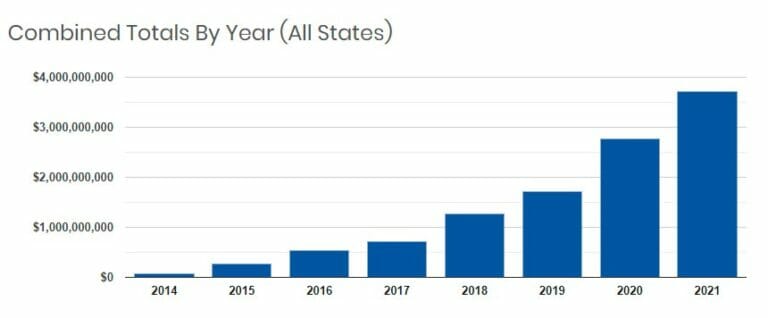
The legal cannabis industry generated $3.7 billion in US tax revenue in 2021

Since 2014, when sales began in Colorado and Washington, legalization policies have provided US states with a new source of revenue. In March 2022, states reported a combined total of $11.2 billion in tax revenue from legal adult cannabis sales since 2014.

In 2021 alone, US states that legalized cannabis generated more than $3.7 billion in tax revenue from cannabis sales for adult use. In addition to revenue generated for state budgets, cities and towns have also generated hundreds of thousands of dollars in new revenue from local adult cannabis taxes.

Cannabis taxes in the United States

Canada has generated CA$15 billion in taxes since legalization in 2018.

18 US states have legalized since 2014

18 US states now have laws that legalize, tax and regulate cannabis for adults 21 and older. Eight of those laws were approved in 2020 or 2021, and in six of those states sales and tax collections have yet to begin.

A recent report from Marijuana Policy Projectthe largest of the organizations working on cannabis law reform in the United States, reviews the different recreational cannabis tax structures for each US state.

“Our report is further evidence that ending cannabis prohibition has enormous financial benefits for state governments. The legalization and regulation of cannabis for adults has generated billions of dollars in tax revenue, funded important state-level services and programs, and created thousands of jobs across the country. Meanwhile, states that are lagging behind continue to waste public money enforcing archaic cannabis laws that hurt far too many Americans,” said Toi Hutchinson, president and CEO of the Marijuana Policy Projectin a press release.

In states where the sale of cannabis for adult use is legal, tax revenue can be used for social services and programs. This includes funding for education, school building, early literacy, public libraries, bullying prevention, behavioral health, alcohol and drug treatment, veterans services, conservation, job training, expungement of convictions, and reinvestment in communities disproportionately impacted by the war on drugs.

A dozen more states could legalize recreational cannabis in 2022, including Maryland, Missouri, Ohio, Rhode Island and South Dakota.

The figures in brief

2021 State Totals:

  • Alaska: $28,900,231
  • Arizona: $153,824,757
  • California: $1,294,632,799
  • Colorado: $396,157,005
  • Illinois: $424,206,703
  • Maine: $12,362,622
  • Massachusetts: $227,474,842
  • Michigan: $209,912,278
  • Nevada: $159,885,501
  • Oregon: $177,773,944
  • Washington: $630,863,570

Year-over-year totals:

  • 2014: $68,503,980
  • 2015: $264,211,871
  • 2016: $530,521,110
  • 2017: $723,145,481
  • 2018: $1,275,483,830
  • 2019: $1,707,204,090
  • 2020: $2,766,027,570
  • 2021: $3,715,994,252

Nepal may end cannabis prohibition

Home of the Legendaries temple balls and other exotic delicacies, Nepal may soon find its way back to legal cannabis, as the reflection has already surfaced several times over the past two years.

“It is not justifiable that a poor country like ours should treat cannabis like a drug,” Birodh Khatiwada, Nepal’s Minister of Health, told Agence France-Presse on April 29. “Our people are being punished (…) and our corruption is increasing because of smuggling because we follow the decisions of developed countries who now do what they want. »

Local activists are also hoping for the availability of cannabis for medical use.

“It’s medicine,” said cannabis activist Rajiv Kafle, who lives with HIV and uses cannabis for medical reasons. HIV can lead to wasting syndrome, i.e. loss of appetite, as cannabis is notorious for post-consumption hunger pangs.

“So many patients consume it, but they are forced to do it illegally,” said Rajiv Kafle. “They can get caught at any time.” On October 11, campaigners introduced a bill in parliament, seeking to re-legalize the cultivation, use and export of cannabis, as more and more countries allow its medical and recreational uses.

Hashish and Kathmandu

In the 1960s, there are many tales of how the most devout hippies traveled to Kathmandu, Nepal, to buy the best hashish in the world, either directly from growers for the more adventurous, or from government-sanctioned stores. Due to increasing pressure from the United States and other countries, Nepal closed its hash shops in 1973.

Today, the application of prohibition is uneven: tourists are often spared and law enforcement often turn a blind eye during religious holidays, where cannabis plays an important role. The consumption of cannabis in Hindu temples is thus commonplace. Shiva, destroyer of evil, is often depicted holding a chillum, a gesture repeated during certain ceremonies or during the Hindu festival of Shivaratri.

In some areas, however, the penalties are severe. Traffickers risk up to ten years in prison and plants are regularly seized and destroyed. In 2018, a temple complex was also raided by police in which 280 people were arrested and 115 charged.

Delaware on the way to legalizing cannabis

The Delaware House of Representatives has approved a bill to legalize the possession and gift of cannabis between adults. The Senate will now have to consider it before it can become law.

Democratic Rep. Ed Osienski’s bill passed 26 to 14. It is the first part of a two-track approach to reform, with a companion bill also passing through committee to put in place regulations for an adult-use market.

Ed Osienski decided to file the measures separately after the House rejected an earlier measure in March.

“This bill ends more than 50 years of prohibition and criminalization in Delaware and allows adults over the age of 21 to legally possess, consume and freely share less than one ounce of cannabis (28 grams) for personal use,” Osienski said ahead of the vote.

The bill in detail

Here’s what Delaware’s HB 371 would do:

  • Bill would change state law by eliminating penalties associated with possession of up to one ounce of cannabis by adults 21 and older
  • It would also add a section stating that adults 21 and older could share up to one ounce of cannabis ‘without compensation’.
  • This section clarifies that cannabis could not be “donated” as part of a simultaneous “reciprocal transition” or if the donation is subject to a separate transaction for goods or services other than cannabis.

Here are the main provisions of the complementary project HB 372:

  • A Cannabis Commissioner would be appointed under the authority of the state’s Alcohol and Tobacco Division. This official would be responsible for regulating the industry and overseeing the licensing of retailers, growers, manufacturers and laboratories
  • Licenses would be granted through a competitive process, with benefits granted to those who pay workers a living wage, provide health insurance or meet certain other criteria.
  • Within 19 months of the bill taking effect, regulators will need to approve 30 retailer licenses, half of which will be awarded to social equity applicants. Social Equity Candidates would be defined as entities majority-owned by people with prior cannabis trafficking convictions or living in an area disproportionately affected by the drug war
  • These applicants would also be awarded one-third of the planned 60 cultivation licenses, one-third of the manufacturing licenses and two of the five analytical laboratory licenses. They would also benefit from reduced application and licensing fees as well as technical assistance from the state.
  • Retail cannabis sales would be subject to a 15% tax. No tax would be levied on sales of medical cannabis
  • 7% of tax revenue would be used to support a new Justice Reinvestment Fund that would provide grants, services and other initiatives focused on issues such as diversion, workforce development and education. technical assistance for people in communities who are economically disadvantaged and disproportionately affected by the drug war, as well as for amnesties
  • Home cultivation for personal use would remain prohibited
  • The legislation would allow municipalities to set their own regulations regarding the hours of operation and locations of cannabis businesses, and they would also be allowed to completely ban cannabis businesses in their jurisdictions.
  • The bill provides explicit legal protections for state employees who work with the state’s legal market. It would also allow cannabis businesses to claim tax deductions at the state level, which they are currently prohibited from at the federal level.

Playboy, the new line of CBD

From entertainment for men to pleasure for all, there is only one step. The iconic brand born in 1953 is now launching an inclusive line of cannabidiol-based products to uplift the senses and promote a healthy, hedonistic lifestyle.

Playboy and the legalization of cannabis

Playboy CBD
Playboy enjoyed a reputation as an institution willing to challenge authority and dominant sexual mores. The magazine never forgot to celebrate hedonism and challenge the merits of criminalizing victimless crimes, including cannabis use.

The brand was the first donor during the creation of NORML in the United States, the main association campaigning successfully for the legalization of cannabis. After a quick meeting with Hugh Hefner, Keith Stroup, the founder of NORML, left with a check for $5,000 which will be followed by funding of up to $100,000 per year for the first 7 or 8 years of the association, plus full-page advertising for NORML in the magazine.

The Playboy CBD range

The Playboy CBD range

Oils and cosmetics

Playboy enters the world of CBD with 6 unique CBD products:

  • 3 CBD oils: with or without THC, and a 15% oil with chamomile for sleep
  • a “Get that Glow” CBD and vitamin C serum to energize the skin
  • a nourishing “Soak it up” face cream
  • a massage oil “Arouse your senses” to relax or play.

Manufactured in Switzerland to the highest quality standards, pleasure has never been so accessible!

Playboy CBD products are available on Cebedia.

You are a professional and you want to become a distributor of the PLAYBOY range? You can go to this link: you will be contacted within the next 24 hours.

Thailand’s health minister plans to donate 1 million cannabis plants to citizens

Thailand’s Minister of Public Health, Anutin Charnvirakul, plans to distribute up to one million cannabis plants for free as soon as personal cultivation and use of the plant is legalized in June.

Anutin said in a Facebook post that citizens will be allowed to grow “as many cannabis plants” as they want in their homes once the reforms take effect.

“This will enable the people and the government to generate more than 10 billion baht [par an, soit 300 millions €] income from cannabis and hemp. (…) During this time, people can present their cannabis and hemp related products and sell their products throughout the country. said Anutin Charnvirakul, echoed by nation thailand.

Cannabis grown must be of medical grade and only for medical purposes, but no registration is required. It is currently legal for registered businesses to sell cannabis products containing less than 0.2% THC.

According to national regulations, small sellers of cannabis products do not need to register with the Food and Drug Administrationbut large-scale operators must seek government approval.

In February, Thailand’s health minister signed a document removing cannabis from the country’s narcotics list, after lawmakers legalized the use of cannabis for medical purposes in 2020, with Thailand becoming the first country to Southeast Asia to adopt this reform.

During the signing ceremony, Anutin said that cannabis “has many medical benefits, which are no different from those of other herbs” and that officials are doing their best “to benefit the people of Thailand at the same time. medically and economically. »

Lausanne will launch its cannabis distribution pilot project at the end of 2022

The city of Lausanne announced on Tuesday May 10 that it will launch its pilot project for the legal sale of cannabis by the end of 2022. The objective is to study the impact of a non-profit sales model on the consumption as well as health and safety.

“In Lausanne, as in other cities, cannabis is very present. It is estimated that 6,500 people used cannabis last month and 1,500 use it daily,” Emilie Moeschler, city councilor in charge of sports and social cohesion, told reporters on Tuesday.

“It is essential for cities to launch such experimental studies in order to approach the subject objectively and calmly,” added the socialist municipal councilor. In 2016, Lausanne had already expressed its interest in a pilot experiment in order to develop its policy in this area.

The city has chosen the competence center Addiction Suisse as a partner, which will lead the scientific component. The trial is planned for a period of four and a half years. The management of the sale of cannabis will be entrusted to a new non-profit association called Cann-L, for “Cannabis Lausanne – The responsible alternative to illegal cannabis”.

Point of sale in the city center of Lausanne

The cannabis distributed as part of the pilot project will come from local and organic crops. Adult participants in the trial will be able to buy it at a specialized point of sale, which will be in the city center. The place will not be medicalized, unlike German-speaking Switzerland which prefers pharmacies, said Emilie Moeschler.

At the end of May, the project should be submitted to the cantonal ethics commission and to the Federal Office of Public Health (OFSP) for examination.

In mid-April, the FOPH gave the green light to the city of Basel for the first pilot project of this type. The Basel project will start at the end of the summer with nearly 400 participants. As part of the study, they will be able to buy various cannabis products, such as dried cannabis flowers and hashish, in certain Basel pharmacies.

New York Approves 90 Cannabis Growers Before Launching Retail ‘This Year’

Authorities in New York approved a second batch of cannabis cultivation licenses last week, as the state prepares to launch retail “later this year.”

The Cannabis Control Board (CCB) has granted 36 additional grower licenses to companies already growing hemp. The body approved the first 52 applications last month, and regulators will continue to review offers as they come. These conditional licenses, approved in February, allow hemp growers to get a head start on growing cannabis to meet future demand.

Office of Cannabis Management (OCM) Executive Director Chris Alexander said Thursday that the state is still on track to launch retail “later this year,” adding that “so far, it had a huge impact in our communities statewide.”

In March, authorities also decided that people with previous convictions for cannabis possession, or whose family members have been harmed by criminalization, will get the first round of recreational cannabis sales licenses, before drug companies. existing medical cannabis.

“Thanks to the initiative” Seeding Opportunity“These farmers are growing the first produce that will be sold in dispensaries owned by Prohibition-harmed New Yorkers by the end of the year,” Chris Alexander said. “I think we have a hundred more [licences de cultivateurs] that will arrive in the pipeline”.

Overcome Federal Prohibition

The bill to legalize adult use of cannabis was signed into law just over a year ago in New York state, after regulators spent months preparing for its implementation.

Holders of a conditional cultivation license must have been authorized by the state Department of Agriculture to cultivate hemp by December 31, 2021 and have cultivated this plant for two of the last four years. They are also required to “participate in an environmental sustainability program and a social equity mentorship program.”

At last month’s CCB meeting, regulators also allowed patients to grow their own cannabis plants for personal use.

Broadly speaking, the rule would allow patients and registered caregivers to grow up to 6 plants, with only 3 flowering. They could possess up to 5 pounds (2.5 kilos) of cannabis from these plants, which is in line with state law on legalizing adult use.

Meanwhile, New York lawmakers recently sent a budget proposal to the governor’s office, which includes provisions allowing cannabis companies to take advantage of state tax deductions enjoyed by other industries, despite the ban. Cannabis Federal. This provision has been enacted and is increasingly part of legalization projects as recently in Delaware.