Home Blog Page 78

Pre-rolls even more popular in Canada than in the United States

According to a recent report by Headset, pre-rolls are even more popular in Canada than in the United States.

Using sales reports between January and June 2022, Headset, a cannabis market data and insights solution, found that US and Canadian consumers combined spent more than US$1 billion on pre -rolls over the period.

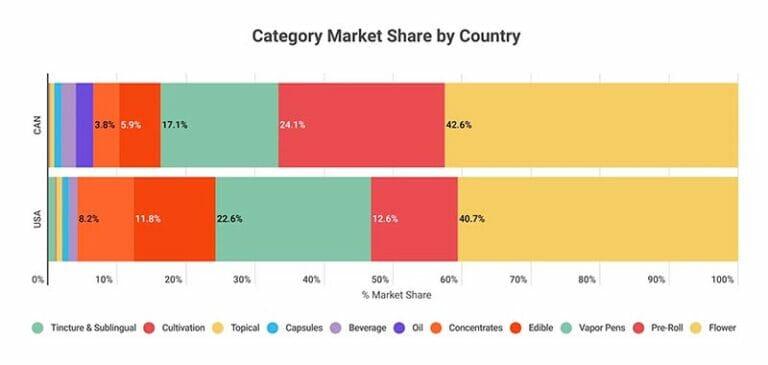
If both countries appreciate this product, Canadians love it. Nearly a quarter of Canada’s cannabis sales in 2022 come from purchases of pre-rolled joints. In the United States, pre-roll sales account for 12.6% of all cannabis sales, up 2% from last year.

Breakdown of cannabis purchases by type of product in Canada and the United States

Breakdown of cannabis purchases by type of product in Canada and the United States

What types of pre-rolls are popular in Canada?

Pre-rolled joints come in all shapes and sizes, with different varieties available. In Canada, pre-rolls containing a single hybrid variety dominate the market, with 42% of all pre-roll sales.

In the United States, premium and “infused” pre-rolls (with added concentrates) are the most sought after, accounting for 41% of the market and narrowly outpacing single-strain hybrids.

Comparing prices, Canadians pay more for pre-rolls. The average price in Canada is 17% higher than in the United States and infused pre-rolls are 21.7% more expensive.

The pre-roll segmentThe pre-roll segment

The pre-roll segment

The study also recalls that the number of people buying cannabis flowers has decreased while purchases of pre-rolls have increased steadily, as have those of edibles. It will be interesting to see if this trend continues in the second half of the year.

For the Supreme Court of South Africa, Cannabis Clubs are illegal

The Supreme Court of South Africa has agreed that there is no big difference between a dealer and a Cannabis Club. The High Court says it is not for the courts to decide the legality of culture clubs, which are set up to circumvent the Drugs Actwhich regulates drug use in South Africa.

The Haze Club case dismissed by the High Court of South Africa

Based on the right to self-determination, Cannabis Social Clubs appeared everywhere after the decriminalization of cannabis in South Africa. One of them, the The Haze Club (THC), was raided by the police and attempted to argue, through a High Court legal action, that Cannabis Social Clubs are a solution for people who do not want or cannot cultivate themselves.

The Cape Town High Court announced this week that it was rejecting the Club’s claim. The Haze Club may appeal, but Justice Slingers’ decision confirms that trade and cannabis legalization are matters of public policy and fall within the purview of the legislature, not the judiciary.

The state argued that the club did not operate in a private space and was therefore in violation of the law.

In her ruling, Justice Slingers said allowing a growers’ club to operate in the absence of statutory or regulatory requirements and guidelines “could have the practical effect of legalizing the sale of cannabis.”

“The legislator may consider legislating on this point in the future, but that does not mean that the courts should anticipate it. Trade and cannabis legalization involves policy issues and falls within the purview of legislators, not the judiciary. »

She stated that plaintiffs and their clients are not barred from consuming or cultivating cannabis: they are simply barred from outsourcing that right.

Operating a grow club is therefore still considered a criminal offense under South African drug trafficking law and a conviction may result in a prison term.

The grow club was based on a business model where a person or entity rents land, equipment, and gardening services; grows, on behalf of its clients, plant material, including cannabis; and does not own or supply its customers with cannabis, cannabis plants or feminized cannabis seeds.

Haze Club Solicitor Shaad Vayej said an appeal is likely: “Unfortunately the Haze Club’s claim has been dismissed by the Cape Town High Court. This represents a narrow interpretation of the right to privacy, which is a private space, and restrictions on the private cultivation of cannabis, as contemplated by the Constitutional Court in the Prince 3 case.”

“However, this is not the end of the road, as an appeal is likely to follow. »

Discovering pipe accessories

0

Smoking a pipe is not just about sitting with your puff in your hand to taste your tobacco. There is a whole ritual around it, allowing you to appreciate this moment for yourself. Smoking invites you to discover which accessories are necessary for any pipe smoker.

The essential pipe accessories

To smoke a pipe, you obviously need a pipe and some tobacco. But it also requires some additional tools. Here are which ones.

The pipe stuffer or pipe cleaner

The pipe-tamper, also called a pipe-cleaner, is an accessory allowing you to pack the tobacco in the hearth of your mouth-burner. It is important, because too little or too much tobacco will not burn properly. But its double name also refers to its dual use. Often represented as a Swiss army knife, this accessory also allows you to remove excess tobacco and ash to clean your pipe as it should.

Discovering pipe accessories

The lighter or matches

It may seem implied, but the pipe lighter is definitely part of it. essential pipe accessories for any smoker. Its flame is specifically designed to light the tobacco in your smoker in complete safety. Of course, you can also use the special pipe matches!

Accessories to protect your pipe

The tobacco pouch or the carrying case

Do you travel often? Do you need to transport your pipes for a weekend or a business trip? Avoid the pockets of your jackets which can damage your pipe blowers, not to mention the fact that you can also perfume them with the smell of cold tobacco… The tobacco pouch or storage cases remain the best transport accessories for pipes.

The pipe holder

Whether you only have one pipe or you have several, know that a pipe holder avoids the risk of falling and premature wear of your blowers. In addition, they are very elegant!

Other pipe accessories

For the maintenance of your pipes, there are specific products to clean them without damaging them. On the other hand, filters being accessories to be changed regularly, make the right choice among balsa, meerschaum, coal and many others!

THC drinks: the latest trending market segment in the United States

As US states legalize cannabis, companies are betting that people will want to drink it too. Major beverage makers like Constellation, which has invested nearly $5 billion in Canopy Growth, have already entered the cannabis-infused beverage market.

The latest cannabinoid water solubilization technology has made it possible to mix THC into a variety of beverages. Today, beverage manufacturers believe that people who don’t want to smoke cannabis or drink alcohol for social or health reasons can find an alternative in cannabis beverages.

According to Amanda Reiman, vice president of public policy research at New Frontier Dataa cannabis company that tracks consumer habits, the market is becoming increasingly crowded while it is still in its infancy.

“The choice for consumers wasn’t as wide in the past, but we’ve seen dozens of companies enter the cannabis beverage business,” Reiman said.

Leveraging its experience in making beer and spirits, Pabst Blue Ribbon began selling a range of non-alcoholic “High Seltzers”. Each 33 centiliter can contains 10 milligrams of THC, which the company says “is the right amount for having a good time.” The drinks are flavored with pineapple, mango, strawberry or lemon. They are sold online or at dispensaries in states where the use of cannabis for medical or recreational purposes is permitted.

Other beer and spirits companies have entered this sector, including Anheuser-Busch, the maker of Budweiser, or Constellation Brands, which distributes Corona in the United States and owns Lagunitas. The range of weed drinks contain varying doses of THC – usually between 2.5 milligrams and 10 milligrams – mixed only in water-based drinks. The mixing of cannabis and alcohol is indeed prohibited in most states that allow the consumption of cannabis.

Brightfield Group, a cannabis research agency, estimates that all cannabis drinks will represent $1 billion in sales in the United States by 2025.

While cannabis drinks have been talked about in the past, some experts call this a once-in-a-lifetime moment, and the right time for this type of drink to be adopted more widely.

“There have been multiple false announcements about THC drinks being the next big thing,” says Keef Brands CEO Travis Tharp. “But I think we’ve gotten to a point where year-over-year growth is substantial. »

Travis Tharp adds that the market for THC drinks has so far been limited by the lack of research on what is responsible consumption, as well as the scarcity of standards and good practices, which for him is one of the main obstacles preventing the industry from reaching the general public more quickly.

4 back-to-school cannabis books

Whether it’s to deepen your knowledge of the history of cannabis or to learn a little more about CBD, here are 4 books on cannabis for this back to school, read and approved.

CBD, what to do with it?

CBD Balance BookWritten by Léa Ruellan, founder of the CBD brand Equilibre, this practical guide to cannabidiol aims to provide all the keys to the effective use of CBD in all its forms. The book answers questions like: how to choose a CBD oil? What dosage is best? Or how to include it in your everyday life?

Nicely illustrated, in the image of the Equilibre brand, this makes it a book that will embellish both your library and your daily life.

Available here

Thai Stick – Surfers, Scammers, and the Untold Story of the Marijuana Trade

thai stick

thai stickBangkok has been the haunt of smugglers and adventurers since the late 18th century. In the 1970s, the Thai Stick arrived discreetly in the United States, via surfers seeking to finance their endless summers or soldiers returning from Vietnam.

From secret smuggling to one of the most complex circuits in the history of the drug trade, Peter Maguire and Mike Ritter are the first historians to document this clandestine industry, the only trace of which lies in the memories of its participants. .

After conducting hundreds of interviews with smugglers and law enforcement officers, the authors recount the purchase, delivery, return trip, and unloading of the product. They look at the eccentric personalities who transformed the Thai cannabis trade from a cottage industry into one of the world’s most lucrative commodities, uncovering a rare story from the smugglers’ perspective. And help to understand how Thai decriminalization has only acted on the know-how that is probably the most advanced in Asia.

Available here

Intoxicating Zion: A Social History of Hashish in Mandatory Palestine and Israel

Intoxicating Zion

Intoxicating ZionMore academic than the previous one, Intoxicating Zion is the first book to tell the story of hashish in Mandatory Palestine and Israel. Trafficking, consumption and law, race, gender and class, colonialism and nation building are all intertwined in the social history of cannabis in this very particular part of the world. Haggai Ram traces the history of the hash trade from the 1920s to the aftermath of the 1967 war which involved smugglers, international gangs, residents, law enforcement and political actors.

Where we learn in particular of the existence of Operation Toto, approved by the Prime Minister himself, David Ben-Gurion, by which Israel tried to flood Egypt with drugs to make Egyptians addicted and weaken its army . And that the concept of “mule” existed with camels, which had to pass through an X-ray portal upon entering Egypt to detect any cans filled with hash in their stomachs.

Available here

Can Legal Weed Win?: The Blunt Realities of Cannabis Economics

Legal Weed

Legal WeedThis book, written by two economists, dwells factually on the new legal segment of one of the oldest industries in the world. The authors take us on a whirlwind tour of the past, present, and economic future of legal and illegal weed.

Drawing on available data and their own work with California cannabis regulators since 2016, Goldstein and Sumner explain why many cannabis companies and some aspects of legalization fall short, while others succeed. . The book covers the period from the first medical cannabis dispensaries in America in 1996 to the boom in legal consumption that occurred during the COVID-19 lockdowns.

Available here

This article contains affiliate links. Newsweed earns a small commission if you use these links to purchase these books.

The long wait for therapeutic cannabis in Polynesia

If metropolitan France has set up an experiment with therapeutic cannabis, Polynesia has been deprived of it. the Economic, Social and Cultural Council of French Polynesia has in fact issued a negative advisory opinion on its extension in the archipelago and the Polynesian Assembly has not taken control of the subject.

The local legislative authorities have however reiterated the need to legalize therapeutic cannabis for Polynesian patients. But nothing can be done without the agreement of the State, including scientific research around the plant, which is still prohibited.

Nicole Sanquer, president of the green and white party, had tabled a bill relating to the experimentation of therapeutic cannabis last year. “She is still on the table at the meeting. We examined it in committee for the first time, but the examination was postponed. A text proposal qualified as incomplete by the majority, which had announced its own text on the subject.

“We have not seen the country bill emanating from the government for the end of the first quarter of 2022”, notes however Nicole Sanquer.

If the solution is simple, remove cannabis from the list of controlled substances and modify the 2014 decree to authorize its use for therapeutic purposes, blocking is political. The elected official asked the chairman of the health commission, John Toromona, to set up an information mission on the subject, like the one that had taken place in mainland France, in order to “help on reflection” the government.

Philippe Cathelain, president of the Polynesian Hemp Union (SPC), reminds Tahiti Infos that politics has everything in its hands.

“They have everything, the Minister of Health, the President of the country. But why isn’t it moving forward? he asks.

Karl Anihia, president of the Tahiti Herb Culture (THC) association, assures him that “it’s simply a lack of political will”.

They both recall that civil society, through THC or SPC, is ready to come and lend a hand. “We must depoliticize” this loose debate Philippe Cathelain.

And the establishment of this mission of information through the health commission, could, according to them, contribute to it.

“We should have done it last year with Virginie Bruant. In fact, we lost a year for nothing and we are going back with the new president (John Toromona, the new president of the health commission, editor’s note) and we hope that he will have enough courage to go through with the promises made, namely that he is ready to take up this dossier and move it forward”.

Pending medical or recreational legalization, 1 in 5 households would plant cannabis in Polynesia, i.e. 60,000 consumers according to the only existing study.

The army’s monopoly on the production of medical cannabis prevents Italian patients from accessing cannabis

While Italy is both one of the first and largest markets for medical cannabis in Europe, new data has revealed the continued failure of its system to “meet patient needs”.

Italy’s medical cannabis market has seen double-digit growth for several years, but the country continues to see its military hold a monopoly on domestic cultivation.

With domestic army production failing to grow since 2019, this monopoly is strangling the growth of one of Europe’s largest medical cannabis markets, which is now Europe’s second largest in terms of patient numbers.

Conor O’Brien, industry and data analyst at Prohibition Partners, told BusinessCann, “The government monopoly on medical cannabis production in Italy has been a complete failure. »

Undersupply

New figures obtained from the Italian Ministry of Health by Italian journalist Fabrizio Dentini show that while domestic supply increased last year from a low in 2020 of just 37kg, it still represents only a fraction of total demand.

In 2021, the Italian military grew 101,904kg of medical cannabis, marking a 175% increase from the previous year, but this was a 17% drop from 2019’s 123kg.

Despite recovering from such a dramatic drop in 2020, this represented a small share of the total medical cannabis sold in Italian pharmacies that year.

Year Kilos sold in pharmacies Kilos grown in Italy % of domestic market
2014 59 0 0%
2015 119 0 0%
2016 138 0 0%
2017 351 56 16%
2018 578 113 20%
2019 861 123 14%
2020 1,123 37 3%
2021 1,271 102 8%

“The numbers speak for themselves,” Dentini told BusinessCann.

“Indeed, if we compare to the 1,400 kilograms estimated by the Ministry of Health as a national need for 2021, the military agency has only managed to cover 8% of the 1,271 kilograms concretely distributed during the same year “.

“The monopolistic production regime de facto fails to fulfill the functions for which it was put in place, and the absence of production permits for the private market blocks the development of a healthy and competitive production chain. »

After launching its medical cannabis program in 2007, the Italian government took steps to enable its military to start producing medical cannabis in 2015 as part of a project to “fully meet the growing needs of Italian patients”. “.

The government continues to tender for all production in the country, and it is understood that it has only awarded 5 licenses to distribute medical cannabis so far.

“To deal with the obvious inability to produce, the Italian State is appealing to the cyclical structural import of medical cannabis from Holland (≈900 kilos imported in 2021)”, explained Mr. Dentini.

Despite importing limited quantities of medical cannabis from Canada and, more recently, Australia, through agreements with Aurora and Little Green Pharma respectively, the limited number of licenses results in a continued shortage of medical cannabis in the country.

According to Mr. Dentini, this situation has led to the launch of “numerous emergency procedures” for the “import a tantum batches of cannabis for medical use”.

On August 24, he launched a new call for the emergency import of batches of medical cannabis to meet the growing deficit.

The appeal, with a deadline of October 5, 2022, requires 630 kg of dried cannabis, including 530 kg of high-THC cannabis, 50 kg of high-CBD cannabis and an additional 50 kg of balanced-strength cannabis. .

“The aforementioned quantity was determined by taking as a reference a unit price per gram estimated at €3 and setting the maximum contractual amount of the supply at €1,810,000. »

Home cultivation on the horizon

“The government’s strict control over the domestic production and importation of medical cannabis has meant that many patients in need of relief have been unable to obtain their medication. Shortages like this are a circuit breaker for the industry as well. If patients and physicians experience even a single shortage, they feel they cannot count on the same drug to be consistently available in the future. »

Current supply issues make the legislation being considered by the Italian government even more important for the country’s medical cannabis patients, who are now estimated to number well over 20,000.

In July, a bill on the decriminalization of cannabis, which had been in the legislative limbo of the Justice Commission since 2019, had finally reached the Chamber of Deputies, the lower house of the Italian parliament.

The bill should be passed by the Senate in September. If passed, the law will be changed to allow any Italian adult to grow up to four cannabis plants for their “personal use”.

While the bill does not actively address the country’s supply problems with medical-grade cannabis, it is designed to prevent those in need from turning to the black market, a problem that O’Brien says , continues to hamper market growth.

“Shortages like this create a circuit breaker for the industry as well. If patients and physicians experience even a single shortage, they feel they cannot count on the same drug to be consistently available in the future. »

“This pushes some patients to leave the legal cannabis space, return to illicit use or seek alternatives such as opiates. This is a major reason why the use of legal medical cannabis in the country has not increased as much as it should have over the past five years. »

“The government must produce a lot more, but in the short term it must also open import licenses if it really wants to meet the needs of patients. »
In the United States, the legalization of cannabis causes Big Pharma to lose several billion dollars

A US study looking at cannabis legalization and its influence on pharmaceutical manufacturers suggests that cannabis legalization reduces annual sales of drug manufacturers by US$3 billion ($3.9 billion) on average.

Using a data set and an estimation approach, researchers from the California Polytechnic State University and the University of New Mexico arrived at this figure after examining how legalization between 1996 and 2019 influenced the stock returns of publicly traded pharmaceutical companies.

The primary study sample included daily stock market return data from 556 companies, 520 of which were classified as pharmaceutical or drug preparation entities. A subsample of 91 companies included 16 brand name drug manufacturers and 75 generic drug manufacturers.

In general, the average market value of a company in the main sample is $8.9 billion ($11.7 billion), and in the sub-sample, “generic companies tend to be much larger smaller than branded companies. »

What the researchers found was that stock market returns for companies, on average, were 1.5-2% lower 10 days after legalization in a US state.

Calling the difference statistically significant and noting that it persists for 20 days after legalization, the researchers say that “this corresponds to a loss of approximately $133 million to $177 million ($174 million to $232 million) per company.” . They explain that this figure is calculated by multiplying the value of cumulative abnormal returns, namely the 1.5 to 2%, by the average market value.

Medical cannabis has a long-term influence on pharmaceutical yields

While cannabis legalization is generally associated with lower stock returns for pharmaceutical companies, “medical legalization has a more moderate effect on cumulative returns than recreational legalization, but is more persistent. Generic companies are more affected in terms of percentage, while branded companies are more affected in terms of magnitude due to their greater market value. »

“We find that the average change in a company’s market value per legalization event is US$63 million,” the researchers write. They further point out that when all businesses are included, the economic significance of an estimated $9.8 billion “business market value loss per cannabis legalization event” is extremely large. »

Brand-name drug makers see the difference in their returns disappear within days of the event, but for generic drug makers, investor reaction to cannabis reform “is greater in magnitude and is persistent. »

Despite this, the authors add that the results should be interpreted with caution. “A key limitation is that we model investors as rational, which may overestimate the economic significance of our results,” reads the article in the open-access, peer-reviewed journal PLOS One.

“For private and public drugmakers, we expect the response to legalization to include investment and marketing,” the study concludes, citing the fact that Pfizer has spent billions to acquire a “biotechnology company which focuses on cannabinoid-like therapies”.

“Pharmaceutical companies have devoted significant lobbying efforts and dollars to fighting the legalization of cannabis,” the study continues. “These are signs that the pharmaceutical industry from a marketing point of view, cannabis currently remains far from a therapeutic equivalent approved by the [Food and Drug Administration], and this could explain why pharmaceutical companies have devoted less education to physicians. »

“Beyond the effects for different stakeholder populations, our study suggests that cannabis could be a useful tool for increasing competition in US drug markets,” the authors said.

Are Cannabis Consumers Abandoning Pharmaceuticals?

Researchers suggest that the legalization of cannabis by US states “likely increases the use of cannabis as an alternative to conventional pharmaceutical drugs”.

An analysis supported by previous studies. In 2019, a review of 450 adults who identified as current cannabis users in the United States showed that 44% of medical cannabis users stopped taking a pharmaceutical drug, or used less of it, or both. for the benefit of cannabis.

“In general, people use medical cannabis to treat pain, back problems, depression, and headaches,” reports the University of Michigan.

Cannabis is also used, anecdotally and in research studies, to treat mental health.

In the spring of 2022, researchers from the institute Harvest Medicine from Calgary announced that their results support the idea that medical cannabis can help treat anxiety and depression. Based on information from 7,362 patients, researchers cited better outcomes after starting treatment and at one-year follow-up.

The use of cannabis for medical purposes must, however, be done in agreement with doctors. Researchers at Washington State University reported in late 2021 that cannabis users who also used other medications to treat various conditions could reduce the effectiveness of the latter.

The researchers found that the positive effects of the drugs could decrease or their negative effects could increase explaining that it appears that certain cannabinoids and metabolites of cannabis “interfere with two families of enzymes which help to metabolize a wide range of drugs prescribed for various ailments. »

Only one week before CB Expo in Zurich!

From September 10 to 11, 2022, the second edition of CB Expo, the Cannabis Business Expo and Conference, will take place in Zurich.

Leading companies from Switzerland, other European countries and overseas will present in StageOne – the thoroughly modern exhibition hall – everything related to CBD, medical cannabis, cultivation, accessories and services.

Exhibitors and professional visitors can meet for informal exchanges in the Network Area, the network space, while renowned speakers will present the latest findings in research, policy, product development and trade in the world. conference space.

The CB Expo will be inaugurated by the national councilor and member of the parliamentary group for the promotion of the cannabis industry, Mr. Jörg MäderSaturday, September 10 at 2:00 p.m.

As a particular highlight, the organizers are delighted to the exhibition of the first Swiss legal cannabis flower, produced by Pure Production for the Basel “Weed Care” pilot project. This is a milestone on the way to a regulated cannabis market in Switzerland and Europe.

The CB Conference informs about current developments and trends around cannabis in Europe. The key themes of CB Expo 2022 are the upcoming legalizations in Switzerland and Germanytheir impact on Europe, the new legislation on medical cannabis in Switzerlandcurrent events around CBD, specialist conferences on strain development, cultivation, harvesting and analysis as well as news and insight into the world of cannabis finance.

And get a 10% discount on all tickets with the discount code: cb-expo-2022-newsweed

Location: StageOne Zurich, Switzerland

Questions and information
Ben Arn, Director CB Company
ben@cb-company.ch

Press accreditation
hello@cb-company.ch

All the details on the CB Expo
www.cb-expo.ch

California wants to protect workers from penalties for using cannabis outside of work hours

California lawmakers on Tuesday approved a measure that would prevent employers from punishing workers who fail urine or drug tests for cannabis.

According to the bill, employers could still punish employees who fail other types of drug tests, such as saliva tests, which aim to determine if a person is currently under the influence of drugs.

Cannabis use is legal for adults in California.

Bill Quirk, Democratic Assemblyman and author of the bill, said “nothing” in the bill “would allow anyone” to be under the influence of drugs at work. Simply, by virtue of the time during which THC remains in the blood or urine, a joint consumed 2 weeks before a test will not be able to prevent having a job.

Matt Bell, secretary-treasurer of the Union of Food and Commercial Workers Local 324, said the legislation is needed because “the outdated use of cannabis tests only causes a sense of ‘insecurity and harassment among employees at work, and does not increase safety in the workplace’.

The measure will not protect employees of companies that receive federal funds or comply with federal contracts, or anyone working in the building and construction trades, who receive federal funds.

The California Chamber of Commerce opposes the bill, saying in a letter to lawmakers that it would “create a protected status for cannabis use” in state law that prohibits workplace discrimination. work.

“Put simply: Cannabis use is not the same as protecting workers from discrimination based on race or national origin,” the letter reads.

The measure will be submitted to Governor Gavin Newsom, who has until the end of September to decide whether or not to sign it. If approved by the governor, it will come into effect on January 1, 2024.