Home Blog Page 77

ICBC Croatia: Meeting Cannabis Industry Leaders and International Policy Makers

ICBC CroatiaAfter a B2B conference in Berlin in July, the International Cannabis Business Conference (ICBC) is organizing a Mediterranean retreat in Rovinj, Croatia, in the superb 5-star Grand Park hotel, on September 22 and 23, 2022.

“This is a critical moment for the international cannabis industry, including for the Balkan region. The emerging legal cannabis industry is growing at an increasingly rapid rate in virtually every corner of the planet. It’s extremely important that industry leaders and policy makers around the world work together,” said ICBC Founder Alex Rogers.

“The cannabis industry is globalizing, and for it to reach its full potential and bring many benefits to society, it is vital that leaders meet, network, brainstorm and compare ideas. That’s why we created this retreat in Croatia. It will certainly contain some of the elements that our events are famous for, but will take place in a more intimate setting so that leaders from dozens of countries can delve into the more granular aspects of creating the next big global industry. Rogers.

With Germany launching a regulated adult-use industry in the near future, each European nation is moving to reform its own cannabis laws. The Balkan region is already home to a number of ancillary industries that would greatly benefit from cannabis reform, including and especially the scientific research industry.

UCBC’s Mediterranean Retreat in Croatia will be unlike any other cannabis event to date. It will offer a mix of education and networking, including:

  • Current legalization efforts in Europe
  • The economic benefits of cannabis regulation
  • Cannabis Research
  • Product development for an international market
  • Sustainable industrial strategies
  • Train health professionals
  • Cannabis policy reform in the Balkan region
  • Raising Capital for Balkan Cannabis Markets

The individual speakers and panelists have already been announced, more will be announced soon. more are expected to be announced in the near future. Of course, it wouldn’t be an international cannabis trade conference without an after-party and that of this particular event will be second to none. The one and only DJ Muggs will provide music for the after-party poolside at the 5-star Grand Park Hotel to close a productive and historic retreat.

The International Cannabis Business Conference is the world’s premier cannabis B2B event series. Events were organized in the United States, Canada, Spain, Germany and Switzerland.

You can reserve your place now.

[Interview] Royal Queen Seeds opens cannabis store in Bangkok

This interview was conducted with Shai Ramsahai, who is part of the management team of Royal Queen Seeeds (RQS) and is responsible for the successful opening of a store in Bangkok. You can find it on LinkedIn.

Hello RQS. After becoming one of the major players in Europe for decades, you opened a store in Bangkok following the decriminalization of cannabis in Thailand. How did you manage to open a store so quickly?

At RQS, we closely monitor cannabis news and potential legislative reforms. When we learned of Thailand’s historic decision, we reacted very quickly to become the first European player to set up a very large branded store there.

Fortunately, we have a good friend who has lived in Bangkok for 20 years. He and his wife, who is a lawyer, helped us and are now our official partners in Thailand.

Without them, we couldn’t have opened a store so quickly in Thailand.

I was present at the opening myself, which was an incredible event. We never dared to hope that it would be such a success!

Opening of the RQS store in Bangkok

Opening of the RQS store in Bangkok

Were you already involved in the medical community there?

No, we have good relations with this environment, but we were not involved in it.

What products do you offer in your store? Do you work with local producers?

At the moment, we sell Royal Queen Seeds seeds, cannabis flowers, and derivative products in our store. Eventually, we will also sell cultivation equipment.

We are currently working with local producers. At the end of the year, we will also be selling grow rooms on the top floor of our store. And a glass walkway will run through our grow room so everyone can see how and what we grow.

The RQS store in ThailandThe RQS store in Thailand

The RQS store in Thailand

What varieties do you sell? Are there many landrace varieties or landrace hybrids?

We sell our full range of cannabis seeds from Royal Queen Seeds. We notice that the varieties from the USA are having some success at the moment. We are also considering bringing Thai varieties to market, but this will take some time.

The varieties of Royal Queen Seeds in ThailandThe varieties of Royal Queen Seeds in Thailand

The varieties of Royal Queen Seeds in Thailand

It seems that the regulatory landscape is still a bit uncertain. Private use is decriminalized at home and the sale of cannabis cannot be sanctioned. Is it correct ?

It’s very difficult to answer. Legislation changes very quickly. If I answer this question today, it is possible that when it is published, the answer will be different.

Thailand has completely legalized cannabis, and is currently preparing the appropriate legislation. We will closely follow the evolution of the situation.

Do you think any regulations will soon be enacted regarding recreational production and distribution?

I think the regulations will be improved in the near future. Since this is all very new and fresh, there will normally be some changes in the early stages of new regulations etc.

Is it possible that sales become prohibited?

Everything is still possible today. Personally, I consider the chances of a ban on cannabis sales to be remote. However, they are now adopting stricter laws on the sale of cannabis.

You can find cannabis on every street corner these days. But that’s expected to change within a year, and you’ll only be able to buy cannabis from licensed coffeeshop-like stores.

We have already seen Malaysian ministers visit a medical cannabis cultivation site in Thailand. Think Thailand will inspire other Asian countries to legalize?

We expect to see more Asian countries follow suit. I don’t want to say too much, but we are in discussions with several players in Asia.

The Czech Republic will present a plan to legalize cannabis by 2023

We revealed it in the official minutes of the meeting of European anti-drug coordinators in Prague. Jindrich Voboril, the drug czar Czech confirms this in an interview with the Czech newspaper Novinky. The Czech Republic should be presented with a plan to legalize cannabis by 2023.

Jindřich Vobořil is currently seeking the support of political entities for his proposal for the regulated sale of cannabis among all government parties.

“This is a subject that has no left-right label. I have solid arguments, we are not running any risks, on the contrary, we will minimize them. I want a consensus to take place in the whole House, rather than passing the majority of 101 votes, ”explained the coordinator.

According to him, an important part of the ODS, of which he is a member, supports the subject. Prime Minister Petr Fiala (ODS) is in favor of opening the debate, his party colleague, Minister of Justice Pavel Blažek has even publicly supported the proposal.

“I have consulted experts on the proposed controlled cannabis market model and see no problem with it. In this context, it is not necessary for the State to devote financial resources to law enforcement and the courts. It is necessary to focus on more serious criminal activities,” Blažek said.

And even if the main lines of the project are already shared – controlled sales in specialized stores, legalization of the use of cannabis and authorized self-cultivation, Jindřich Vobořil wants to gather before seeing if the proposal will be submitted by the government or by the deputies.

“I would first like to agree on the basis of the political spectrum in order to be authorized to prepare the proposal. I would like to create a working group so that the wording of the paragraphs is created and a draft is created by the end of the year,” he said.

According to Jindřich Vobořil, the project would then be submitted to the House of Representatives in the first half of 2023,

German health commission goes on “weed tour” of the United States and Canada

According to a very official statement, the German Bundestag is sending eight members of the Public Health Committee from all parliamentary groups in the Bundestag on a trip. The destination of this trip is California in the United States as well as the Canadian province of Ontario, during the week of September 10 to 17, 2022.

In these two places, cannabis has already been legalized and politicians will be able to see firsthand what the legalization looks like in the American state and the Canadian province to possibly draw inspiration from these two models for the legalization of cannabis in Germany. .

We can already give them a few hints. In California, licenses for the cultivation of cannabis cannot be obtained without financial security. Large groups have no trouble affording these licenses, where historical players have enormous difficulty in joining the legal market. Also, state-imposed taxes make cannabis expensive for customers and unprofitable for growers. The illegal cultivation of cannabis continues there and the black market remains very active.

In Ontario, the model is different. The province has more than 1,500 cannabis stores, with a wholesale purchasing and distribution monopoly held by the Ontario Store Cannabis, and recently widely criticized. The latest estimates show that in less than 4 years, 62% of cannabis purchases would now be made on the legal market and that every 100 stores open earn 2 points on the legal market. The delegation has already been able to visit the Niagara College and its Cannabis Research Center.

Illegal online cannabis shopping platform advertises on London Underground

An unusual advertising campaign in the London Underground! Dispenseroo, an illegal online cannabis purchase platform, has decided to pull out all the stops to make itself known: put up posters in the Tube. This obviously did not fail to raise some eyebrows among metro users, who could read:

“Do you love 🍃? Use code ‘tube’ for £5 off. #dispenseroo”.

If social networks are already widely used by the black market, like these dealer snapchats, a physical poster campaign remains quite uncommon. The quick searches carried out on Deliveroo attest in any case to the legitimacy of the site, like Hub420 or Stardoggy, which already made it very easy to buy and have weed or cannabis-based products delivered to your home. United Kingdom.

A spokesperson for Transport For London, which runs the London Underground, said after being contacted by local media: “These adverts are not authorized by TFL or our advertising partner Global. This is wild posting, which we take extremely seriously. We have already asked our contractors to remove all posters of this type found on our network. »

Czech Republic calls for legalizing cannabis in Europe

European drug coordinators met last week in Prague. The Czech representative called, on this occasion, for a “collective effort” by the 27 to regulate the medical and recreational cannabis markets.

“We hope it will be a coordinated effort [pour réguler le marché du cannabis]. It is impossible not to talk about it at European Union level. Prohibition has not proven effective enough; we have to look for other models of control. A controlled market may be the only possible solution,” said Czech National Drug Enforcement Coordinator Jindřich Vobořil.

He also announced that he wanted to strictly regulate the Czech cannabis market. While recreational cannabis is not permitted in the Czech Republic, possession and home cultivation has been decriminalized since 2010, but is still punishable as a civil offense when used in public.

Vobořil is currently preparing a plan for the legalization of cannabis in the Czech Republic, which he plans to submit by the end of the year. “I am happy that we are not alone in the EU,” Vobořil said.

In particular, he mentioned the projects of Germany, Luxembourg and the Netherlands which are currently engaged in legal regulations of cannabis. On the other hand, some states, such as France and Sweden, are against any regulation.

Leading drug policy experts joined the event in Prague. According to Michel Kazatchkine, of the World Commission on Drug Policy, the EU should remove cannabis from the list of prohibited substances.

“We have been trying to do this for more than ten years. There are many legal complications. But I believe there will be a change of understanding in Europe and around the world, and a regulated cannabis market will be in place,” Kazatchkine was quoted as saying by Czech News Agency.

He added that thanks to the Czech EU Presidency, the regulated market debate is also reaching a “political level. »

Gilbert-Luc Devinaz: “Legalization is the least bad solution”

The socialist senator will soon table, with his parliamentary group, a bill to legalize cannabis in France. A new attempt which has little chance of succeeding, but which continues the debate. Newsweed met him in the Senate.

Newsweed: In 2015, a bill to legalize failed in the Senate. In the National Assembly, other texts were also rejected in 2017, 2018, 2019 and 2022. This time, do you believe it?

Gilbert-Luc Devinaz: No. But we only lose the fights we don’t fight (he’s laughing).

But then, why try your luck if you don’t believe in it?

I think the debate is always enriching. In Parliament, we are there to negotiate. This is the strength of a democratic society. It’s true that bringing in a law that doesn’t pass is frustrating. But there is also a joyful side to having been able to debate. It’s better than silence.

Is your bill already drafted? Are you going to receive associations specializing in cannabis to listen to their proposals?

No, it is being drafted. Normally, it will be tabled at the end of 2022. We have already heard from the former MP Michèle Victory, the economist Christian Ben Lakhdar, the representative of NORML France Hugo Bessenay. And we want to hear magistrates, law enforcement, doctors… The doors are not closed.

There are several models of cannabis legalization, among countries that have taken the plunge. Which one should we follow in France?

There are several important points to define. The first is age. Should 18-year-olds be allowed to legally buy cannabis? Doctors, on the other hand, recommend avoiding consumption before the age of 25. Between 18 and 25, we have to find a happy medium. Do not define an age too late, at the risk of fueling a parallel black market. Then the price. It must also not be too high, like cigarettes. Also, we need to define where we could buy cannabis. We favor a specific location, such as CBD shops. And then, finally, we have to determine the role of the state.

In this regard, are you in favor of a public monopoly, as in Quebec for example?

(He shrugs) France has done well with tobacco! I am not in favor of the free enterprise of the cannabis trade, because the goal is to reduce the number of consumers, not to increase them. We may not be asking the state to become a cannabis grower… but we can imagine a model where it delegates to the farmers, and strictly controls the quality of the product.

Luxembourg has just authorized the self-cultivation of cannabis, the German government wants to table a bill to legalize its trade by the end of the year. In France, the government has reinforced repression with a fine of 200 euros. Why this discrepancy?

France is conservative. We have historically had a bad image of cannabis. First because it’s a drug that comes from the colonies (Morocco, the leading cannabis producer, was a French protectorate for 40 years). Then, because cannabis is associated with the demonstrations of May-68, with the hippie movement, and all this scared the power of the time. And then the opponents of legalization think that allowing cannabis is like allowing people to take drugs. Finally, there are many traffickers who have no interest in legalization.

In your opinion, is the Minister of the Interior, Gérald Darmanin a brake?

He thinks prohibition lowers cannabis use, but it doesn’t. According to him, it is necessary to increase the number of police forces, to clog the courts. But it doesn’t work like that. And then he also thinks of 2027, thinking of seducing a right-wing electorate with a discourse focused on security.

San Francisco decriminalizes psychedelics

The San Francisco Board of Supervisors last Wednesday unanimously approved a resolution that decriminalizes entheogens and their compounds for adults.

The resolution defines entheogens as “the full spectrum of plants, fungi, and natural materials that can inspire personal and spiritual well-being.” This list includes psilocybin, ayahuasca, DMT, ibogaine…

It is not content to decriminalize the possession of entheogenic substances, but also authorizes “the planting, cultivation, purchase, transport, distribution and practices with” these substances. It does not set limits on the amounts of entheogens.

The measure notes that “substance abuse, addiction, recidivism, trauma, post-traumatic stress symptoms, chronic depression, severe anxiety, end-of-life anxiety, bereavement, diabetes, clusterhead and other ailments afflict our community” and that the use of entheogenic plants and fungi has been shown to benefit “the health and well-being of individuals and communities by treating these afflictions through scientific and clinical studies and through ongoing traditional practices, which can catalyze profound experiences of personal and spiritual growth.

This resolution makes San Francisco the fourth city in California to decriminalize psychedelics, after Arcata, Oakland and Santa Cruz. More than a dozen cities in the United States, as well as the entire state of Oregon, have decriminalized psilocybin or all entheogens.

“I am proud to work with Decrim Nature to have San Francisco speak out in support of the decriminalization of psychedelics and entheogens,” Supervisor Dean Preston, one of the resolution’s two sponsors, said in a press release.

“San Francisco joins a growing list of cities and countries that are taking a fresh look at these herbal medicines, following the science and data, and destigmatizing their use and culture. Today’s unanimous vote is an exciting step forward. »

The Council’s vote is also seen as a signal to Sacramento lawmakers, who recently rejected a Senate bill (SB 519) to decriminalize personal possession of small amounts of psychedelics statewide. This bill will probably be reintroduced next year.

The only restriction on decriminalization, since entheogens remain Schedule 1 controlled substances at the federal and state level, police and prosecutors can still legally prosecute a person for possession or sale.

Measures like the one passed by San Francisco can only “urge” law enforcement to make entheogen law enforcement “one of the city’s lowest law enforcement priorities.” law “. It will be up to San Francisco Police Chief Bill Scott and City Attorney Brooke Jenkins to decide whether this advice will be implemented as official policy.

A clear majority of Germans now support the legalization of cannabis

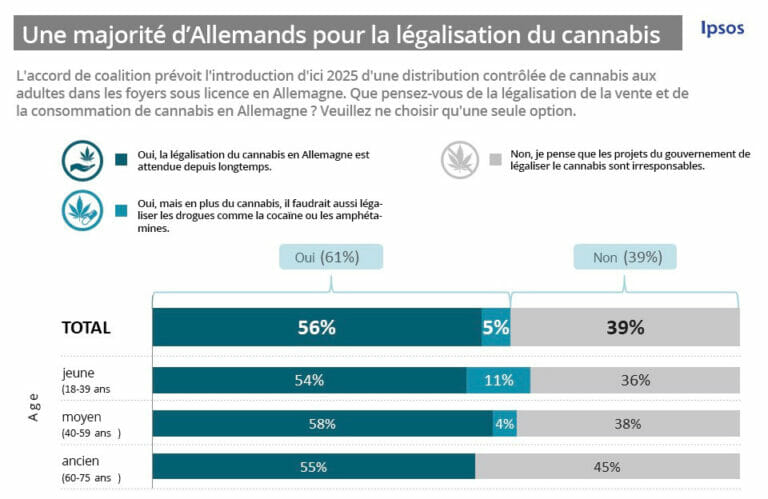
A recent Ipsos poll shows that more than half of Germans now support the legalization of cannabis. 61% of respondents indicate that they would be in favor of a controlled distribution of cannabis in authorized stores. Only 39% see plans to legalize cannabis as irresponsible and oppose legal sale and use on principle.

In the coalition agreement, the current federal government has agreed to introduce by 2025 controlled distribution of cannabis to adults for consumption in licensed stores. The latest indiscretions from the German Minister of Health also provide for a more ambitious schedule with a presentation of the bill by the end of the year and sales at the earliest in early 2024.

Young people clearly in favor of legalization, older people divided

Although the majority of Germans are in favor of the legalization of cannabis, all generations combined, there are significant differences between the different age groups. While two thirds of 18-39 year olds (65%) are in favor of legalization, they are only a little more than half (55%) in the generation of 60-75 year olds. Among middle-aged respondents (40 to 59 years), the percentage of people in favor of the bill is certainly significantly higher than among older people (62%), but it is lower than that of younger people .

Legalization of other drugs faces public hostility

While a majority of Germans would therefore be in favor of a controlled distribution of cannabis, further legalization of other drugs such as cocaine or amphetamines is strictly rejected by a large part of the population (95%).

However, there are also clear differences between different age groups for this question: Among young people under the age of 39, at least one in ten people (11%) would support the decriminalization of recreational drugs. Among middle-aged people, this proportion is only 4% and among those over 60, it is even less than 1%.

Ipsos survey in Germany

UK rejects cannabis legalization in Bermuda

One of the first steps taken by the new British Prime Minister Liz Truss was therefore to refuse to enact the legalization of cannabis in Bermuda, despite Liz Truss’ past support for the legalization of cannabis.

This development is not taken lightly by Bermuda’s senior officials who see it as a continuation of the colonial era by the United Kingdom.

Lawmakers in Bermuda, a British territory since the 17th century, approved the administration’s “flagship” cannabis legalization proposal earlier this year. Bermuda’s government was waiting to receive “Royal Assent”, an official, monarchical signature, from the territory’s UK-appointed governor.

On the day Ms Truss became Prime Minister of the United Kingdom, the government informed Bermuda that it had decided “not to give its assent to the bill as drafted”, Governor Rena Lalgie announced. of Bermuda. The UK said it could not give permission due to its interpretation of international treaties which prohibit member states from legalizing cannabis for reasons other than medical or scientific use, even as it did for Canada.

Nonetheless, Bermuda’s attorney general said in a statement on Tuesday that the government would continue to implement the reform despite the denial of assent.

“Disappointing but not surprising, given the limits of our constitutional relationship with the UK government and their archaic interpretation of the narcotics conventions,” said Attorney General Kathy Lynn Simmons. “The people of Bermuda have democratically expressed their desire for a regulated cannabis licensing regime, following strong support at the ballot box and an extensive public consultation process. »

“The Government of Bermuda intends to continue to move this initiative forward, to the full extent of its constitutional powers, consistent with our 2020 General Election Platform commitment,” Simmons said.

Bill Details

Under Bermuda’s proposal, a cannabis regulatory authority would be created to manage the licensing of cannabis businesses and make recommendations on future policies. Adults 21 and older could possess up to seven grams in a “public place”, or more if they have a valid type of license. The “intent” of the bill is to prioritize licensing for those disproportionately affected by the war on drugs.

Fees collected by licensees would cover the costs of administering the program, and these revenues could also be distributed to support drug treatment programs, training licensees in cultivation, and scientific research on cannabis. .

In Bermuda, medical cannabis was legalized following a Supreme Court ruling in 2016 that allows people to apply for a license to legally possess and consume cannabis for medical purposes. Possession of up to seven grams of cannabis is also decriminalised.

What suites?

Governor Rena Lalgie, for her part, said she had “bribed the Prime Minister and relayed the UK’s continued desire to work with Bermuda on reforms within our existing international obligations”.

“The Secretary of State for Foreign, Commonwealth and Development has concluded that the Bill, as currently drafted, does not comply with the obligations of the United Kingdom and Bermuda under the Convention Convention on Narcotic Drugs of 1961 and the Convention on Psychotropic Substances of 1971,” she said.

Ms Lalgie had already said in May that the UK was “currently supporting and assisting certain Crown dependencies and other overseas territories to develop policy and legislation in line with the relevant conventions”.

“I hope Bermudian officials will work with UK officials to find a way forward – one that does not result in life-altering criminal records for users of small amounts of cannabis and that unlocks business opportunities, while maintaining the ‘Bermuda’s excellent reputation for upholding the rule of law,’ she said at the time.

Bermuda Premier David Burt of the Progressive Labor Party did not immediately react to the denial, but he warned earlier this year that if the UK blocked the legislation it would “destroy the relationship we have with the UK.