Home Blog Page 74

After 5 years of medical cannabis, Germany continues to import massively

Since 2017, medical cannabis can be prescribed by doctors in Germany under certain circumstances. Cannabis cultivation was not available in Germany initially, so all flowers had to be imported.

To meet growing demand and reduce reliance on imports, three medical cannabis companies were granted licenses in 2019 that entitle them to grow a total of 10,400 kilos of medical cannabis in Germany over four years.

The majority of medical cannabis companies in Germany import and sell cannabis to the so-called Cannabis Agency of the Federal Institute for Medicines and Medical Products (Bundesinstitut für Arzneimittel und Medizinprodukte or BfArM), which will then sell it to pharmacies. In July 2021, the first German cannabis flowers were sold to pharmacies by the BfArM Cannabis Agency.

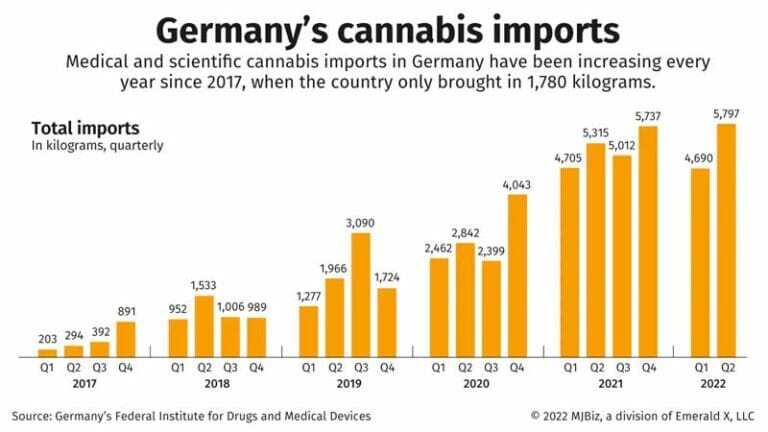
Germany imported a record amount of cannabis for medical sale and scientific use in the first half of 2022, putting the European Union’s largest market on track to match or even surpass exceed, the 2021 total.

Imports of flowers and extracts in the first six months of 2022 reached 10,487 kilograms, 6.1% more than in the first half of the year, according to data from the Federal Institute of Medicines and of medical devices (BfArM) compiled by MJBiz.

Imports of medical cannabis into Germany

Imports of medical cannabis in Germany, compiled by MJBiz

In the year 2021, Germany imported 20,589 kilograms of cannabis for medical and scientific purposes, a substantial increase from the 13,346 kilograms imported in 2020.

The medical market is constantly growing and supply circuits have been evolving for 5 years. Canada, the country’s leading supplier, now faces competition from European countries such as the Netherlands, Denmark and Portugal, which are stepping up their production and export efforts. Some Canadian companies like Aurora have also relocated their production to Denmark and now produce on European soil before exporting to Germany.

Origin of medical cannabis imports in GermanyOrigin of medical cannabis imports in Germany

Origin of medical cannabis imports in Germany, compiled by MJBiz

If Germany does not communicate on its legal cannabis sales, the market is estimated at 300 million euros, with still room for growth, whether by the number of patients or by the development of a real home production. The addition of a recreational market could well drastically increase these figures!

In the footsteps of Gorilla Sherbet F1 Fast Version® by Sweet Seeds®

The cannabis world is currently heavily influenced by the North American market and its cannabis strains with high THC percentages. Sweet Seeds® always works to preserve and improve its genetic collection, available to all, in order to develop high quality cannabis genetics.

The one that interests us today is the Sunset Sherbet (Girl Scout Cookies x Pink Panties), a famous variety created by Mr. Sherbinski, in a feminized photodependent version with accelerated flowering. The whole family F1 Fast Version® benefits from a shortened flowering of about two weeks while retaining the same qualities as the genetics from which they come.

the Gorilla Sherbet F1 Fast Version®

The work of the R&D department of Sweet Seeds® is particularly interesting to save time, whether to reduce electricity costs indoors or to avoid autumn rains and their inconveniences outdoors. Let’s go back to the Gorilla Sherbet F1 Fast Version® (SWS98) of Sweet Seeds® [Sunset Sherbet x Gorilla Girl XL Auto (SWS82)].

Vigor and scent

The varieties Sweet Seeds® are distinguished by their incredible vigor, which is particularly visible in flowering with a sustained production of pistils that stand out against the bright green of the leaves. The aromas are very sweet and lemony and the resin is present on all the leaves surrounding the flowers. This cross also ensures high yields and great potency.

At the end of their life, the plants see their pistils turn orange, a sure sign of maturity, and the branches become heavy with swollen and sticky calyxes.

Gorilla Sherbet F1 Fast Version® is one of the most worthy representatives of the Cookies family, much appreciated in cannabis dispensaries in the United States where it is prescribed for symptoms related to stress and mood disorders.

Geneva also wants to test the sale of cannabis

After Lausanne, Basel, Bern, Biel and Zurich, Geneva in turn wants to test the legal sale of cannabis for adults as part of a pilot project.

The request for authorization will be submitted shortly by the ChanGE association to the Federal Office of Public Health (OFSP). It will plan to authorize 1,000 major cannabis users to join the experiment for a period of three years.

The municipality of Vernier, which is part of the canton of Geneva, will host the cannabis shop, without further details for the moment except that it should be located in the city center, and therefore a few kilometers from the French border.

The University Hospitals (HUG) and the University of Geneva (Unige) will follow this experiment to study its repercussions on the local black market, on consumption habits and on the mental and physical health of consumers.

“Faced with a system of repression which has demonstrated its inefficiency and a strongly established black market, we must study new solutions, such as the transition to a legal and controlled market”, explained Mauro Poggia, in charge of the Department of Health and of security. For the Geneva State Councilor, taken up by 20minutes.ch, this project will also make it possible to “better calibrate the measures for the prevention of addictions and the protection of young people”.

However, the FOPH will have to give the green light to open the pilot project. In Lausanne, a file was submitted last June and “is being analyzed” according to the city. The point of sale could thus open in 2023. More than 1,500 people have registered for the Lausanne trial.

The Swiss pilot projects allow a determined number of Swiss and adult consumers, and limited to 5000 per pilot test, to buy up to 10 grams of pure THC per month at a maximum of 20% THC (i.e. 50 grams of flowers ).

At the same time, parliamentary interest in federal legalization of cannabis is beginning to take shape.

The pragmatic approach to cannabis in the UK is focused on the economy and aims to win the support of the new Prime Minister

Remarks made decades ago by the new British Prime Minister Liz Truss regarding the legalization of cannabis have sparked enthusiastic comments feverishly speculating about impending cannabis reform in the UK.

When she was a student, the 47-year-old Conservative Prime Minister – then a Liberal Democrat – wondered in an Oxford University newsletter whether cannabis should be legal.

However, on the day she became Prime Minister, the attempt by the British Crown dependency of Bermuda to introduce cannabis reform was rejected by the Foreign Office – a department that had been headed until then by Ms. Truss.

A “bottom-up” reform

Nevertheless, with a new Prime Minister and a new cabinet in place, work is already underway to secure Westminster’s support for further liberalization of UK cannabis laws.

In the absence of clear commitments to reform, reform is currently limited to a bottom-up approach and is led by two All-Party Parliamentary Groups (APPGs).

The APPG on prescription medical cannabis aims to boost access to NHS medical cannabis, and the APPG on CBD products is co-chaired by two Tory MPs, Crispin Blunt MP and Baroness Manzoor CBE.

In July, the latter unveiled its “Cannabis Plan”, which proposes changes regarding the cultivation and prescription of medical cannabis, the licensing of hemp and the financing of cannabis.

The co-chair of the CBD advisory board is Nicholas Morland, CEO of Tenacious Labs, who says his approach is “operational, rather than lobbyist.”

“What we find is that as long as we are reasonable and divide (our proposals) into reasonable blocks, every MP we go to says, ‘Yes, you have my support. Just let me know when you have something to support.

“Our aim now is to find ministers in the newly formed cabinet who want to lead the project and instruct their individual departments on who needs to work on what.

A massive boost to the economy

“The proposals we have put forward could create 500,000 new jobs and generate billions of pounds in tax revenue – and we haven’t found anyone to say no to these proposals. »

“We try not to make waves…but who doesn’t want jobs, who doesn’t want tax revenue? “.

Through its membership in the Cannabis Trade Association (CTA), at Cannabis Industry Council et al’European Industrial Hemp Associationthe CBD APPG says it speaks on behalf of some 700 of the UK’s 900 cannabis companies.

In the coming days and weeks, he will focus his efforts on three of the main state departments, namely agriculture, business and the interior ministry.

All these ministries have new secretaries of state: Jacob Rees-Mogg for agriculture, Suella Braverman for the interior and Ranil Jayawardena for DEFRA.

Appear on the list of ongoing projects

Mr Morland continued: “We have spoken to people in these departments – other than the ministers who have just been appointed – and our proposals need to be added to the list of things they are doing.

“We want to make sure we’re not just on the ten things they say they do, but we’re also on the five they’re working on right now. »

The APPG will also target the Deputy First Minister and Secretary of State for Health, Therese Coffey, who represents a rural constituency in Suffolk – jobs in hemp farming, perhaps? — and as a former Mars executive, she understands branding, food products and the importance of consumer protection, Morland said.

He added, “Fundamentally, we are against prohibition that puts money in the hands of the wrong people. …as cannabis becomes more socially acceptable, it needs to be managed the same way as alcohol. »

“Nobody wants more children with epilepsy; nobody wants people who buy hand cream (CBD) to be criminalized. »

Galvanized British Industry

Marika Graham-Woods, the CTA’s co-executive director and operator at Westminster, said Mr Rees-Mogg’s appointment was welcome.

“It’s a good thing – he has no problem with the APPG cannabis plan that we announced in July. And why would he? It will create lots of jobs, support the new economy and fuel the development of the green economy. »

“The new Prime Minister has been briefed on the cannabis plan beforehand and we feel that the doors of Westminster are opening to cannabis.”

The UK Cannabis Industry Council has already written to the new PM highlighting a number of post-Brexit opportunities available.

Its CEO, Mike Morgan-Giles, says Brexit has proven the opportunity for the UK to implement its own regulations, which should include revised rules on CBD Novel Food and hemp seed varieties. available to UK farmers.

“Another area of ​​importance is to help enable patients to have better access to medical cannabis,” he added.

However, there are a few dissenting voices in the industry. A business executive told BusinessCann the industry needs to be more realistic and stop trumpeting its potential value, as it gives politicians a misleading picture of a thriving industry that can get by without government help.

Rising political consensus

This bottom-up policy approach appears to be cementing a growing cross-party consensus in favor of cannabis.

This was evident last year when a private member’s bill by Manchester Labor MP Jeff Smith to boost access to NHS medical cannabis garnered widespread support but ultimately failed to pass.

This project aimed to build on groundbreaking 2018 legislation that allowed access to medical cannabis in the UK for the first time.

Although this law also garnered widespread support, it proved ineffective – almost four years later – with only three young people receiving medical cannabis to treat epilepsy.

This stalemate has led to an upsurge in paid and unlicensed prescriptions through a growing army of private clinics accommodating up to 15,000 patients.

In June last year, more than 60 MPs and peers from across the political spectrum called for an urgent review of the Misuse of Drugs Act.

Public opinion in favor of reform

Away from Westminster, the emerging support for cannabis is also evident in the general public, with opinion polls showing that twice as many UK adults support the legalization of cannabis rather than oppose it.

In London, Mayor Sadiq Khan is set to introduce a decriminalization pilot scheme and a dozen UK police forces have taken a soft approach to cannabis prosecutions.

Recent research has shown that the number of cannabis possession offenses increased from 160,733 in 2010/11 to 110,085 in 2019/20.

In May this year, the Mayor of London also announced the launch of a commission to review the effectiveness of UK drug laws, with a particular focus on cannabis. This commission will be chaired by Lord Charlie Falconer QC, former Lord Chancellor and Secretary for Justice.

Commitments by political manifestos

However, for the UK to make more fundamental progress, cannabis reform will also need to feature – as it does in the US – in political party election manifestos.

This has happened in Germany, where cannabis is among the political commitments of two of the three members of the traffic light association, with a focus on health protection.

German cannabis legislation is expected to be unveiled in the coming weeks, with 2024 looking the likely date for the introduction of a fully regulated adult-use market.

Returning from a trip abroad, opposition Labor MP David Lammy echoed Germany’s approach, saying: “I want the market to be legalized, regulated and removed from criminal gangs”.

Immediate reform on the other side of the world

The views of Sadiq Khan and David Lammy were echoed by former Labor leader Ed Miliband earlier this year and are more widely shared in the left-wing opposition.

Until there is, perhaps, a change in government, hopes for top-down cannabis reform in the UK – and an eventual market for adult use – seem unrealistic.

Nevertheless, Britain’s new economically liberal Prime Minister is keen to roll back the weight of the state, indicating an openness to exploring new areas of economic growth for the UK – and an opportunity, perhaps. be, for cannabis?

It’s also worth noting that alongside the young prime minister’s stance on cannabis reform, she also once advocated for the privatization of street lights in Britain.

Members of the UK cannabis community hope that the first point will carry more weight in the months and years to come than the second!
Discover the Peter Charles Paris brand

0

Paris is the capital of fashion and trendy accessories. Many designers are established there, such as Peter Charles, a leather craftsman who stands out with his high-end smoking products. Focus on this noble Parisian brand.

A rich cultural heritage

Peter Charles is a Parisian leather goods designer with deep-rooted influences. Indeed, his grandfather, himself a craftsman living in Burgundy, worked leather in an artisanal way, to make it a popular material through various creations. But Peter Charles also enjoyed observing the cobbler in his neighborhood. This awakened both his senses and his curiosity and creativity. The smell of leather, its touch and its texture have remained forever engraved in the genes of this craftsman.

Still very young Peter Charles already knew that he would make a trade around leather. At 18, self-taught, his passion allows him to follow an atypical path to achieve his dream with his fingertips. Meticulous and neat, his achievements have succeeded in seducing his clientele.

Discover the Peter Charles Paris brand

An atypical journey and racy products

Quickly familiar with “classic” leather, Peter Charles is passionate about exotic leather, whose patterns and colors are very diverse. He constantly creates and reinvents classics with his personal touch in which he systematically refers to his two mentors. Its smoking products are a perfect example of its success. Lighter covers, cigar cases, table ashtrays and much more will make you stand out to your friends or family.

These luxurious products are offered at an affordable price to allow everyone to afford a rare and precious object. Offer a cigar cellar Peter Charles Paris or even a table lighter from the brand and you are sure to surprise the person you want to please. The solitary ashtray, for example, will make its most beautiful effect on a desk. Don’t hesitate to match your wallet to your lighter cover, for example, for a winning combo!


Sint-Maarten launches consultation on the legalization of cannabis

The Government of Sint Maarten is seeking proposals from organizations or companies willing to work with the government to create a comprehensive pathway to legal, responsible and viable access to the cannabis industry.

The government of Sint Maarten paves the way for a legal cannabis industry

Health, Social Development and Labor (VSA) Minister Omar Ottley welcomes and welcomes proposals to explore a regulated and legalized cannabis industry.

“The objective is to carry out studies on the effects of the legalization of cannabis before making a decision on how this legalization could materialize”, specifies the government. Therapeutic, recreational, scientific and religious uses will be studied.

With this in mind, “Minister of Health Oma Ottley is open to all proposals to study the question of a legal cannabis trade. The objective is to receive suggestions from local and international companies who would like to work with the government and ensure that the economic, social and medical aspects can benefit Saint-Martinois”.

The official launch of the tender begins on September 12, 2022, for a period of 90 days.

All proposals submitted by the submission deadline – December 5, 2022 – will be reviewed and assessed, based on the information provided in the proposal, as well as the list of deliverables to be included.

As CannabisIndustrie.nl points out, the big question will now be whether the Dutch government will shirk, like the United Kingdom, which refused the legalization of cannabis in Bermuda. Sint Maarten and the BES Islands, also called Dutch Caribbean, are indeed part of the Kingdom of the Netherlands.

The BES Islands would like to model their cannabis policy on that of the Netherlands

The BES islands of Bonaire, Sint Eustatius and Saba already indicated at the end of 2021 that they wanted recognition to equalize the cannabis policy with that of the Netherlands. At the time, the island council of Saba made this request in a letter addressed to the Minister of Justice and Security, Mr. Grapperhaus.

Meanwhile, in August, the Cannabis Association Bonaire was created. She will lobby the government to make the cannabis industry on Bonaire legal and well regulated, both for medical and recreational purposes.

In July 2020, a petition was also launched to legalize cannabis in Bonaire.

Canopy Growth withdraws from cannabis retail in Canada

Canadian cannabis company Canopy Growth, one of the largest cannabis companies in Canada and globally, is exiting its cannabis retail operations in Canada. It will sell 28 stores, run under its Tweed and Tokyo Smoke brands, close 5 others and end franchise and licensing agreements.

Financial terms of the store sale were not immediately disclosed.

Canopy’s exit from retail “reinforces the company’s focus” on achieving “profitability as a cannabis and consumer packaged goods (CPG) company focused on premium brands,” according to A press release.

Divestitures announced last Tuesday include:

  • 23 Canopy-owned retail stores in Saskatchewan, Manitoba, and Newfoundland and Labrador, to be purchased by Canopy’s retail partner, OEG Retail Cannabis (OEGRC), which already owns and operates Tokyo Smoke franchise stores in Ontario
  • 5 Canopy-owned stores in Alberta, which will be acquired by Four20, a Calgary-based cannabis retail company, and rebranded.

In a press release, OEGRC said it will become “the sole owner of the Tokyo Smoke brand and all Tweed retail stores acquired in this transaction will be rebranded.” OEGRC already has 64 Tokyo Smoke stores in Ontario.

Canopy also terminated a master license agreement with convenience store operator Alimentation Couche-Tard for the Tweed retail brand in Ontario.

The Tweed brand will continue to be used by Canopy for cannabis products.

Canopy explains the sale of its stores by a drop in turnover in the retail sector of 28% as of June 30 last year compared to the previous year. The company attributes the decline to “the rapid and continued increase” in the number of retail cannabis stores in Canada as well as “price compression resulting from increased competition.”

In early August, Canopy announced a net loss of C$2.1 billion ($1.6 billion) for the first quarter. The company also laid off many employees at the start of the year in order to reduce its operating costs and following the closure of several production sites.

Australian Greens push for cannabis legalization

The Australian Greens are preparing a campaign to legalize cannabis, an initiative already launched in 2018.

According The Guardianthe Greens, on the advice of a constitutional lawyer, argue that the Australian Parliament could override the laws of the various Australian states on the matter.

“The council suggests that there are three heads of power in the Commonwealth that would enable it to legalize and regulate the use of cannabis, the clearest route being through part of section 51, which relates to copyrights , patents for inventions and designs, and registered trademarks,” reports The Guardian.

The Guardian reports that lawyer Patrick Keyzer relies on the part of the article relating to “copyright, patents for invention and design, and trade marks”, claiming that he empowers the Commonwealth to ” regulate varieties of cannabis as plant varieties and include them in a list over which the Commonwealth has exclusive regulatory control”.

“We have been told for too long to wait for cannabis law reform, even though it is clear that the majority of the damage caused is due to the police and the war on drugs, not to the plant” , said David Shoebridge, spokesman for the Greens, in a statement on Monday.

“Recreational cannabis is enjoyed by millions of people in Australia and around the world, and to claim otherwise is increasingly ridiculous,” Shoebridge added. “At least 40% of Australians have used cannabis and any laws that make nearly half of us criminals must go. »

A poll earlier this year found Australians were split on whether to change marijuana laws in the country, with 50% saying they support comprehensive cannabis reform.

The Greens aren’t the only party pushing for cannabis reform. Earlier this year, the Australian party Legalize Cannabis exceeded expectations in senatorial elections and came close to securing a seat.

Cannabis has already been decriminalized in the Australian Capital Territory, where the government announced earlier this year that it would decriminalize other small amounts of illicit drugs. South Australia also announced that it was tabling a cannabis legalization bill last May.

In the United States, the legalization of cannabis linked to a drop in the rate of obesity

While cannabis is notorious for making you hungry, a recent study found that the legalization of cannabis is associated with lower levels of obesity.

The study, published this month by the Journal of Health Economicsanalyzed obesity data in Washington State, one of the first states to legalize cannabis, from 2002 to 2018.

Researchers from North Dakota State University, Center for the Study of Public Choice and Private Enterprise and some Metropolitan State University of Denver said that despite the cannabis snacking factor and general concerns about obesity, the relationship between legalization and excessive weight gain “remains an open and understudied question.”

To help fill this gap, the study set out to examine what happened in Washington state in the years after cannabis stores opened, compared to the rest of the country, and after controlled for other factors.

The experiment showed that “the opening of cannabis dispensaries for adults led to decreases in obesity rates. Specifically, the state’s obesity rate “is on average 5.4% lower” than other states, compared to an average difference of -0.01% in the years before legalization.

“Our primary experiment found that cannabis legalization, which allowed cannabis dispensaries to open, led to lower obesity rates in Washington state,” the authors wrote. “This is somewhat surprising given previous literature finding that cannabis use is often associated with increased consumption of unhealthy foods and lethargy. »

“As more states move toward decriminalization, expanded medical use, and legalized recreational use of cannabis, our findings shed important light on contemporary policy in drugs,” the study says. “Providing a more robust understanding of the relationships between recreational cannabis use and obesity rates also provides insights for public health policy examining the determinants and behaviors that may increase obesity. »

“Our findings also provide insights for health economics and health policy more broadly, as obesity rates continue to pose health and financial challenges across the United States,” she adds. .

A major limitation of the study is that it does not pinpoint exactly why legalization appears to be linked to declining obesity rates, and so future research should seek to identify these potential mechanisms.

“The cumulative effect on obesity depends on the impact of cannabis use on a range of factors, including physical health, mental health, dietary changes, physical activity, and drinking habits,” write the authors of the study. “Ultimately, how cannabis legalization affects obesity is an empirical question that requires further investigation. »

The study breaks one of the stereotypes associated with cannabis users. A recent study also challenged the cliché of lazy, unmotivated cannabis users, with researchers finding no difference in apathy or reward-based behavior between people who used cannabis at least once per week. week and non-consumers.

Boralia: CBD and well-being

With its CBD concept store mixing black and wood, like a contrast to the Scandinavian-style shops, Boralia leaves its mark in the 15th arrondissement of Paris and online.

The brand, founded by two enthusiasts of plant and alternative medicine, offers well-being products based on cannabinoids with the ambition of helping everyone to live a healthier life.

A prerequisite: to offer only superior quality products, from organic and natural farming. The products sold by Boralia are all laboratory tested, guaranteed chemical-free, pesticide-free and without traces of heavy metals and comply with European standards.

What CBD products can you find at Boralia?

Boralia wants to make the benefits of CBD accessible to everyone. Full spectrum CBD organic oils and capsules, CBG and CBN oils, CBD flowers and CBD resins are thus present in the Boralia boutique.

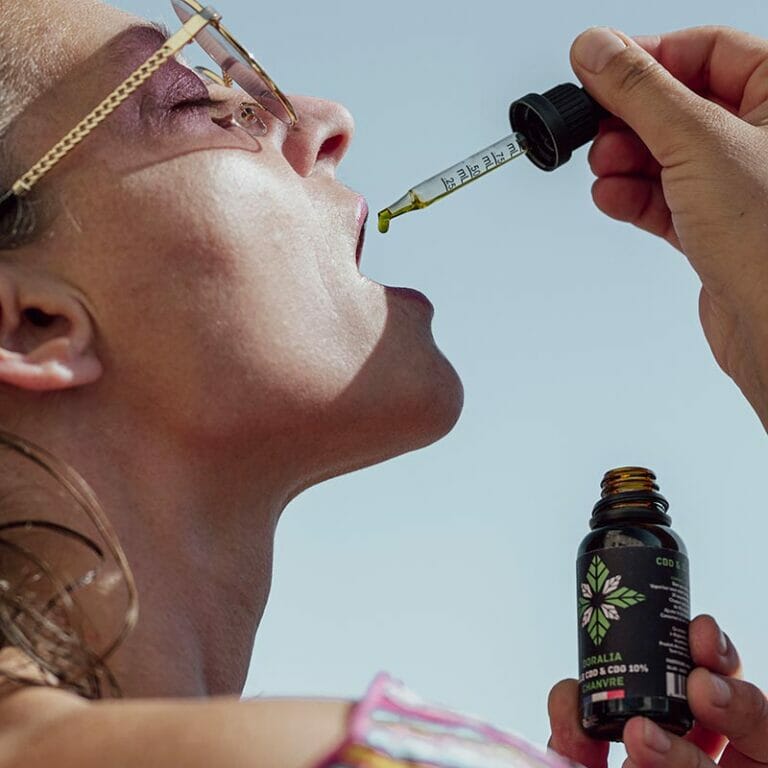
Boralia CBD Oils

Boralia CBD and CBG oils

The oils are made in France, based on hemp oil or MCT oil flavored with red fruits or citrus fruits. CBD, CBG or CBN extracts are used alone or in conjunction to target different and specific effects. CBD oil will particularly help with physical relaxation while CBG works more on mental relaxation. CBN would have more effects on sleep problems and appetite.

Hemp extract also comes in CBD capsules, for ease of intake and the advantage of a longer effect.

Boralia CBD FlowersBoralia CBD Flowers

Boralia CBD Flowers

In terms of flowers and resins, the products are chosen in Europe with natural levels of CBD, between 5 and 8%, and less than 0.3% THC. CBD varieties such as AC/DC, Cannasutra or Gelato are offered for sale, with the guarantee that they do not contain pesticides or heavy metals.

The resins are available in several textures and percentage of CBD: Caramello at 13% CBD, Pollen Lemon Haze at 25% CBD or Ice-o-lator at 80% CBD.