Home Blog Page 44

Singapore set to execute man accused of trafficking 1kg of cannabis

Singapore is set to hang a man for smuggling cannabis, in the city-state’s latest controversial execution.

Tangaraju, 46, was found guilty of “aiding and abetting in a trafficking conspiracy” for a delivery of 1 kg of cannabis from Malaysia to Singapore in 2013. Although he was not caught in the act, the State prosecutors said he was responsible for coordinating it and traced two phone numbers used by a delivery man to Tangaraju.

Tangaraju claimed that he was not the person who communicated with others related to the case. He said he lost one of the phones and denied owning the second.

Singaporean law provides for the death penalty for drug trafficking and lighter sentences for smugglers. On Tangaraju’s final appeal, the judge agreed with the prosecution that Tangaraju was responsible for coordinating the delivery, which barred him from a more lenient sentence.

Activists have also expressed concern that Tangaraju did not have access to an interpreter and had to plead his last appeal alone, as his family was unable to find him a lawyer.

Singaporean authorities claim that Tangaraju only asked for an interpreter during the trial, and not before. They add that he had access to a lawyer throughout the procedure.

In recent days, family members and activists have written letters to Singapore’s President Halimah Yacob in a last-minute appeal for clemency, while British billionaire Sir Richard Branson has called for the arrest of the execution and a review of the case.

“I know my brother did nothing wrong. I urge the court to consider his case from the beginning,” Leela Suppiah, Tangaraju’s sister, told a news conference.

Sir Richard, who previously criticized the 2022 execution of intellectually disabled Nagaenthran Dharmalingam, said Tangaraju’s case was “shocking on many levels”.

In a blog post, he said Singapore “could be on the verge of killing an innocent man” due to “more than questionable circumstances”.

“The death penalty is already a dark stain on the country’s reputation. An execution following such an insecure sentence would only make matters worse,” he said.

Refuting his claims, Singapore’s Home Office said they were false and accused him of “disrespecting Singapore judges and our criminal justice system”.

Singapore’s Home Affairs said the death penalty was “an essential component” of a multi-pronged approach that has proven “effective in keeping Singapore safe”.

Kirsten Han, spokesperson for the Singapore Death Penalty Advocacy Association Transformative Collective Justice (TJC), said the government did not want to appear to bow to pressure.

But, she added, “of all the things that Singapore stands out for on the international stage and in the United Nations, defending its right to murder people on behalf of its citizens is not something we should be proud”.

Singapore has some of the toughest drug laws in the world, going so far as to prohibit the marketing of snacks containing hemp flour. Singapore’s strict rules contrast with recent moves by some of its neighbours. Thailand has largely decriminalized cannabis and even Malaysia has ended the mandatory death penalty for serious crimes.

Tangaraju’s family said they will continue to push for reforms to Singapore’s justice system, even if he ends up being executed.

“If such an injustice happens to my brother, I would not want it to happen to anyone else and so I will continue to fight,” said his sister Leela.
Delaware, 22nd US state to legalize cannabis

Delaware has become the 22nd US state to legalize cannabis. On Friday, Democratic Gov. John Carney said he would allow two cannabis legalization bills to go into effect without his signature, despite continued concerns about the consequences of lifting prohibition in the state of Delaware.

“After years of advocacy, collaboration and organizing, we are thrilled to see cannabis legalization become a reality in our state,” said Laura Sharer, executive director of the Delaware chapter of the National Organization for cannabis law reform (National Organization for the Reform of Marijuana Laws, NORML), in a press release. “This victory is the result of the tireless work of thousands of volunteers, dozens of legislators and the support of a large majority of the Delaware community. Many have championed this just cause and recognized the need for reasonable cannabis policy reform.”

Delaware has allowed medical cannabis since 2011. In 2015, lawmakers decriminalized possession of one ounce or less, making it a civil offense punishable by a $100 fine.

Last year, Governor Carney vetoed legalization.

“My view on this issue has not changed,” Mr. Carney said on Friday. “I made this decision because I think we’ve spent far too much time focusing on this issue when Delawarens face bigger and more pressing issues every day. It is time to move on. »

2 bills

Bill HB 1, which was passed by the House of Representatives by a vote of 28 to 13 on March 7 and by the Senate by a vote of 16 to 4 on March 28, removes all penalties for possession of one ounce (28 grams) or less of cannabis per adults 21 years or older. It also allows adults to share up to an ounce “without compensation”, but it does not allow home cultivation.

Consumption “in a place accessible to the public or in a moving vehicle” remains an offense punishable by a maximum fine of $200 and/or a prison term of up to five days. Driving “under the influence” of cannabis also remains illegal.

The HB 2 law, passed by the House of Representatives by a vote of 27 to 13 on March 9 and by the Senate by a vote of 15 to 5 on March 28, authorizes the appointment of a “cannabis commissioner” who will be responsible for issuing licenses and regulating the commercial production and distribution of cannabis for recreational use. The commissioner will have to start accepting license applications 13 months after the law comes into force and start issuing licenses one month later. Retail sales will be subject to a 15% tax, and municipalities are allowed to ban cannabis businesses from their territory.

Retail sales will therefore not begin for more than a year. Since home cultivation is not permitted, cannabis users will have to continue to rely on the black market for the time being, although they will not be subject to civil or criminal penalties as long as they are 21 years old or older. more and that they do not possess more than one ounce of cannabis.

Delaware is bordered by two states, New Jersey and Maryland, which have also legalized cannabis.

Out of stock for a second product of medical cannabis experimentation

After the stock shortage of the most prescribed product in the experimentation of therapeutic cannabis, the health authorities recommended to fall back on a CBD:THC 20:1 oil. Lack of luck – or anticipation – the 20:1 ratio oil was announced to be out of stock on Wednesday morning April 19th.

Does this signal the end of the experiment? The signal sent is in any case very worrying.

“We are in a transitional situation where we have no more products”, regrets Professor Authier to the Quotidien du Médecin. “It’s a very negative signal: we’re going to have a hard time keeping health professionals in the experiment,” he predicts.

Short of stock on the CBD 50 oil supplied by the Australian Little Green Pharma (LGP), the professor had been able to fall back on the 20:1 oil, also supplied by LGP, for certain patients with resistant neuropathic pain .

“And now I’m going to be stuck, because I just have to offer them a balanced ratio of THC and CBD. he indicates. I also have patients who cannot tolerate THC, and I have nothing more to offer them. »

An information meeting is to be held this Friday, April 21 at the DGS on the question of the status of therapeutic cannabis, its possible reimbursement and its possible legalization. As he had described during a recent symposium at the National Assembly, decisions must be taken quickly so as not to miss the boat of generalization.

“The arbitrations must take place before the summer,” hopes Professor Authier. “Otherwise, it will be too late to bring cannabis into common law with the next PLFSS. »

As for the reason for the stock shortage, the role of the General Directorate of Health (DGS) is still singled out.

“The calls for tenders were launched too late”, judges Professor Authier. “We go from administrative error to administrative error,” he laments.

Little Green Pharma, which provides the two out-of-stock products, did not wish to re-enlist for an additional year, the first two years having cost it around 10 million euros according to our information.

The DGS is now trying to limit the pots and busts after having failed to allocate all the batches of a first call for tenders aimed at providing the extension of the first 2 years of the experiment. A second tender is currently underway to replace the supplier and/or the CBD 50 oil that failed in the first place. Before a third tender for 20:1 oil?

Cannabis consumption in Quebec remains stable since legalization

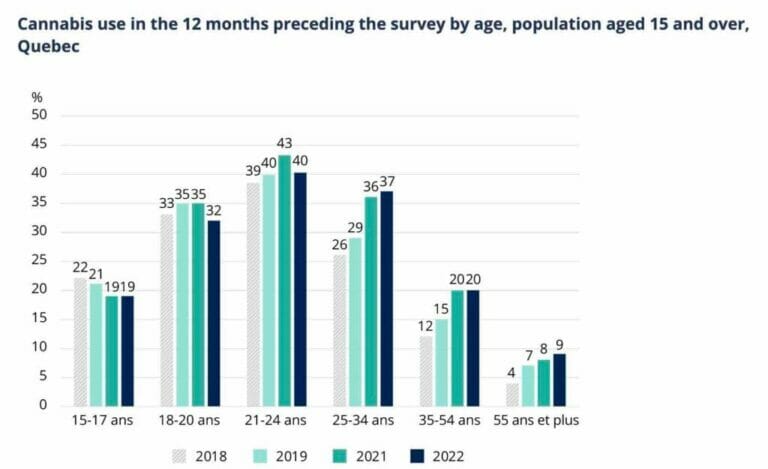
The annual survey that follows the evolution of cannabis consumption in Quebec does not show an increase in cannabis consumption in the province compared to the previous year. Young people (15 – 20 years old) are also less inclined to use cannabis than before legalization.

The 2022 Quebec Cannabis Survey shows that 19% of Quebecers used cannabis in 2022, roughly the same proportion as the previous year. The figure has remained stable since legalization, which saw a slight increase from 14% pre-legalization to 19% after, for all of Canada.

In Quebec, men are more likely to use cannabis than women, since 23% of men and 16% of women report using it.

In 2022, young Quebecers aged 21 to 24 were the most likely to use cannabis, with 40% of respondents reporting having used cannabis. Then come the 25-34 year olds, with 37%.

Although consumption has increased slightly among adults in Quebec, the proportion of consumers aged 15 to 17 who report using cannabis has also decreased since 2018, the year of legalization.

Cannabis consumption in Quebec in 2022

Cannabis consumption in Quebec in 2022

Cannabis vaping on the rise

Although not a legal product in Quebec, the report shows an increase in residents vaping cannabis cartridges, from approximately 19% in 2021 to 24% in 2022. 15 to 17 year olds who reported using cannabis, the number vaping it is about three times higher, rising from over 24% in 2019 and almost 44% in 2021 to 70% in 2022.

As in other provinces, smoking cannabis remains the most popular mode of consumption, down slightly from 85% in 2021 to 82% in 2022.

Almost half of respondents (42%) who used cannabis did so less than once a day, and around 19% did so between one and three days a month. About a quarter (24%) use cannabis one to six days a week, and 14% say they use it every day.

About 30% of consumers reported using edibles, oils, or ingestible capsules.

The black market is shrinking

About two-thirds of cannabis consumers (67%) in Quebec said they had purchased cannabis at least once from the Société québécoise du cannabis (SQDC), roughly the same proportion as the previous year.

Only around 8% said they had obtained cannabis from an illicit source, compared to 11% in 2021 and 32% in 2018. Another 40% said they had obtained cannabis from a family member, friend or an acquaintance.

Quebec’s efforts to raise public awareness of health problems related to cannabis use are also proving successful. About 79% of Quebecers aged 15 and over say they have seen or heard of such campaigns in 2022.

91% of young people aged 15-17 said they had seen such messages, followed by 88% of 18-20 year olds and 86% of 21-24 year olds.

The full report can be viewed here.

The events planned for the 420 (2023)

April 20, or “420,” is a day celebrated by cannabis enthusiasts around the world. France does not cut it, carried by the various actors of hemp and cannabis. Here are the various events planned for this 420, in France and elsewhere, and online.

In Paris

Deli Hemp is releasing a range of products inspired by New York Delicatessen, with a CBD Donut composed of 2g of CBD flowers and 1g of CBD extraction. Available online and in stores from April 20.

The Equilibre CBD brand will distribute 500 hemp kits to plant, at Printemps and Citadium in the Haussmann district.

Greeneo will launch a treasure hunt around Châtelet and on the Ile de la Santé on April 20. At 4:20 p.m., the brand will also launch a competition with a prize worth €420.

Ho Karan is celebrating 420 Day by hosting a special event at his boutique at 65 rue de Bretagne in Paris. On the program, a PAX stand to test their new vaporizers and Breton CBD flowers, an official celebration at 4:20 p.m. then a tasting with hemp until 9 p.m.

The brand and franchise High Society will release a limited edition variety, the Northern Light.

In Nice

In Nice, the CBD brand Bloom&Cie is organizing a taste discovery workshop around hemp on April 20 from 3 p.m. at the Pop-up Nice Initiative on the 1st floor of Nice Etoile. Their Insta: https://www.instagram.com/bloom.cie/

In Pointe-A-Pitre

The Happy Corner and the 1973 restaurant are organizing a special Bodé Night 420 with DJ Spawny on April 20 from 7 p.m. to midnight. Street Food infused on site. 19 Rue Gilbert de Chambertrand in Pointe-à-Pitre. Their Insta https://www.instagram.com/p/CrBXW6tIExx/

Online

The High Chameleon releases a podcast that gives voice to growers and breeders. To follow on their Insta https://www.instagram.com/thc.thehighchameleon/

Ciflow will spend 24 hours on Twitch for the 420. His Twitch https://www.twitch.tv/ciflowclub

In Barcelona

The RDM Club organizes a Bong Competition, the NBA (National Bong Association), with different tests: the biggest cloud, the greatest number of bongs of weed, hash and for the 3 that would remain, a bong of rosin of 0.3g.

Would you like to be featured in this article? Contact us by email or via our RS 😉

How to successfully light the shisha charcoal?

To enjoy a good shisha session, it is important to be able to light the charcoal in the best possible way. To do this, there are many accessories allowing a homogeneous and durable ignition. Explanations.

The success of the shisha session: the ignition of the charcoal depends on it

If you are new to the subject, you may not know that the preparation of the shisha, but especially the lighting of the charcoal, are steps that should not be overlooked for a successful session. We advise you to use natural coal rather than self-igniting coals. Nevertheless, the preparation of the ignition requires specific accessories since they must be heated beforehand to light them. Here are which ones.

Gas or electric charcoal lighter

They are perfect accessories for lighting the charcoal of the hookahs outdoors. They run on gas or electricity depending on the model. They can also be transported easily since they remain light and compact. To light your charcoal, set the flame to maximum for gas models or let the spiral become incandescent for electric models, then place the coals in the receptacle or on the resistance and simply wait until they are red. Don’t forget to turn the coals so that they are red on all sides.

For the price, it is possible to find gas or electric coal lighters for less than 30 euros.

Torch lighters

A practical and ideal solution, the torch lighter, also called a flame lighter or a torch lighter, also allows you to light the shisha charcoal. However, it is rather recommended for self-igniting coals, as it is a rapid ignition system. The price of these lighters is accessible since it varies between 5 and 25 euros.

table lighters

These models of lighters work on the same model as torch or blowtorch lighters. They are also rather recommended for self-igniting coals. On the price side, these are ignition systems at less than 10 euros at the entry level, but which can reach several hundred euros for luxury models.


Maltese regulation of Cannabis Clubs hinders their arrival

As regulations for Maltese Cannabis Clubs were announced last month, Maltese authorities are accused of treating cannabis like plutonium, at the risk of delaying their arrival.

According to local reports collected by Business of Cannabis (BoC), the rules are too restrictive: overly restrictive testing policy, waste disposal and handling requirements, bureaucratic registration mechanisms and potential fines of up to 10,000 euros.

People wishing to create a cannabis risk reduction association on the Mediterranean island will also have to find several hundred thousand euros to achieve this.

A cost of up to 1 million euros

An island-based businessman specializing in cannabis told BoC: “The new rules for recreational use mean that at least €500,000 or even €1 million will have to be invested to make the association take off. »

“I know quite wealthy people who were going to buy properties to start an association, but after reading the rules and restrictions I find it ridiculous. »

“It’s all there: safe transport of products, separate sites for storage and distribution, and the fact of having only 500 grams at a time in the Club. »

” They [l’ARUC, l’autorité maltaise de régulation du cannabis] have made it really hard to do without a big capital. Many people who want to do this don’t have the money. And those who have the money say they won’t be able to get their money back for a long time. »

“CURA shot themselves in the foot. The barriers to entry are too high”.

Due to the strict rules, the sale price of cannabis grown by the association could reach 15 euros per gram, compared to 12 euros on the medical market and 8 euros on the illegal market.

No request received

In December 2021, Maltese President George Vella signed the law allowing adults to possess up to 7 grams, grow four plants at home and source cannabis from regulated clubs.

A few weeks later, he created the CURA, charged with drawing up a detailed plan for the implementation of these proposals.

These were released at the end of February this year, and those interested in setting up a Club were invited to apply for licenses. No request has been received to date according to BoC.

The rules have been criticized from all sides. For example, there are only two test machines on the island, which must record the levels of at least nine cannabinoids according to the regulations imposed on the Clubs.

One observer told Lovin Malta: “We were asked to test our cannabis at ten times the level of medical cannabis…if an NPO (non-profit organization) has eight strains, and the test costs 2,500 euros more, that’s thousands and thousands of dollars every month just to test the quality”.

Rules that are too restrictive

Transporting and disposing of waste also poses problems, as the rules are as strict as those applying to the transport of fuels, gas and fireworks.

The size of the Clubs can vary from 50 to 500 members. The annual registration fee is 1,500 euros for the smaller ones and 26,000 euros for the larger ones.

Cannabis Clubs will be required to contribute 5% of their annual revenue to a Harm Reduction Fund and 10% of their cumulative revenue to a Community Projects Fund, both managed by CURA.

People who sell cannabis to non-members or minors will be subject to a fine of up to 10,000 euros. Regardless of size, all associations must keep detailed records of each cannabis grow cycle and submit a quarterly report to CURA detailing membership numbers, cannabis sold and cash flow.

Associations must also maintain a register of members including all personal data.

Association founders must have lived in Malta for at least five years to establish an association and anyone convicted of serious crimes or drug offenses within the last ten years cannot establish an association or work for an association. association.

CURA inspectors will conduct site inspections or audits and violators will face a range of penalties including warnings, specific stop orders, fines, and even license revocation.

Cannabis Treated Like Plutonium

Fines range from €1,000 – for failing to submit a quarterly report or failing to maintain an adequate membership list – to €10,000 for more serious offences, such as selling unlabeled or mislabeled cannabis. packed up.

ReLeaf Malta, an NGO that has been at the forefront of cannabis regulation in the country, believes that the new regulations will exclude the local cannabis community.

Andrew Bonello, Chairman of ReLeaf Malta, told BoC: “As far as I know, there have been no requests so far. »

“These guidelines are not what the cannabis community would have liked. There is too much paperwork […] and the grassroots community is excluded from the process. »

“Permits are required for many things, including transportation from cultivation to the association and waste disposal. It seems like they treat cannabis like plutonium…that’s totally over the top. »

“All of these guidelines are what the illicit market doesn’t have, so how is the price in the regulated market going to match the price in the illicit market?” It looks like the goals will be very difficult to achieve.”

He said ReLeaf Malta had been pushing for a community-based approach where members band together to support the organization on a not-for-profit basis, which would not require outside investment.

He estimated that the minimum cost of the proposed scheme would be well over €100,000, which is beyond the reach of these grassroots organisations.

However, he added that it could very well open the door to those who have compliance teams in existing businesses such as entertainment or other psychoactive businesses such as alcohol or tobacco. »

Soon a pilot project for the legalization of cannabis in Luxembourg?

It’s as if Luxembourg was only waiting for Germany to move forward on its legalization of cannabis. Announced in 2018 in the Grand Duchy, the desire for legalization had finally turned into the legalization of the personal use of cannabis (consumption and self-cultivation) without a cannabis sales system or Cannabis Social Club.

While the country was still dragging its feet at the start of the year, and assured that it was not certain to “legalize” cannabis before the end of 2023, the recent declarations of the Minister of Health, Paulette Lenert, revive the project, without completely emancipate themselves from the announced deadlines.

On RTL, the Luxembourg radio station, Minister Lenert declared that the pilot project for the legalization of cannabis must pass “quickly” before the Council of Government. The controlled public sale of cannabis should thus, as in Germany, be authorized within the framework of an experiment, before going further.

In June 2022, Justice Minister Sam Tanson introduced a bill that was the first step on the road to legalizing cannabis. Under the blue-red-green government plan, adults were to be able to grow up to four cannabis plants per household from seed.

However, the Luxembourg Council of State recently raised four formal objections to the bill. The Ministry of Justice is now working on changes to the text. This first stage of the parliamentary process must be completed if possible before the general elections on 8th October next. During her interview on RTL, Paulette Lenert did not specify whether the legalization project could also pass the vote in the Chamber before October.

Slowly, but not too quickly either.

Taiwanese pro-cannabis activists demonstrate for decriminalization

Last Saturday, activists from Green Sensation, a Taiwanese cannabis law reform association, called for the decriminalization of cannabis on the island of Taiwan.

A series of entertainment and musical performances were planned in Taipei with non-governmental organizations participating in the event starting at 4:20 p.m. to march to the legislature.

“Our movement has come under increasing attack this year, and we have faced coordinated efforts to disparage us, including misinformation and fake news circulating online by conservative religious groups with the help of forces pan-blue policies,” said group spokesperson Chung Ho-yun.

“In fact, the harsh crackdown on cannabis was done by Justice Department officials under the administration of the Democratic Progressive Party,” the party currently in power, he added.

However, activists have successfully defended their freedom of expression and their right to personal belief.

“It shows that Taiwan still needs to work on transitional justice and ease the crackdown on cannabis, as we have to constantly fight against conservative forces,” he added.

This is the fifth year that the event has taken place in Taiwan, a few days from 420. A petition had gathered last year more than 14,000 signatures in favor of the legalization of cannabis in this country of 23 million inhabitants. .

“We call on society and lawmakers to stop the crackdown on cannabis,” he said. “We urge decriminalization and call on the Department of Justice and the courts to end their so-called ‘war on cannabis’ which targets the younger generation.”

Mr Chung called on the government to allow products containing 0.3% THC, in line with regulations in many countries, and to follow the United Nations Commission on Narcotic Drugs, which decided to remove cannabis from its list of narcotics in 2020.

“The Department of Justice and Legislators [taïwanais] should do the same and amend the Narcotics Risk Prevention Act,” he said.

Cannabis is illegal in Taiwan. It is classified as a category 2 narcotic by the Narcotic Risk Prevention Act (Narcotics Hazard Prevention Act) in Taiwan. Persons who manufacture, transport or sell category 2 narcotics are liable to life imprisonment or a fixed term imprisonment of at least 10 years, as well as a maximum fine of 15 million Taiwan dollars (450,000 euros).

Frankfurt and Offenbach want to set up cannabis sales pilot projects

Last Wednesday, the German Ministers of Health, Karl Lauterbach, and Food and Agriculture, Cem Özdemir, presented the plan to legalize cannabis in Germany at a press conference. Instead of full legalization with the sale of cannabis in specialized stores, the reform now rests on two pillars.

For the first, the consumption of cannabis for recreational purposes will be decriminalized and self-production authorized within limits still to be defined but which should turn between 3 and 5 plants per household. Instead of commercial cultivation and distribution, private associations, Cannabis Clubs, will cultivate cannabis themselves and can sell a maximum of 25 grams per day to their members at cost price. Possession of up to 25 grams for personal consumption will be more punishable for people over 18.

In the second part, pilot projects are to test the regulated sale of cannabis to adults. The results of these scientific experiments will provide the basis for further cannabis regulation.

Although the reform is still far from being ready, several municipalities are already showing their interest in becoming a model region for the distribution of cannabis.

Frankfurt applies to become a model region

The two cities of Hesse, Frankfurt am Main and Offenbach, have already expressed their willingness to apply for the implementation of pilot projects for the distribution of recreational cannabis. Frankfurt health deputy Stefan Majer commented on the matter:

“We welcome the fact that the federal government has now presented concrete plans for cannabis. It is obviously not possible to go further at the moment, but we must nevertheless implement now what is possible”.

Offenbach would automatically be involved in the cannabis project

But Frankfurt will not be the only one to present itself as a model region as soon as the foundations are laid. Due to a city council decision that the two municipalities adopted in 2021, Offenbach would be forced to follow suit. The two cities would then together form a model region and carry out their scientific project. The green mayor of Offenbach, Sabine Groß, however, pointed out that there were still many open questions that needed to be clarified.

The second phase of cannabis law reform is hardly achievable before 2024

In the weeks and months to come, other municipalities will probably express themselves on the legalization projects of the federal government and, if necessary, announce their candidacy as a model region. Already, the implementation of the first part of the cannabis reform will probably not be fully implemented before the fall.

It will therefore probably be necessary to wait until 2024 for the first German cities to start carrying out pilot cannabis distribution projects like those that already exist in Switzerland.