Home Blog Page 112

Salt Bae teases its brand of cigars

0

He is an emblematic character of social networks. Turkish chef Nusret Gökçe has just made a strange video in which he “plays” with a cigar. According to some sources, he is about to create his own brand.

A music video that leaves little to the imagination

At the beginning of December, the man who fans call “Salt Bae” published a new video, but this time, we don’t see him salting or cutting a piece of meat. No, he’s just sitting, holding a cigar in his hand. After sniffing, caressing and inspecting it, he finally puts it in his mouth.

Then, on his Instagram account, between the videos and photos of Chef where Nusret salts the meat, cuts it or serves it, several publications have been linked to the cigar since December. We see him sometimes playing mafia at a poker table, sometimes on a seat playing with an extinguished cigar.

Salt Bae teases its brand of cigars
Photo credit: @nusr_et

A new brand of cigars in Dubai?

Many hallway rumors suggest that the Turkish chef would seek to invest in the world of cigars. While some say he wants to take control in this fairly closed world, others claim he is creating his own brand. It would therefore seem that Nusret’s new fad is still luxury, but after food, he would have set his sights on cigars.

Behind the iconic little rimmed glasses, is the famous Salt Bae becoming a formidable businessman? You have to admit that he leaves some doubts, especially after his last video in which he wears a striped suit, a turtleneck sweater and his famous cigar. Hair impeccably smoothed and tied back, he looks like a Mexican baron. Like a true aficionado, he twirls the cigar in his hand, sniffs it and inhales all the flavors. Then he examines a well-stocked cigar box.

United States: A candidate for the Senate smokes a blunt in a campaign on the evils of prohibition

A candidate seeking to represent Louisiana in the U.S. Senate released a campaign on Tuesday that puts cannabis front and center. Democrat Gary Chambers sits in an armchair in a field, smoking a blunt, and listing statistics on the harms of cannabis prohibition.

The clip is titled ” 37 Seconds“, in reference to a study that found that US police make a cannabis-related arrest every 37 seconds on average.

“Black people are four times more likely to be arrested for marijuana than white people,” says Chambers. “States waste $3.7 billion enforcing marijuana laws every year. Most of the people the police arrest are not drug dealers, but rather people who have small amounts of weed, like me. »

While cannabis has not been legalized for adults in Louisiana, possession of up to 14 grams was decriminalized last year and is now punishable by a $100 fine. And in New Orleans, where the spot was filmed, police recently announced that they will no longer issue tickets for simple possession of cannabis. The governor also signed a bill last year allowing patients in the state’s medical cannabis program to legally smoke cannabis flowers.

“For too long, candidates have used marijuana legalization as an empty argument to appeal to progressive voters,” Chambers said in a press release. “I hope this ad works to not only de-stigmatize marijuana use, but to force a new conversation that sets the stage for legalizing this beneficial substance, and forgiving those who have been arrested for outdated ideology. »

In the press release attached to the campaign, Chambers said he supported the HOPE Act (Harnessing Opportunities by Pursuing Expungement), a congressional bill introduced by bipartisan lawmakers last month that would urge states and local governments to expunge cannabis-related criminal records in their jurisdictions.

It also supports the Secure and Fair Enforcement (SAFE) Banking Act, another bipartisan bill aimed at protecting financial institutions that provide services to legal cannabis businesses. This bill has passed the House of Representatives five times in one form or another but is still stalled in the Senate.

Mauritius: the medical cannabis program is taking shape

Since the reclassification of cannabis by the UN, and the recognition of its medical properties, Mauritius intends to legalize all or part of therapeutic cannabis. And if in 2020, the Minister of Health of Mauritius already announced to get to work, the Mauritian medical cannabis program is only beginning to take shape.

At first, Mauritian medical cannabis was limited to CBD. The latest work from the technical committee that assessed the value of using medical cannabis, however, suggests that it could include medical products based on CBD and THC.

The technical committee also ruled on the types of diseases for which therapeutic cannabis can be used, who can prescribe the drug, what operating protocol to apply, how to obtain a license, how to ensure the training of pharmacists and agencies that will ensure the sale of the drug.

The committee recommends, for example, the establishment of a system for registering patients or cardholders. Medical cannabis products (CBD/THC) should only be used in hospitals. Another important recommendation: only government-licensed or trained specialists will be allowed to prescribe cannabis-based medicines and provide treatment to patients.

A specialist board would also be able to recommend and approve prescriptions for patients referred to the board by a private specialist. The body also recommends the development of a protocol to support patients visiting abroad who take medical cannabis.

Load now at Steering Committee put in place to apply the recommendations on the use of therapeutic cannabis. It began its work a few weeks ago, under the chairmanship of the Senior Chief Executive of the Ministry of Health, so that the use of therapeutic cannabis becomes a reality in Mauritius.

Poland fails to legalize medical cannabis production

Poland legalized medical cannabis in 2017. Since then, Polish patients have been issued cannabis produced abroad, mainly in Canada, at the expense of patients who pay for their treatment full price, without reimbursement. Several bills are currently under study to legalize the production of medical cannabis and at the same time increase the legal rate for hemp from 0.2 to 0.3%.

Meanwhile, two proposals to legalize self-cultivation of cannabis for patients and public funding of treatments were also rejected by lawmakers.

Beata Maciejewska, the MP behind one of the rejected bills, said: “The bills drafted by our team address the issue comprehensively. We believe that cannabis should be grown by anyone who meets strict requirements, not just by research institutes. Our project also includes the education of doctors in the field of treatment with cannabis preparations and the reimbursement of drugs. »

The proposal was rejected, however, in what looks more like strong conservatism in the face of opposition proposals. If the initiative had been approved, medical cannabis could have been cultivated in research institutes under the supervision of a chief pharmaceutical inspector.

The bill on increasing the level of THC in hemp has been referred to parliamentary committees.

Polish parliamentarians will soon study a project to decriminalize cannabis, the outcome of which can already be predicted. The text envisages the decriminalization of the possession of small quantities of cannabis for personal use. It would allow each adult to have 5 grams of cannabis on them. Penalties for growing cannabis for personal use would also disappear.

4.2 tons of cannabis reserved each month for Israeli patients

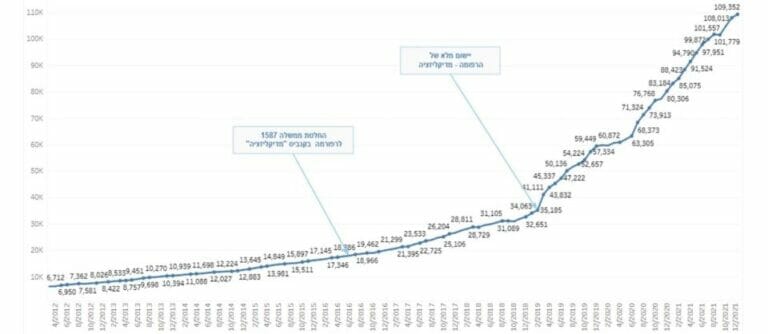
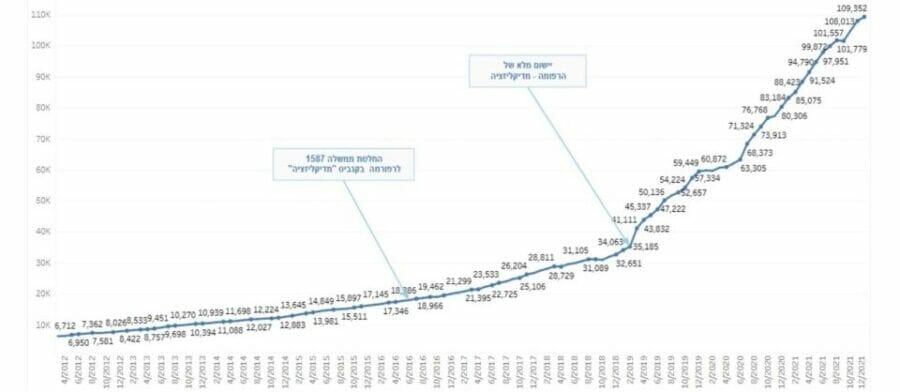
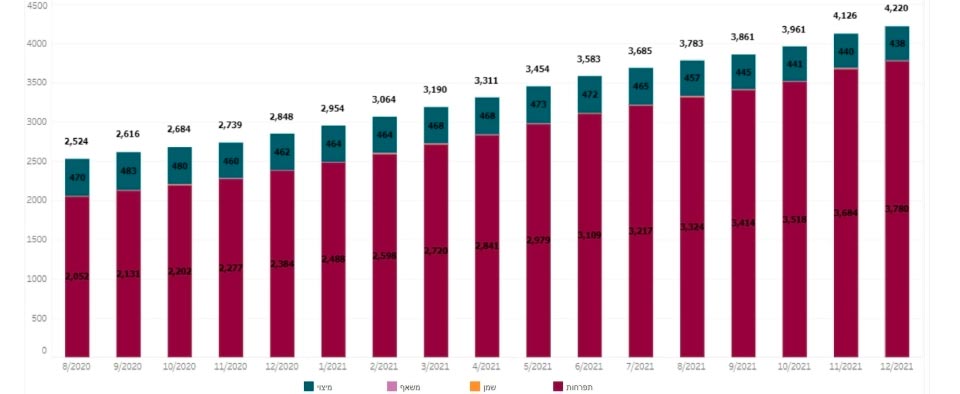
According to a recent report by Israel’s Ministry of Health, the country’s medical cannabis program onboards more than 109,000 patients and allocates more than 4.2 tons of cannabis per month, 56% of which is for “pain,” usually in amounts including between 20 and 40 grams per month.

Still more patients

The Israeli medical cannabis program continues to open up to more and more patients. The rate of increase nevertheless decreased slightly in December 2021 compared to November and only increased by around 1,300 patients, compared to an average increase of around 3,000 new patients per month during the year 2021. In total, at the end of December 2021, the number stands at 109,352 patients treated with medical cannabis in Israel.

Patients treated with cannabis in Israel

Patients treated with cannabis in Israel

In terms of the monthly amount of cannabis that patients are entitled to, it continues to increase. In December, it reached around 4.22 tonnes, of which 89.5% in flowers and around 10.5% in extraction (CBD and/or THC oil).

This is, however, eligibility data, not actual “distribution” data that the Israeli Health Ministry does not release so far. According to local sources, the actual use would represent 85% of the eligibility.

Quantities of medical cannabis available in IsraelQuantities of medical cannabis available in Israel

Quantities of medical cannabis available in Israel

The majority of patients treated with medical cannabis are for pain (56%), i.e. more than 61,000 of the 109,000 patients. In second position, an “others” section, with more than 15,000 patients, or around 15% of all prescriptions for medical cannabis. This section discusses health conditions that are not on the list of indications, without the Israeli Ministry of Health providing information about which diseases are included in this section.

Most patients, about 23% of them, hold a license for 30 grams of cannabis per month, 20% of patients hold a license for 20 grams per month and 20% for 40 grams. The rest is distributed between 50 grams (14%), 60 grams (8%), 70 grams per month (4%) and the rest with 80 grams or more.

Costa Rica: All that’s missing is the President’s signature to legalize medical cannabis

The Costa Rican Congress approved last Thursday in a second and final vote the legalization of medical cannabis and industrial hemp. The text now awaits the signature of the country’s president, Carlos Alvarado, who recently expressed doubts.

By a vote of 29 votes for and 10 against, with 39 congressmen present out of the 57 members of the Legislative Assembly, the law on cannabis for medical and therapeutic uses and hemp for food and industrial uses was approved.

The next step is for President Alvarado to sign the law so that it can enter into force, but there is the possibility of a veto or partial veto, as the Ministry of Health has expressed doubts on certain points of the law . The main questioning of this initiative by the Ministry of Health during its discussion process was that it allows the self-cultivation of people diagnosed as patients.

The lawmakers behind the law urged the president to respect Congress’ decision and ratify the initiative. On January 10, Carlos Alvarado said that once the law is passed, he will “examine the final text” with the authorities of the Ministry of Health “before making a decision”.

The law will allow Costa Rican authorities to grant licenses for the production and industrialization of cannabis for medical or therapeutic purposes. In addition, the law declares free the cultivation, production, industrialization and marketing of hemp or non-psychoactive cannabis and its products or by-products, for food and industrial purposes, without prior special or additional authorization from the authorities. .

Italy: 630,000 signatures collected for the legalization of cannabis

The Italian authorities certified last Wednesday that the popular initiative which seeks to legalize cannabis in Italy has collected enough signatures to be put to a referendum next spring. However, there is still a procedural step before the measure is officially presented to voters.

About three months after the defenders of the cause submitted the approximately 630,000 signatures, the Supreme Court of Cassation informed the campaign that it had validated them.

Now that the signatures are confirmed, the referendum will go to the separate Constitutional Court, which will determine the legality of the proposal’s provisions. This opinion will be given on February 15 and, if it is deemed legal, the government will set a date for the vote.

“While we wait for final validation… we are already beginning to organize a national mobilization to inform all citizens that cannabis should be legalized,” the campaign said in a Facebook post.

The Constitutional Court will now examine whether the measure conflicts with the Constitution, the country’s tax system or the international treaties to which Italy is attached. The lawyers are convinced that they have sufficiently limited the scope of the proposed reform to meet legal standards.

If the courts allow the referendum, voters should have the opportunity to vote on the policy change between April 15 and June 15.

What does the Italian cannabis legalization proposal contain?

The Italian proposal would completely end the criminalization of the cultivation of cannabis, but it would maintain a decriminalized fine for the possession and use of this substance.

Under this proposal, the processing of cannabis would also remain criminalized. Products like hashish would continue to be banned. Nor would there be a system for the legal and regulated sale of cannabis.

Activists were able to gather so many signatures so quickly, thanks in part to a change in policy that allowed them to collect signatures online rather than only in person.

“We believe that the fact that we were able to collect more than 500,000 signatures online in one week will be taken into consideration as a strong request to modify an unreasonable set of prohibitions in our laws,” said Marco Perduca, chairman of the committee. Referendum, at Marijuana Moment.

He added that the validation of the signature by the Court of Cassation “marks a historic event” in Italian history.

If the referendum passes, a simple majority vote will be required for it to pass.

A growing interest in Europe for legalization

Italy would not be the first European country to legalize cannabis. The smallest member of the European Union, Malta, indeed adopted this reform last month.

Germany’s new coalition government also recently unveiled some initial details about its plan to legalize cannabis, although the reform is expected to take some time to roll out.

In Luxembourg, ministers of justice and internal security unveiled a legalization proposal last year, which will still have to be voted on by parliament, but is expected to be adopted. For now, the country is focusing on legalization in a domestic setting. Parliament is expected to vote on the proposal in early 2022, and ruling parties favor the reform.

Why did Philip Morris fund Interpol?

0

It seems almost implausible, yet Philip Morris did finance Interpol through checks and even signed an agreement with the international police organization.

Inconvenient funding

Interpol is an international police organization whose head office is based in Lyon, since the idea of ​​creating such a group was originally born in France by Edmond Locard, professor of forensic medicine.

The creation of Interpol was rather tense. However, the organization was born and now has 195 member countries. Recognized for 50 years by the UN, its role is essentially the search for people by color codes: red for suspects, yellow for the missing and black for the identification of corpses. The blue code is used to obtain information, as for the green, they indicate individuals threatening public safety.

In 50 years of existence, Interpol has suffered many scandals. Judged as a poor institution with a budget of 136 million euros for 995 employees who work on 19 databases comprising a total of 66,000 active files. Countries are struggling to provide funds, which is why the organization is now appealing to private funding.

Why did Philip Morris fund Interpol?

Private financing of Interpol: an ethical problem

As an international police organization, private funding is frowned upon. In 2011, for example, that of 20 million euros operated by FIFA caused a lot of ink to flow, especially following the corruption case in which the latter was wet.

But the same year, a contract signed with Philip Morris set fire to the powder. The 15 million allocated by the tobacco company were dedicated only to the training of police officers in order to help obtain information on cigarette smuggling. It is neither more nor less than lobbying completely sweeping away the impartiality of the organization.

But that’s not all, the tobacco companies obviously supplied the traffickers themselves. Suspicion which proved to be validated by the complaint in 2020 of Raoul Setrouk having unmasked Marlboro as an actor in international traffic. However, the partnership between Philip Morris and Interpol continued until its end in 2015.

The Assembly rejects the proposal to legalize cannabis

In an almost empty hemicycle, the majority wanted to be present to oppose the text. It would be a question of not doing a task by clumsily letting pass a proposal for the legalization of cannabis which does not correspond to the political orientation demanded by Emmanuel Macron and embodied by Gérald Darmanin.

About twenty amendments had been tabled to oppose the text, including one signed by Caroline Janvier, herself a signatory of the legalization proposal. “The technique of the parliamentary group” we are whispered in the ear, by which the deletion amendments tabled in the LREM group are considered automatically signed by the deputies, it is up to them or their collaborator to withdraw their signature.

Unsurprisingly, the proposal was rejected with 19 votes in favor and 54 against, with the adoption of the amendments removing the LREM group and François Jolivet, a fervent defender of prohibition and interior policy. Fun fact: between false modesty and moral panic, his amendment took the example of legalization in the Netherlands [ndlr : qui n’a jamais légalisé] and the failure of cannabis legalization in Canada where 58% of consumers now source their supplies from the legal market.

Jean-Baptiste Moreau, general rapporteur for the information mission on cannabis, intervened to support the text.

Some will see a glimmer of hope in the response of the LREM group to the legalization proposal which “considers the legalization of recreational cannabis to be premature to date” and would like “above all to organize a societal debate on the question of cannabis, in order to consult all citizens on its legalization. »

The group also calls for in-depth work on the issue.

“If the recreational use of cannabis were considered, it would be necessary to define the desired French model of regulated legalization, which takes into account both the successes and failures of foreign experiences and the political, historical and cultural specificities of our country. This is the meaning of the report of the joint fact-finding mission on the regulation and impact of the different uses of cannabis, which draws up a list of questions that the public debate must answer in order to legalize this substance (production and distribution, status to be given to self-production, methods for setting the price, “Evin” cannabis law, reintegration of former traffickers, etc.). »

Canadians’ perception of cannabis has changed little in 2021

Canadians have roughly the same opinion on most issues related to cannabis, its use and legalization as they do in 2020, according to Canada’s latest annual report.

The “Cannabis Survey in Canada 2021” is the fifth of its kind, the first having been published at the end of 2017. The survey asks a sample of Canadians a number of questions about cannabis, such as their knowledge and skills. their views on cannabis use and cannabis laws, knowledge of legal sources, cannabis and driving, cannabis and pregnancy, home use and cultivation of cannabis, and cannabis for purposes medical among many other subjects.

Stable acceptability

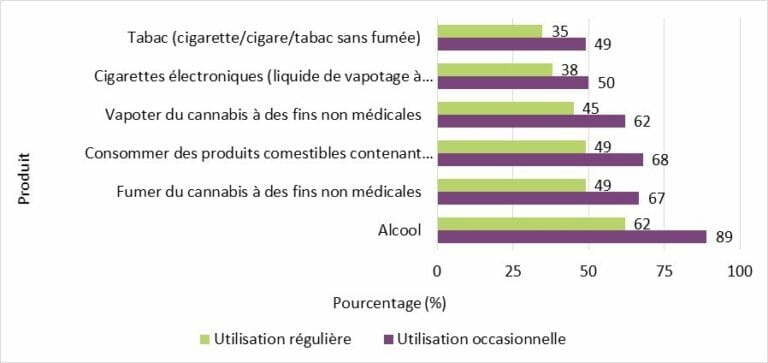
Canadians consider cannabis use to be the second lowest perceived risk, behind alcohol, but a healthier choice than smoking or nicotine. The occasional use of cannabis is also considered to be more socially acceptable than the regular consumption of alcohol. Smoking and eating cannabis is considered slightly more socially acceptable than vape cannabis. Tobacco and e-cigarettes have the lowest level of social acceptability among these three broad categories.

Acceptability of cannabis use

Social acceptability of the use of various products, among all Canadians, 2021

Overall, 89% of respondents believe that cannabis use can be addictive. The majority of people (93%) who reported using cannabis in the past 12 months believe cannabis can be addictive. A majority (88%) of those who have not used cannabis also believe that cannabis can be addictive.

A slight decrease in consumption

25% of Canadians say they have tried cannabis in the past 12 months, down slightly from 27% in 2020. Men were once again more likely to use cannabis than women, but the consumption by men declined slightly, as did consumption by Canadians aged 16 to 24.

Cannabis use by ageCannabis use by age

Cannabis use in the past 12 months, by sex and age group, 2020 to 2021

14% of Canadians aged 16 and over also reported having used cannabis for medical purposes, but only 22% said they had done so with the permission of a health care professional.

People born in Canada are about twice as likely to use cannabis as those who immigrated to Canada, and use is about twice as high among people who identify as gay, bisexual, or an “other sex” than among those who identify as heterosexual.

Those enrolled in school are more likely (35%) to report consuming than those who do not report being enrolled in school (25%). People who report having worked at a job or business in the past week or having taken a vacation are slightly more likely to use cannabis than those who do not work at a job or business (28% vs. 21%).

Canadians with a graduate degree are less likely to use cannabis than those without, 17% versus 24%.

Among those who reported consuming more cannabis due to the COVID-19 pandemic, Canadians under the age of 25 reported a larger increase in their use.

25% of people 25 and over reported using more cannabis, compared to 46% of people 16 to 19 and 40% of people 20 to 24. At the same time, 21% of people aged 25 and over reported using less cannabis, compared to 27% of people aged 16 to 19 and 25% of people aged 20 to 24.

Once again, most Canadians who use cannabis report using it less than one day per month, or 33% of users, while 19% report using it daily. 27% said they used it one to six days a week.

Most cannabis users (72%) reported being stoned or high for one to four hours in a day of use, while 15% reported being stoned for five or more hours per day when using.

All of these figures are the same or similar to those for 2020.

A later experiment

The age of initiation to cannabis has also continued to increase slightly since legalization. In a 2017 survey, the average age of first introduction to cannabis was 18.6 years. In 2020 it was 20 years old and in 2021 it was 20.4 years old.

Cannabis is also legal in different provinces at different ages, either 18, 19 or 21 years old.

Smoking remains the most common form of consumption (74%), although this is down from 79% in 2020, while vaping has increased from 24% in 2020 to 28% in 2021. edibles of cannabis was the second most popular form of use, at 54%. Those who reported drinking cannabis doubled from 2020, from 7% to 15%. 22% said they used cannabis oil or capsules, a new figure in 2021.

Among those who vape cannabis, vaporization of cannabis extracts increased from 60% to 68%, that of dried cannabis flower decreased from 65% to 54%.

Men were slightly more likely than women to use cannabis flower or concentrates, while women were slightly more likely to use edibles and topicals.

The legal market supplants the illegal

58% of Canadians who reported using cannabis said they would be more willing to disclose publicly if they used it, up from 51% in 2020.

Sources of cannabis supplySources of cannabis supply

Typical sources of supply in the past 12 months for people who used cannabis in the past 12 months, 2020 to 2021

53% said they made a purchase from a legal store, an increase from 41% in 2020. People were less likely to get cannabis from a friend or legal source online, or from a store or illegal online source or “dealer”.

Of those who reported using cannabis, 43% said they only obtained their supplies from the legal market, an increase from 37% in 2020. 63% said they never used an illicit source, compared to 55% in 2020.

A higher percentage (43%) indicated that they still source from a legal / licensed source in 2021 than in 2020 (37%). There was also a higher percentage (63%) indicating that they never source from an illegal / unauthorized source in 2021 compared to 2020 (55%).

Of those who buy from the illicit market, most (59%) say they get it from someone they know, while 20% say they get it from an illicit online store. 20% also state that they obtain cannabis from a “dealer”. Only 11% say they get it from an unauthorized retail store, although it is possible that this figure is higher because some consumers feel that the illicit stores are in fact legally operated.

The average consumer spends CA $ 40-100 per month on cannabis.

Among consumers who reported using cannabis for medical purposes, those who reported obtaining it from legal stores increased from 44% in 2020 to 53% in 2021, and those who obtained it from a online legal source increased from 23% to 38%.

In addition, 21% obtained their supplies from an approved producer through the medical system. 13% said they grow it or have it grown for them under a designated production license, as in 2020.

Of those who have obtained cannabis directly from a licensed producer, 77% say they intend to continue to do so even if non-medical cannabis stores are available.

The full study is available on the Health Canada website.