
A new report offers an encouraging picture of the current and future CBD landscape in Europe. Let’s explore how, when, and why (or why not) people consume CBD products.
CBD-infused products are popping up everywhere, from the corner grocery store to the high street pharmacy. The potential benefits of CBD are well known, but how many people actually incorporate it into their daily lives? Is there a growing appetite for CBD as cannabis (and the attitudes around it) become more unleashed?
A recent report on the CBD market in Europe and the UK reveals that CBD is now one of the most popular wellness products in Europe.
the European CBD reportreleased by industry analysts Prohibition Partners, estimates that in 2022, just under €1.7 billion worth of CBD products were sold in Europe. This figure is expected to rise to just under €2.6 billion by 2026.
What explains the success of CBD?
The authors of the report attribute the success of CBD to:
- The growing proportion of people who say they use CBD products
- The resurgence of CBD products on European shelves following the judgment of the Court of Justice of the European Union (CJEU)
- Continued sales of food and beverage products under legally “grey” conditions, as well as the expected increase towards the end of 2023, when new fully approved CBD products will be marketable
- When it comes to CBD consumption in Europe, 11% of the 5,234 respondents have used a CBD product in the last 12 months and 4% claim to have used CBD at some point in their life (but not in the last 12 months for various reasons which are discussed in more detail in the report)
Awareness of CBD in Europe is high, with just over half of respondents having at least heard of CBD products. This is likely due to increased awareness of CBD’s safety and efficacy, its inclusion in FMCG portfolios, and the growing prevalence of CBD products among mainstream retailers.
Dive into the data below and explore seven key CBD consumption trends from the report.
Which country in Europe is the first to consume CBD?
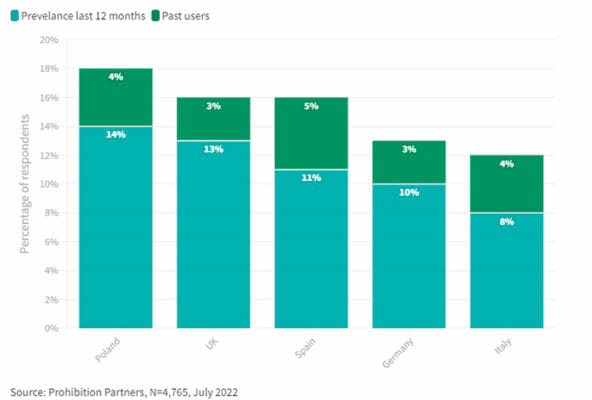
The highest prevalence of CBD use in the past year was found in Poland, where almost 15% of respondents indicated that they had used a CBD product in the past year. This fits with Poland’s evolution as a center for the production and distribution of CBD products.
CBD consumption in Europe
Italy recorded the lowest percentage of CBD consumption over the past year at 8%, but this could be explained by the fact that CBD is commonly known in Italy as “cannabis light”. and that some consumers might not recognize it as a CBD product. These results confirm that CBD is now a commonly purchased consumer product in most European countries, despite the lack of regulation and enforcement.
How many times a week do people consume CBD?
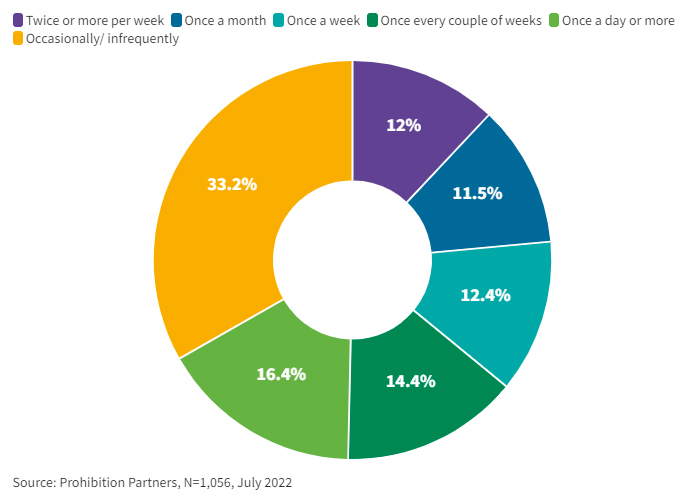
While 11% of respondents indicated that they had used a CBD product in the past year, approximately 35% of CBD consumers classified their use in the past 12 months as infrequent or occasional, that is ie less than once a month.
Frequency of CBD consumption in Europe
This figure speaks to the number of people on the continent who are, at least, curious about CBD products and willing to try them or use them for short periods throughout the year.
About 39% of consumers indicated that they used CBD once or more per week. This represents a portion of the population that has incorporated CBD products into their daily lives, often as part of their wellness routine.
How old are CBD consumers in Europe?
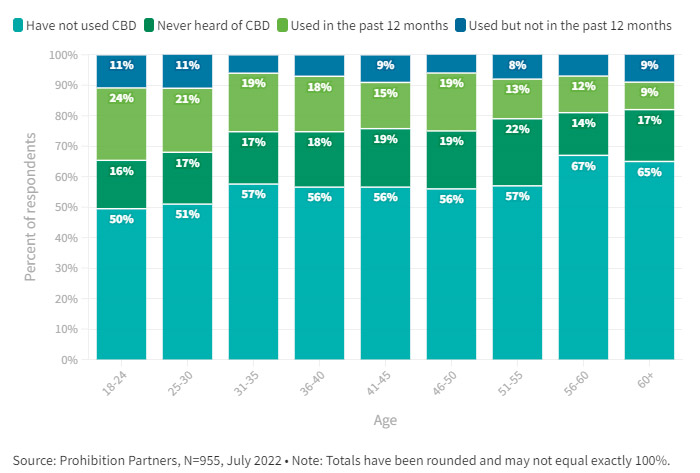
In general, CBD is more commonly consumed by the younger generation rather than those aged 50 and over. This is normal for new industries, where younger consumers are more open to trying new products, while older generations may take longer to adopt them.
Age of CBD consumers in Europe
In Europe, a respondent aged 18-24 is approximately twice as likely to report having consumed CBD in the past year as a respondent in the 50-60 age category. Also, the percentage of people who have heard of CBD is much higher for younger generations, where new trends spread faster, especially those related to wellness.
The prevalence of people who have never heard of CBD peaked in the 51-55 age category, while 18-24 year olds were the most “aware” of these products.
How do people consume CBD?
Prohibition Partners surveyed 955 CBD consumers about their buying habits to understand the current state of the market.
Overall, it’s clear that CBD oils and tinctures remain the most popular product format, with over 56% of CBD consumers last year reporting consuming both. This makes sense because oils are a familiar product format in the wellness category. The oils are also easy to dose and are commonly available throughout Europe, partly as legal ‘grey’ dietary supplements, but also as cosmetics, which can be consumed topically and in some cases ingested. like regular CBD oil.
Hemp flowers are currently the second most common method of consuming CBD products on the continent, surpassing food and beverage formats respectively. As we have seen above, CBD flowers are regulated very differently in different countries. In some, such as the UK, CBD flowers are, in theory, not marketable and especially not as a tobacco substitute, while in Italy and Spain more liberal regulations have allowed the market to “ cannabis light” to thrive.
The consumption of different CBD products varies greatly across age groups. The division can generally be traced along the lines of familiar product formats such as oils, capsules and pills more often consumed by older age groups and newer product formats on European shelves such as herbal products. plants, flowers, e-cigarettes and vapes used by younger groups.
We can expect this situation to stabilize in the coming years. As CBD flowers become a more accepted product format for consumers, and regulators are better able to distinguish between legal and illicit products, more stores will begin to carry them. New inhalant product formats such as flowers and vapes should also be appropriately regulated in future updates to tobacco regulations in Europe.
Why don’t Europeans consume CBD?
Respondents who indicated that they had heard of CBD, but had not used it in the past 12 months, were asked about the reasons for their non-use. According to the report, the main reason why people do not consume CBD products is a lack of confidence that the wellness effects, which are much talked about in the media and in the marketing of CBD, will not work for them. This may be true in many cases.
However, some factors can misinform consumers, such as lack of dosage awareness, such as when consumers try very small amounts or try for an insufficient amount of time before giving up due to lack of beneficial effects.
Price is the second most common reason why consumers do not consume CBD products. As new products hit the shelves, especially after the advent of new legal foods, the price squeeze is likely to drive down the cost of CBD products in Europe, which could encourage consumers to buy them. to try.
The following three most common reasons can all be addressed directly by the CBD industry: increased marketing of where to source CBD products, better education on the legality of CBD, and finally, better education on the latest studies on the safety and effectiveness of CBD. These initiatives would go a long way towards removing barriers to consumer entry into the market.
Are non-CBD users likely to try CBD in the next year?
All the measures that Prohibition Partners studies, after interviewing people across Europe, indicate that the number of consumers and the amount of consumption in Europe continues to increase gradually.
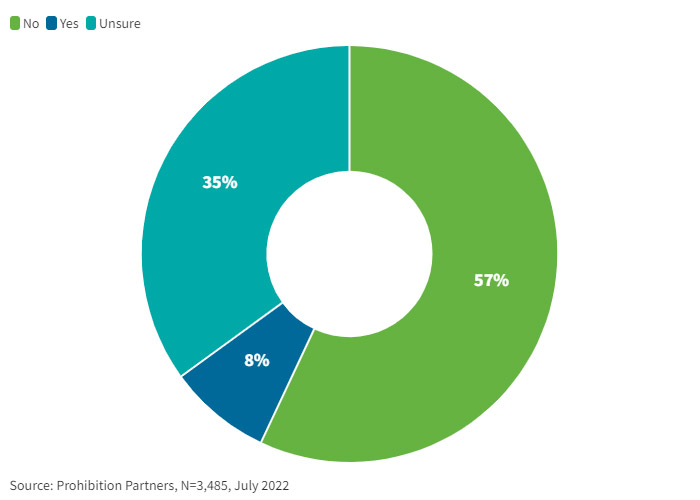
CBD non-consumers
About 8% of people who have not used CBD products in the past 12 months indicated that they intend to use them in the next 12 months. This represents a massive influx of old and new consumers into the market. This figure does not take into account the 35% of non-consumers who are hesitant to consume CBD products in the next 12 months.
Will CBD consumers continue to use it for the next 12 months?
Prohibition Partners also asked current consumers how they think their consumption will change over the next 12 months. A large number (36%) of consumers indicated that they would reduce or stop using CBD products in the next 12 months.
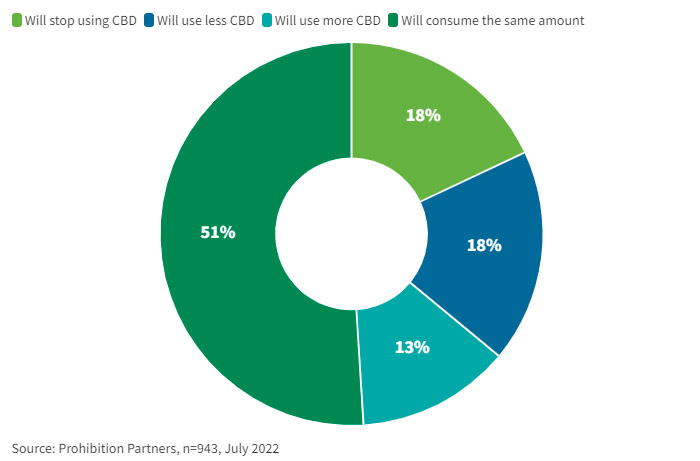
Use of CBD in Europe
This high turnover rate is manageable for now for the young industry, but deserves special attention from operators, as in the long run, reliable revenue generation and a stable consumer base will be needed to sustain the industry.
Bonus insight: CBD search trends on Google
The results show a general trend of increasing interest in CBD purchases on Google Shopping in most European countries. Some countries have peaked in recent years, such as Italy and Germany which saw their respective peaks in 2018 and 2020 although interest remains strong.
Germany is the country with the largest drop in average interest over the past three years. This data compares favorably to the same trends observed in the United States, where a sharp decline in interest in CBD has been recorded since 2019.