Home Blog Page 64

“Afghanistan, Fortress of Cannabis”: Afghanistan as you’ve never seen it

Through rare images, Lucas Strazzeri traces the history of cannabis to the present day, highlighting the influential role of Afghan practices, rites and legends. It also warns of the cultural and ecological excesses of the legal cannabis industry, while paying homage to ancestral and traditional Afghan practices. The new version of this book is available in a hardcover version in English and is sold with its digital version (e-book) in French.

“Afghani, Fortress Cannabis” is a valuable photo book for anyone interested in Afghanistan, cannabis, and the environmental issues of a growing legal industry.

With 130 photos and as many pages, it allows the uninitiated to grasp the essential notions of the history of cannabis and hashish, as well as an overview of the past and present uses of this plant. It also offers connoisseurs lexical details on common words in popular cannabis culture, and unique insights into Afghan cultural practices.

This book also aims to inform and raise awareness about the loss of ancestral varieties and the decline in cannabis biodiversity due to the sale of seeds on the internet. The reader will also find 2 interviews in the book and can listen to their audio recordings via QR codes. About thirty bibliographical references complete this work for the reader wishing to go further on these themes.

“Let’s now take a look at the history of Afghanistan, its spiritual traditions and its relations with the rest of the world, to discover how this country has influenced the evolution and consumption of cannabis until today” writes Lucas Strazzeri.

Afghanistan, Fortress of Cannabis » (128 pages) available here

Brittney Griner released from prison in exchange for an arms dealer

WNBA star Brittney Griner, after being locked up for months in Russia for 0.7g of cannabis extract, was released on Thursday in a prisoner swap for international arms dealer Viktor Bout.

Griner, who plays for the Phoenix Mercury, was arrested at a Russian airport on February 17 and later pleaded guilty to possession of cannabis cartridges in her luggage, a week before Russia invaded Ukraine. She faced 9 years in prison.

” [Mme Griner] bought two cartridges for his personal use, which contained 0.252 grams and 0.45 grams of cannabis extract, for a total of 0.702 grams,” Russian news agency TASS said. Griner was transferred to a Russian penal colony last month.

“She’s safe, she’s on a plane, she’s on her way home,” Biden said at the White House, alongside Griner’s wife Cherelle, Vice President Kamala Harris and of Secretary of State Antony Blinken.

The Russian Foreign Ministry said in a statement carried by Russian news agencies that the exchange took place in Abu-Dhabi and that Viktor Bout had been repatriated by plane.

Viktor Bout is a former Soviet Army lieutenant colonel who has been described by the US Department of Justice as one of the world’s most prolific arms dealers, including supplying arms and missiles to Afghanistan, in Colombia, Congo and against Gaddafi’s government in Libya in 2011.

The mobilization of the American government to bring back the basketball player did not fail to react given the thousands of other Americans imprisoned in the United States and elsewhere for reasons related to cannabis.

In Portland, a shop openly sells psychedelic mushrooms

A Portland herbalist openly sells psilocybin mushrooms, drawing queues of more than two hours to get your hands on several varieties of psychedelic mushrooms.

In November 2020, Oregon voters approved Measure 109, a ballot proposal to legalize the therapeutic use of psilocybin by therapists licensed by the Oregon Health Authority. The successful ballot measure is currently undergoing a two-year implementation period, with the OHA currently drafting regulations for the production, distribution, and administration of psilocybin for medical purposes.

Another ballot item passed that year, Measure 110, decriminalized the possession of small amounts of all drugs, including psilocybin, but did not legalize the production or sale of controlled substances. Under federal law, psilocybin mushrooms remain a Schedule I prohibited drug of the Controlled Substances Act.

Although the OHA has yet to license psilocybin suppliers, the Shroom House store in Portland has apparently started selling shrooms. Last week, a local TV station reported that the store owner admitted to selling psilocybin mushrooms after a former employee contacted the media about the possibility of illegal sales and distributions taking place at the establishment. .

“I was led to believe by Shroom House management that this was the first licensed and medically sanctioned place to purchase psychedelics in the state of Oregon,” Kace Colwell, the former employee, told the TV channel. “They’re breaking all kinds of laws there.”

According to local reports, to purchase psilocybin mushrooms from Shroom House, customers must provide two identification forms and complete an application to become a member of the Shroom House Society. Applicants must be at least 21 years old and complete a questionnaire on anxiety and depression, among other mental health issues. A journalist from a weekly newspaper was able to buy psilocybin mushrooms about five minutes after submitting a request.

“Please use products purchased from the Company responsibly,” reads one of the forms. “While larger doses of psilocybin mushrooms are psychedelic and will certainly impair driving, microdoses should not affect your ability to drive or perform other tasks. »

The Shroom House reportedly has a menu of mushrooms to choose from, including Knobby Tops, Penis Envy, and Albino Golden Teacher, Willamette Week noted in its article. Seven grams of psychedelic mushrooms cost between $85 and $95.

Cocaine Bear: The true story of a bear addicted to cocaine

Would a bear that swallowed a brick of cocaine go on a rampage attacking a group of rightly terrified people? This is the pitch of the film Cocaïne Bear which will be released in February 2023:

“A wacky group of cops, criminals, tourists and teenagers converge in a Georgia forest where a 500-pound black bear is on a murderous rampage after unwittingly ingesting cocaine. »

But beyond the scenario that Jean-Jacques Annaud could have written for Hyper Tension (Rank with Jason Statham), Cocaine Bear is inspired by a true story.

The true story of the cocaine addicted bear

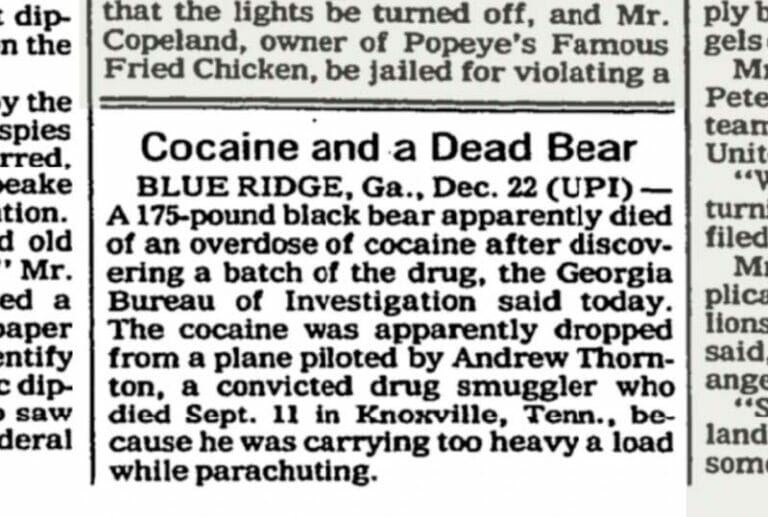
A 1985 Associated Press (AP) article, simply titled “Cocaine and Dead Bear,” reports that a 150-pound black bear died in Georgia of a cocaine overdose after consuming an unidentified amount of coke dropped from a plane piloted by a convicted drug dealer.

The original Cocaine Bear article

The original Cocaine Bear article

The trafficker died later while parachuting and carrying too heavy a load. “The call was received by an elderly man who called the switchboard to say that there was someone in his garden and that he did not seem to be moving, and that they had to send the police on site to see what was going on,” an investigator in the original case told WGN radio.

Quoting an official from Georgia Bureau of Investigation (GBI), a longer AP article describes the deceased as a former Kentucky narcotics investigator who fell to his death in Tennessee.

As for the bear, investigators were searching for the fallen cocaine in mountains nearly 130 miles north of Atlanta and just south of the Tennessee border when they discovered “a torn shipment of the scent powder and the remains of a bear”.

“The bear took care of it before us, he tore up the duffel bag, took cocaine and overdosed,” the GBI official reportedly said. “All that’s left are bones and big skin,” he noted, adding that it looked like the animal had been dead for about a month.

The duffel bag and 40 packets containing approximately one kilogram of cocaine that had been torn open and strewn on a hillside were discovered near the bear’s remains. At the time, authorities estimated the 40 kilograms of coke could be worth up to US$20 million, adding that three such discoveries involving identical duffel bags had been made in Georgia.

The bear, plane, pilot and cargo were found in various locations, the AP reports. The bear’s remains were discovered in Georgia, the smuggler’s body in Tennessee and his unmanned Cessna plane, which hit a mountain, in North Carolina.

Now stuffed, the bear, which has been named Pablo Eskobear, is a tourist attraction in Lexington’s “Kentucky For Kentucky” store.

As neighbors seek to legalize, Poland’s medical cannabis and hemp industry could also thrive in 2023

Earlier this month, Czech Drugs Commissioner Jindřich Vobořil announced his intention to submit draft legislation for an adult cannabis market by the end of the year, hoping that a full-fledged market could be launched by 2024.

The news not only placed the Czech Republic as one of the most exciting European markets to watch over the coming year, but also focused attention on the region and the potential opportunities for cannabis businesses.

If Germany and Czechoslovakia realize their ambitions of launching adult cannabis markets in 2024, neighboring Poland would share a collective 1,300 kilometer border with nations where cannabis is legal.

Although the Polish parliament’s task force for the legalization of cannabis is unlikely to pass legislation, Poland already has one of the largest medical cannabis markets in Europe and earlier this year proceeded legislative changes that should “have a significant impact on the development” of its cannabis market.

Cannabis in Poland

Cannabis for medical use was legalized in Poland in 2017 as a pharmaceutical raw material. In 2018, the first variety was approved, while Sativex, a pharmaceutical THC:CBD oil prescribed in particular in cases of cancer or multiple sclerosis, was registered in the country in 2012.

Until 2017, medical cannabis was only available through targeted import for a single patient.

Despite these changes, strict regulations and a lack of drug reimbursement, with 10 grams of medical cannabis costing between €138 and €149, have prevented the industry from thriving.

The initial ban on domestic cultivation of medical cannabis made Poland entirely dependent on imports, which repeatedly led to supply disruptions, leaving patients without access for months.

Despite this, the market continued to experience rapid growth. The first precise data on the amount of medical cannabis imported into Poland, published in early 2021, showed that imports had fallen from 66 kg in 2019 to 167 kg in the seven months to August 2020.

In November 2021, after several months of shortage, Poland received its largest shipment of 140 kg of flowers from Aurora Europe, which was reportedly consumed in just two weeks.

According to the last European Cannabis Report from Prohibition Partners, in the first nine months of 2021, Polish doctors dispensed 28,076 prescriptions to 9,261 patients, making Poland one of the largest medical cannabis markets in Europe.

Moreover, according to a study published by the National Center for Biotechnology Information (NCBI), only 8% of Polish physicians have ever prescribed medical cannabis, with 60% saying they have never received cannabinoid training, although 50% of them say that some of their patients could benefit from cannabinoid therapy.

The guidelines surrounding medical cannabis in Poland are also extremely vague, with “no official guidelines created by medical associations or government agencies to guide clinicians in implementing cannabinoids in their practice”.

Additionally, there is no “list of approved indications, contraindications, or national recommendations to define dosage,” meaning there is no upper limit to the amount of cannabis that may be prescribed to treat an illness.

This has led to a thriving black market, where medical and recreational uses intertwine.

Recent Progress

In April 2021, two new bills were submitted to the Sejm, the lower house of the Polish parliament, aiming to create a new regulatory framework for the domestic cultivation of hemp and to liberalize the cultivation and manufacture of medical cannabis in Poland. These two bills were rejected at the beginning of 2022.

Crucially, however, a separate bill was also submitted, and was eventually approved by Poland’s parliament and president, before coming into force on May 7, 2022.

This bill, which amends the law on the fight against drug addiction, authorizes the cultivation and harvesting of “non-fibrous hemp intended for the manufacture of pharmaceutical raw materials”.

This effectively enabled the cultivation and manufacture of medical cannabis, including the harvesting of the plant or resin for the production of pharmaceutical raw materials.

Founder of Polish cannabis strategy and business consulting firm Cannabis Partners, Arek Kuich, told BusinessCann that this development is “extremely important for Polish patients.”

“These changes will have a significant impact on the development of the Polish cannabis market, and in particular the medical cannabis market, and can therefore significantly increase operational capacity and development potential, especially in the field of cannabis distribution. pharmaceutical. »

Poland and hemp

Meanwhile, a second new law saw the level of THC in raw plant material drop from 0.2% to 0.3%, before possibly rising to 1%.

Arek Kuich explains that, while hemp cultivation has been allowed in Poland for some time, its use was limited to “cosmetic, food, textile and agricultural industries”.

Now the list of uses for which it can be grown has been expanded to include land reclamation and reclamation, seeds, food, veterinary care, beekeeping, fertilizers, cellulose and paper, insulation, production of composite materials, building materials and natural phytosanitary products.

“Farmers will be allowed to cultivate fiber hemp and poppy for their own needs on an area of ​​less than one hectare per year. It will also be possible to grow poppy with low morphine content and fiber hemp for your own needs. »

“A higher THC limit of 0.3% allows completely new plant varieties to enter the market. This means crops that are better adapted to the climatic conditions of different regions of Poland. »

“The new regulations will make it easier for Polish companies to carry out activities in the field of cultivation and purchase of poppy seeds and fiber hemp through, among other things, rapid registration, the lifting of the obligation to obtain an annual permit, to the lifting of area, region and time limitations in the certificate issued. »

According to Kombinat Konopny CEO Maciej Kowalski, this should see Poland’s hemp fields return to growth next year after two years of decline that have seen them nearly halve since 2020.

Medical cannabis in France: the DGS sets up a working group

After 4 years of discussions around the experimentation of therapeutic cannabis in France, and its launch almost 2 years ago, the General Directorate of Health (DGS) is setting up a working group on the continuation of the experimentation of medical cannabis.

This working group will meet for the first time on December 16, according to information from APMnews.

It provides for “an update on the status of cannabis for medical use within the European Union” as well as discussions, which should have taken place in parallel with the first phase of the experiment, “on the various possible options for an entry into common law in France at the end of experimentation”.

It will bring together experimental stakeholders and external actors involved in one way or another in medical cannabis.

For the former, there will be the Canadian cannabis producer Aurora and its French relay laboratory for experimentation Etypharm, the Canadian Tilray and the French Medipha, the Israeli Panaxia Pharmaceuticals and the French Neuraxpharm, the Australian Little Green Pharma and the French Intsel Chimos, as well as the French Boiron and the Italian Recodarti, the latter two being “only” on the list of replacements and not currently supplying any product.

According to APMnews, more or less external actors will also participate in the experiment, such as:

  • the American Curaleaf which bought Emmac in 2021, Emmac being on the list of replacement suppliers (with Boiron as a distributor)
  • the Jazz Pharmaceuticals and Almirall laboratories, Jazz having acquired GW Pharmaceuticals, producer of Sativex and Epidiolex, in 2021. Almirall is the distributor of these products in Europe. As a reminder, despite a marketing authorization in 2014 for Sativex, it is still not distributed for objectively obscure reasons while Epidiolex is only distributed drop by drop in Temporary Authorization for Use (ATU) nominative

Representatives of Leem (Medicine companies) and Gemme (Generic same medicine) are also invited, as well as members of the National Agency for Safety and Medicines (ANSM), the Social Security Department (DSS) and the Directorate General for Healthcare (DGOS).

Accessories for the maintenance of the shisha

0

Maintaining a hookah is essential to guarantee its proper functioning, but also your pleasure when using it. Here are the essential accessories to effectively clean your shisha pipe.

Specific accessories and products

The very design of the shisha sometimes makes it difficult to clean. It is for this reason that there are accessories dedicated to cleaning hookahs. They allow you to reach inaccessible corners so that your shisha is perfectly clean.

The accessories and products necessary for the maintenance of a shisha

The bottle brush

Also called a cleaning brush, the brush is essential to keep your shisha in good condition and perfectly clean. It sneaks into the smallest corners and also passes through the narrowest orifices. Its small hairs rub the walls to remove the smallest deposits. Some brush models are fixed and others are flexible to fit the shapes of the most complex hookahs.

The cleaning brush

If the brush is perfect for the vase, the cleaning brush is very useful for the chimney. Thinner, it slips ideally into the duct to rub the walls.

The sponge

The sponge is very useful for cleaning the entire exterior of the shisha, but also for cleaning the hearth. It is a detail not to forget to clean to keep a clean shisha!

Accessories for the maintenance of the shisha

Cotton swabs and cloth

Cotton swabs are ideal for cleaning small parts and pipe mouths for example. As for the cloth, it is used to wipe and remove any traces of water on the vase of the hookah.

The cleaning fluid

You can absolutely use warm soapy water to clean your shisha. However, there are also specific and organic products to remove the smallest deposits and dirt effectively. The Limpuro brand, for example, offers an organic and gentle liquid to clean the walls of your hookah.

powder cleanser

There is also cleaning powder, more economical, but just as effective. Just dissolve it in a little water and let the mixture act directly in your shisha before rinsing thoroughly with clear water.

Colombian Senate approves cannabis legalization bill

The Colombian Senate has overwhelmingly approved a bill to legalize cannabis in Colombia, although there are still several legislative steps before it can be enacted.

The bill, which also received initial approval in the country’s House of Representatives, was approved in the Colombian Senate in the fourth round of debate on Tuesday by a vote of 56 votes in favor to 3 against.

Lawmakers have met several times in recent weeks to debate the reform proposal, which would amend the country’s Constitution to end cannabis prohibition for adults. Yesterday’s vote came about two weeks after the legalization bill was passed by the Senate First Committee.

The proposed constitutional amendment, sponsored by Deputy Juan Carlos Losada, takes into account the impacts of legalization on public health and the economy, as well as the ideological principle of individual autonomy. If passed, authorities will have six months to enact rules for the adult-use market.

The legalization bill supports “the right to free development of personality, by allowing citizens to decide on the consumption of cannabis within a regulated legal framework”. And it would mitigate “arbitrary discriminatory or unequal treatment of the population that consumes”.

The bill will limit possession and public consumption in schools and certain public spaces. It also includes public education campaigns and the promotion of addiction treatment services.

As a proposed constitutional amendment, the legislation must go through a total of eight debates, spread over two separate calendar years.

In September, the Colombian president gave a speech at a meeting of the United Nations (UN), in which he urged member countries to fundamentally change their approach to drug policy and end prohibition. .

Gustavo Petro also recently raised the prospect of legalizing cannabis in Colombia as a way to reduce the influence of the illicit market. And he indicated that this change in policy should be followed by the release of those currently imprisoned for cannabis.

He also met with the Mexican President to jointly reshape drug policies.

Agrican rhymes hemp with excellence

In the heart of Weppes, 20 minutes from Lille, Agrican has settled, a cooperative of farmers and hemp workers dedicated to creating a French center of excellence around legal cannabinoids.

From the outside of the farm, there is nothing to suggest that the company grows 3,000 hemp plants in outdoors and 10,000 feet under glass. The latter benefit from top-of-the-range installations whose light support and CO2 or heating supply reproduce the growth cycles and allow 3 to 4 harvests to be made per year. Agrican now harvests 2 tonnes of flowers per year, with cultivation carried out in an organic, responsible and transparent manner.

A multi-faceted expertise

Agrican obviously pays great attention to the cultivation of hemp plants. The good growth of the plant is found ultimately in harvest and in cannabinoid levels. Once detached from their stem, slow and controlled drying perfects the organoleptic and visual qualities of the flowers before being ripened to develop their full potential.

The result is flowers that are certainly airy for those grown outdoors, hemp remains hemp, but olfactorily interesting with natural CBD levels between 5 and 10%. We will retain from our tasting:

  • Orange Bud (outdoor), whose orange flavors form a marked olfactory reminder
  • the Chocolope (greenhouse) which navigates between sweetness and coffee
  • the Orange Sorbet (greenhouse) with its pretty flowers containing 14.9% CBD, certificate in support!
  • the Gelato (outdoor) which under its purplish looks and small buds develops 10.9% CBD and powerful smells of spices and pine

However, Agrican’s agricultural expertise is not limited to a qualitative cultivation of hemp. Everything that will not be sold in the form of flowers, to specialized shops or individuals, will be ground into biomass for the extraction carried out by their partner Green Exchange Lab. This allows them to offer French CBD extracts, in crude oilin isolate or distillate, and to go as far as the manufacture of finished products such as CBD or CBG oils, vape pen or even cosmetic products, in white label or for their distribution network.

Uruguay: cannabis with 15% THC soon in pharmacies

The executive director of the Institute for Regulation and Control of Cannabis (IRCCA), Juan Ignacio Tastás, announced during the ninth edition of ExpoCannabis Uruguay that the Uruguayan government will put on sale a third variety of cannabis with a higher level tetrahydrocannabinol (THC). This new variety could be available in the 30 authorized pharmacies in the country as of December 20.

“This third variety, in a way, will have a level of THC (tetrahydrocannabinol), or psychoactive element, less than or equal to 15%; so it would be much closer to what many customers or people were asking for. This is much closer to the THC levels you can get in the clubs. It was a very important need,” announced Juan Ignacio Tastás.

When the sale of cannabis in pharmacies was launched in Uruguay, the varieties available had only 2% THC. 4 years later, Uruguay added a 10% THC strain.

Juan Ignacio Tastás also said that they are “working on a fourth variety, which could be launched around December next year” and that they are analyzing how to guarantee universal access, which could open the door to tourism. cannabis in Uruguay. Projections estimate that allowing cannabis to tourists could bring in up to 100,000 people.

“We agree 100% on the fact that there must be a regulation that is amended legislatively so that anyone in the national territory over the age of 18 can access cannabis through legal channels and reduce the market. gray that exists today,” said Gonzalo Maciel of the Ministry of Industry, Energy and Mines.

The IRCCA board member said they are looking to “simplify access to pharmacies and discuss whether or not to buy from clubs” and that these should become ” dispensaries”. This would require changing the legal form of the clubs, which are currently non-profit associations.

As for pharmacies, which will number 40 next year throughout the country, the necessary software is being designed to allow universal access to nationals, residents and foreigners.

Other novelties announced by the IRCCA Board of Directors include the opening of a seed and cuttings registry for individuals, as well as official authorization for companies that cultivate for the State to develop their own genetics, with the aim of increasing and varying the supply.