Home Blog Page 55

Med Men, the fall of a giant

MedMen, a California chain of cannabis stores once described as the “Apple weed store” and valued at up to $1.7 billion, is on the verge of financial collapse.

The company said it was left with just $15.6 million in cash versus $137.4 million in debt.

“The conditions described above raise significant doubts about the company’s ability to meet its obligations for at least one year,” the company said.

MedMen also noted that “its cash requirements are significant and cannot be met with current cash flows from operations. »

MedMen has faced a long list of challenges, from selling its Florida assets for $16 million less than the original offer to failing to sell its New York assets to multi-operator -Ascend Wellness cannabis states.

MedMen said it would delay new store openings, permanently or temporarily close underperforming stores, and conduct other restructuring activities. The company is still looking for a buyer.

Shares of MedMen (MMEN) were trading at 4 cents on the Canadian Securities Exchange on Tuesday against $8 after its IPO.

The bursting bubble?

MedMen is just the latest of the old cannabis darlings to face a difficult situation, as the industrial bubble of five years ago deflates due to excessive debt, falling prices cannabis, competition from illegal sellers and high taxes.

MedMen, based near Los Angeles, operates 23 stores, including in California, New York and Illinois. In an effort to cut costs, it sold its Florida stores last year, is trying to sell its New York stores and is also trying to renegotiate leases for the remaining stores.

Shares of other cannabis companies have also suffered from the cannabis sector’s loss of glamor with investors. The stock of Tilray Brands, a cannabis producer that is among the biggest companies in the industry, is down more than 90% from its all-time high, for example, while Canopy Growth, another major player, lost an amount similar.

Norway: towards a reform of medical cannabis?

Norway, one of the most cautious states in Europe when it comes to cannabis liberalisation, recently held a public meeting to discuss access to medical cannabis.

The event, which took place in Oslo on January 20, 2023, brought together politicians from across the political spectrum, alongside healthcare professionals, patient representatives and industry stakeholders.

According to MedCan Norway, which organized the event alongside Normal Norge and FTR Oslo, it was the first such event in the country, representing the “very first steps” towards reform.

With Norway’s first medical cannabis conference slated to take place this year and medical cannabis studies underway at Oslo University Hospital, Norway may soon be catching up with its neighbors when it comes to cannabis.

Cannabis in Norway

The small Scandinavian country, which has a population of just over 5.4 million, is one of around 15 countries in Europe to have technically legalized medical cannabis.

In 2016, the Norwegian Medicines Agency approved GW Pharma’s Sativex for the treatment of multiple sclerosis, while issuing new guidelines for a specific medical cannabis approval framework.

While it is understood that other products are available “in special circumstances”, it remains incredibly difficult for any patient to access medical cannabis.

According to an annual survey conducted by the European Monitoring Center for Drugs and Drug Addiction (EMCDDA) in collaboration with the Norwegian Institute of Public Health, just under a quarter (24.5%) of the Norwegian population aged 16 to 64 year olds have tried cannabis at least once in their life, with 5.3% reporting having used it in the last 12 months.

Another survey by Norml Norge suggested that medical users make up about 29% of the total cannabis users in the country, and only about 5.9% of them get it from their doctors, of which only 0.8 % have it delivered to a Norwegian pharmacy.

Due to difficulties in obtaining medical cannabis, 72.4% of patients obtain it on the black market, while 3.8% grow it themselves and 1.5% buy it abroad.

CBD is also classified as a prescription medicine in Norway, which means that you can only buy limited amounts of CBD on prescription, and you cannot order it privately, in the country or abroad. .

Despite this, Norway appeared to lead its neighbors in terms of drug reform in 2017, when it voted to decriminalize drugs and focus on harm reduction and treatment rather than punishment. However, these progressive reforms were then rejected three years later, in 2021.

Barriers to Access

According to Norml Norge: “Medical cannabis is technically legal in Norway, but it is extremely difficult to obtain, and doctors don’t know much about it or become downright hostile to patients seeking treatment. Therefore, many Norwegians seek treatment in the Netherlands or Denmark. »

Thomas Skovlund Schnegelsberg, CEO of Stenocare, who spoke on both panels at the recent Oslo event, says several hurdles were raised.

After chatting with one of the three politicians present about Norwegians’ state of mind when it comes to cannabis, he said he “feels that in Norway you are quickly stigmatized if you are a self-medicating patient with medical cannabis.

“If the doctors, by chance, realize that you have been self-medicating, you will actually be blacklisted, which means there will be a lot of treatment offers that you will never get. . »

Stenocare logo

Stenocare logo

He goes on to say that based on discussions among the medical professionals present, including Sigurd Hortemo of the Norwegian Medicines Agency, the body responsible for approving new products, many opinions continue to be based on research. published more than ten years ago.

A white paper published in 2012 “concluded that the side effects were too severe” because there was little research at the time “that could support that medical cannabis had utility and value”, thus the notion of reform was “completely ruled out”.

“So that’s still the starting point, ten years later, but it was also mentioned during the debate that they expected a new white paper to be published, most likely this year. Of course, it will be based on all the new research and evidence published since,” added Schnegelsberg.

Steps to progress

While the ‘sober’, ‘factual’ and ‘patient-centred’ debate clearly highlighted the problems facing the sector in Norway, it also raised hopes that change could be on the way.

MedCan Norway President Julie Welde told BusinessCann, “The situation in Norway is very unclear at the moment, and many patients are now losing their prescriptions.

“Awareness of cannabis as a medicine in Norway is generally very low, which is why it is almost never prescribed. This is what MedCan Norway wants to change”.

The group says it is working on a number of initiatives to spread knowledge to “doctors, politicians and anyone working in healthcare”, including launching more events throughout the year.

“We also anticipate and hope that Norway’s first conference focused on medical cannabis will take place in 2023.”

Oslo University Hospital has also requested funding to launch a study on medical cannabis, which could have a significant impact on prescribing attitudes in the country.


🎙️ “Let’s talk Canna! » : « Arm yourself and have the right arguments to continue » – Patrick BEDUÉ – Founder CBD Expo

The flagship CBD and hemp event, the unmissable CBD EXPO France, is organized by Patrick Bedué, entrepreneur and passionate family man. A few years ago, Patrick founded a company specializing in electronic cigarettes and his ambition only grew.

He then had the idea of ​​creating a show that would bring together professionals from the CBD and hemp sector to energize the market through conferences, meetings and exchanges. By becoming the industry’s flagship event, CBD EXPO France aims to convey an image of unwavering professionalism that can change public and government opinion.

Patrick also wants cannabis to be legalized to avoid unnecessary conflicts and for better control.

All the details in this new podcast! We wish you a very good listening!

You can find all of the Let’s Talk Canna podcasts here.

How is a shisha made?

0

If there are many brands of hookahs, all of them design their products on a more or less similar pattern. To find out how hookahs are made, follow the guide!

What is a shisha?

To begin, it is good to explain what a shisha is. This is a water pipe for smoking tobacco. Its origin comes from the Middle East and the word chicha, of Persian origin, means “glass”.

There are many models, more or less large. The shisha can be smoked alone or with others. Its originality comes from the fact that it is possible to enhance tobacco with several natural essences, such as fruits, herbs and other flavors.

The making of shisha

In the past, hookahs were all made by hand. They were therefore unique pieces, but not always optimal. Today, design techniques have evolved a lot. Some manufacturers continue to blow glass or shape certain pieces by hand, retaining ancestral know-how. Others preferred to machine their parts to optimize the quality of their products.

There are luxury hookahs, all meticulously handcrafted. They meet a very specific demand from demanding customers. On the other hand, it is easy to find miniature hookahs at very affordable prices. Between the two, several manufacturers offer very good signature hookahs, as aesthetic as they are practical.

The various elements of a shisha

The main asset of a shisha remains its glass vase. It can be declined in several different models, as well as in several colors. It is to this vase that the chicha owes its name. It must be filled with water when in use. This is surmounted by a valve, serving as a link between the vase and the combustion system.

Above the vase, the ashtray and the hearth surmount the chicha so as to allow the combustion of coal and tobacco. Finally, the shisha wouldn’t be one if it didn’t have a hose!

Comment About How is a shisha made? Below ..

Soon coffeeshops in California?

Amsterdam’s coffeeshops, both places of sale and consumption of cannabis but also of drinks and food not necessarily infused, have always been the envy of people. From there to give ideas to California?

A California lawmaker has proposed allowing the state’s cannabis “consumer lounges” to sell freshly prepared food and drink and to host events. The measure, Assembly Bill 374 (AB 374), was introduced last week by Democratic Assemblyman Matt Haney.

Bill provides new opportunities for consumer fairs

According to California law, cannabis parlors are not allowed to sell freshly prepared edibles to their patrons. A rule change passed in November 2022 allows salons to offer pre-packaged food and beverages and customers to bring their own freshly prepared products, but businesses themselves are barred from serving most non-food products. -infused to their customers.

“A lot of people want to enjoy legal cannabis in the company of other people. And a lot of people want to do it while sipping coffee, eating a scone or listening to music,” Mr. Haney said in a statement.

“There is absolutely no good reason, from an economic, health or security point of view, for the state to make this illegal. If a licensed cannabis retail store also wants to sell a cup of coffee and a sandwich, we should allow cities to make that possible and stop holding back these small businesses. »

The bill would not allow cannabis parlors to sell alcoholic beverages. Additionally, Haney noted that the proposal is limited to licensed consumer lounges and does not allow other types of businesses to enter the legal cannabis market.

“To be clear, we’re not saying cafes should be allowed to sell cannabis,” Haney said. “We say cannabis stores should be allowed to sell coffee. It should not be illegal for an existing cannabis business to restrict itself to the sole sale of cannabis and have the opportunity to grow, prosper and create jobs by offering coffee or live jazz. »

In Washington, a bill wants to index taxes on the rate of THC

Cannabis taxation is a cornerstone of regulations. Generally indexed on the quantities of cannabis sold between producer and wholesaler and/or directly on retail purchases, taxes are used to finance regulation. The sums generated are then reinjected into the state education system, roads, real estate programs or reintegration initiatives.

A proposed bill in Washington state would dramatically increase the tax on cannabis products based on THC concentration. Under the proposal, cannabis excise taxes would be restructured into three rates based on product type and THC concentration.

According to the bill:

  • a 37% tax would be imposed on flowers and concentrates with a THC concentration of less than 35%
  • a 50% tax would be added to flowers and concentrates with a THC concentration between 35 and 60%
  • and a 65% tax would be included on sales of flowers and concentrates with a THC concentration above 60%

The measure would also limit the purchase of products with a high concentration of THC to people aged 25 and over.

Republican Rep. Kelly Chambers said that since Washington state legalized cannabis for adults a decade ago, “the market has driven demand for more potent products.”

“So that’s why they’re very popular, and why they exist. At the same time, we want to maintain public safety. she explained to FOX 13

Adan Espino, Executive Director of the Craft Cannabis Coalitionsaid the high taxes give the organization “heartburn and worry” because they might just push people into the unregulated market.

He noted that high-THC cannabis products “should not be in the hands of young people or minors and…when used inappropriately…can certainly cause harm.”

The proposal is currently under review by the House of Representatives Committee on Controlled Substances and Gaming.

Why is Captain Zig Zag an icon of stoners?

The tobacco industry has the Marlboro cowboy. Cannabis lovers have the Zig-Zag zouave.

Over the years, Zig-Zag rolling papers have become synonymous with a smooth, slow burning experience. You know exactly what time it is when your friend pulls out the iconic bright orange wrapper with the mustachioed man on the front. But have you ever wondered who this man is and where he comes from?

A brief history

To understand the Zig-Zag man, aka Captain Zig-Zag, let’s go back to the origins of the brand. Founded in 1855 by Frenchmen Maurice and Jacques Braunstein, the Zig-Zag brand introduced a convenient new way to roll tobacco products with specially designed paper.

The duo quickly found success and, in a few years, they managed to perfect a packaging process that allows the papers to automatically come out of a booklet, one by one, in the shape of a “z”: hence the name Zig -Zag. The brand then patented the process and this invention earned it a gold medal at the Universal Exhibition in Paris in 1900.

However, its slim design and ingenious packaging weren’t the only things that caught the eye – many wondered who the dashing man was on the cover of every rolling paper brochure.

The truth is that the Zig-Zag Man himself is part of folklore. Legend has it that Captain Zig-Zag, a Zouave soldier, was in the midst of battle when his clay pipe was pulled and broke in his hands. Seriously in need of a smoke, he decided to try rolling tobacco using a piece of paper torn from a musket cartridge. Little did he know that at the headquarters of Sevastopol, his most prized achievement would be rolling the cigarette that inspired a whole generation of smokers.

The Zig Zag Zouave

The Zig Zag Zouave

Thanks to the slow combustion of the leaves and their ease of gluing, Captain Zig-Zag has made cannabis history with a very well-known brand among stoners. As the brand experimented with other looks and figureheads, the famous bearded man became an integral part of its image and success.

The ZIG ZAG sheet is made of a natural gum arabic. Hemp and linen are the two components of this sheet, guaranteed without any chemical agent.

The Evolution of Captain Zig-Zag

With over 140 years under its belt, Captain Zig-Zag has gone through many iterations and been transformed over and over until it got the iconic neon look we know and love. Let’s take a closer look at how he became the charming and almost hip captain of today.

1879

Although the company was founded several years ago, the Zouave soldier we know as the “Zig-Zag man” did not appear on the packaging until 1879. The intricate image paid homage to the ever-full soldier of resources that inspired a DIY movement.

1894

The year that changed everything: In 1894, the Braunstein brothers perfected and patented their “z”-shaped packaging method. They call the new product “Zig-Zag” in reference to the unique shape that the intertwined papers take when extracted from the packaging. Still in use today, each booklet is made using the same revolutionary process.

1900

In 1900, Zig-Zag papers achieved international fame when they received a gold medal at the Universal Exhibition in Paris. Six years later, Zig-Zag is registered as a trademark and is enjoying success in almost every corner of the world.

1966

In the classic form of “do first, ask forgiveness later”, the Zig-Zag logo is used to design a poster for a show in San Francisco at the Avalon ballroom for Big Brother, The Holding Company ( Janis Joplin), and Quicksilver Messenger Service in the summer of 1966.

Although the creators of the poster didn’t bother to get official copyright clearance, they did take the time to include a quote at the bottom of the poster: “What you don’t not know about copying and duplicating will not hurt you. » Lesson learned.

1969

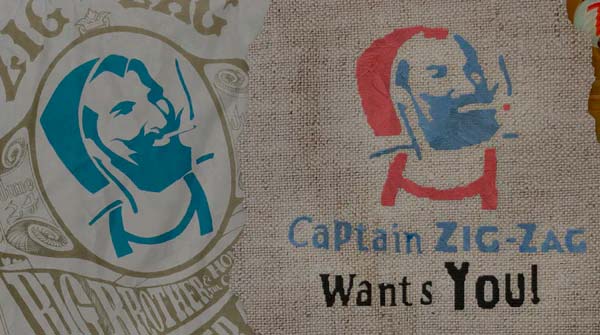
In 1969, the Captain Zig-Zag campaign was created and our captain was born. Depicted similarly to the Uncle Sam propaganda poster, the Zig-Zag Man poses with the quote “Captain Zig-Zag Wants YOU!” » below. While the campaign didn’t last long, Captain Zig-Zag’s name stuck around for good.

Captain Zig ZagCaptain Zig Zag

Captain Zig Zag

1986

In 1986, the Bolloré group bought Zig-Zag, among other things, which it sold in 2000 to Républic Technologies.

1992

To cement their place in pop culture, Dr. Dre released his first solo album “Chronicle” with a tribute to the Zig-Zag rolling paper on the album cover. The image shows a depiction of himself in the golden frame of Zig-Zag, ready to smoke from the Chronic.

Dr. Dre and Captain Zig ZagDr. Dre and Captain Zig Zag

Dr. Dre and Captain Zig Zag

2020

Today, Zig-Zag proudly sells a wide range of rolling papers and smoking accessories, with the same ingenious soldier drawn on every pack. He now appears to be sporting a slouch beanie and an impressive mustache, clearly trying to fit in with his new circle of stoner friends – but no matter what he wears or how he styles his facial hair, we still know his face represents nearly 150 years of quality rolling.

High Tide and Sanity Group join forces to legalize cannabis in Germany

Sanity Group, one of Germany’s largest cannabis companies, has reached an agreement with leading North American cannabis retailer High Tide.

The non-binding letter of intent aims to “leverage the synergies between the two complementary businesses and position each of them to take advantage of the potential legalization of cannabis in Germany in their respective vertical supply chains”, announced High Tide in a press release.

He continued, “Sanity Group and High Tide intend to work together on go-to-market strategies, identifying quality M&A opportunities, sourcing quality real estate, expanding into European markets and regulatory compliance topics such as licensing and government awareness. »

Raj Grover, President and CEO of High Tide, said: “We want to be well positioned to bring this success to the German market, should the government pursue its publicly stated goal of legalizing cannabis for adult use. »

“That is why we are proud to partner with a leading player in the German medical cannabis space like Sanity Group, especially since our business models are complementary in nature. »

Finn Hänsel, Chairman and CEO of Sanity Group, said: “We are very excited and proud to lay the foundations for a strong and trusted partnership in the event of the legalization of recreational cannabis in Germany with a leading player like High. Tide through this Letter of Intent. »

“High Tide has extensive experience and expertise in building retail cannabis brand strategies like no other player. We strongly believe in the mutual value of this partnership. »

The agreement calls for the company to work together on:

  • Market access strategies
  • Identifying merger and acquisition opportunities
  • The search for real estate
  • Expansion into other European markets
  • Regulatory compliance issues, such as licensing and government awareness

Japan to legalize medical cannabis

The Japanese government is set to allow the medical use of cannabis to treat patients with incurable diseases, according to outlines of the bills revealed last week in Japanese media.

The Japanese government plans to submit several bills, including one to revise the cannabis control law, during the current session of the Diet, Japan’s legislature.

The first intentions of legalizing medical cannabis in Japan only concerned the authorization of Epidiolex, a pharmaceutical CBD oil prescribed for childhood epilepsy refractory to usual treatments. In December 2022, Epidiolex also entered phase III of a clinical trial with 84 participants, in order to test the efficacy and safety of the drug.

Epidiolex has been approved by the US FDA and European health authorities.

The proposed revision would also criminalize the recreational use of cannabis, which is not criminalized today under an original provision of the Cannabis Control Act that did not punish consumption in order to protect growers from hemp who could involuntarily inhale psychoactive substances from the crop. The possession, sale and cultivation of cannabis for recreational and medical purposes is illegal, however.

By cracking down on the recreational use of cannabis, the Japanese government wants to prevent its growing use among young people.

CBD, a market of hope

In parallel with this medical reform, the CBD market is developing rapidly, with a turnover of around €120 million in 2022.

Currently, products containing CBD, extracted and manufactured only from the mature stems and seeds of the cannabis plant, do not fall into the legal category of cannabis, and therefore can be manufactured and sold in Japan.

When importing CBD products, the importer must nevertheless prove that they do not contain THC and that they are extracted only from the stem and the cultivated seeds. Moving from regulations based on plant parts to regulations based on extract composition would immediately widen the potential gateway for CBD imports and provide new market opportunities.

While CBD oils are the most popular formats of healthy forms of CBD consumption, vaping is the most popular format in Japan. Their popularity is attributed to Japanese e-cigarette regulations, where vapes containing nicotine are prohibited by law. Liquids containing CBD provide the sensation of vapor inhalation without prohibited ingredients.

Topicals are also good entry products in Japan, as Japan has a massive skincare market.

Australia to allow prescription of MDMA and psilocybin

In Australia, licensed psychiatrists will be able to prescribe MDMA and psilocybin, the active ingredient in magic mushrooms, from July 2023.

There Therapeutic Goods Administration (TGA), which regulates medicines in Australia, will allow the prescription of MDMA for the treatment of post-traumatic stress disorder and psilocybin for treatment-resistant depression.

“These are the only conditions for which there is currently sufficient evidence of potential benefits in some patients,” the agency said.

The amendment follows substance reclassification requests made to the TGA, extensive public consultation and an expert panel report.

This change means that MDMA and psilocybin, which were previously Schedule 9 prohibited substances, will now be considered Schedule 8 controlled substances when prescribed by a psychiatrist. In all other cases, such as recreational use, they will remain Schedule 9 drugs, except in provinces where they are decriminalized.

“This decision recognizes the current lack of options for patients with specific, treatment-resistant mental illnesses,” the TGA said. “It means that psilocybin and MDMA can be used for therapeutic purposes in a controlled medical setting. However, patients may be vulnerable during psychedelic-assisted psychotherapy, necessitating controls to protect these patients. »

Prescribing psychiatrists will need to be licensed under the TGA’s Authorized Prescriber Program and receive approval from a Human Research Ethics Board.

Although there are currently no approved products containing psilocybin or MDMA, psychiatrists will be able to access and legally supply specified “unapproved” medication containing these substances.

Stephen Bright, the charity’s director Psychedelic Research in Science and Medicinetold the Sydney Morning Herald that the announcement “was unexpected given that Australia is such a conservative country”.

“The details provided so far by the TGA are slim. There are no products available, and apart from me and a handful of colleagues, there is no one trained to provide the treatment. We are waiting for a bit more information, to get an idea of ​​what this looks like in practice,” he added.

Early last week, it was announced that the Swinburne University of Technology, a Melbourne-based public research university, had signed a psychedelics research agreement. According to Swinburne, the trial will be the largest in Australia to study psychedelic mushrooms and treatment-resistant depression. Approximately 160 patients will participate in a randomized controlled trial of psilocybin-assisted psychotherapy versus placebo.

“Psychedelics could transform the treatment landscape for many psychiatric disorders, including major depression,” Professor Susan Rossell said. “We have the opportunity to make a substantial difference and for Australia to lead the way in psychedelic research.”