Home Blog Page 47

Spain Reaches Agreement on Future 1% THC Hemp Regulation

In the absence of an agreement for the immediate regulation of light cannabis in Spain, the Spanish Workers’ Party (PSOE) has managed to get an initiative approved in Congress which opens the door to future regulation of cannabis at less than 1% THC.

Although the initial objective has been considerably reduced, the initiative will allow the development of a clear framework for the “production, marketing and consumption of products” derived from the whole hemp plant in Spain.

Finally regulate CBD hemp in Spain

The final text will have to regulate all the aspects that affect the activities of the production cycle of non-psychoactive cannabis, as well as the regional legislation on agriculture, developing in a more precise way the European directives for the cultivation of industrial hemp.

According to Lucía Muñoz, deputy of the UP quoted by Europa Press, “the prohibition of this non-narcotic cannabis is equivalent to the prohibition of non-alcoholic beer and harms the competitiveness of Spanish agriculture. »

The text adopted by the Congress launches work to define a clear framework.

It thus calls for “progress in promoting the regulation of industrial hemp in order to provide legal certainty to the production, marketing and consumption of products derived from it, while respecting the competences of the autonomous regions and the principle of subsidiarity in terms of the protection of public safety, health and agriculture”.

It also asks the Spanish Agency for Medicines and Health Products “to indicate the existing position and the possible consequences of non-compliance with the judgment of the CJEU of November 19, 2020” – called in France the Kanavape case – concerning exceptions in the hemp market, which allow the marketing of all parts of hemp.

And from there, the agreed text calls for “establishing in a future regulation of industrial hemp the limitation of the percentage of THC that guarantees the absence of narcotic effects, as well as a higher crop yield and their sustainability in accordance with the European Green Deal; which, if this were not done, would force us to operate in this market at a distinct disadvantage compared to other countries around us”.

It also asks to “clarify the full competence of the authorities competent in agriculture for the cultivation of hemp and, in particular, for the processing of declarations relating to the cultivation of hemp for industrial and horticultural purposes”.

He adds that it will not only be about its industrial uses, “but also the production and trade of all parts of the hemp plant, including the flowering tops without narcotic effects, for commercialization or for the extraction of its non-narcotic cannabinoids such as CBD”.

Finally, it invites the Spanish government to “harmonise the process of inspection, control and analysis of the cultivation of products derived from hemp by the competent authorities” and to “be attentive to the progress made at European level to implement diligently a legal framework on all foods derived from hemp, including those containing CBD and other cannabinoids that do not have narcotic effects, taking into account, where appropriate, authorization processes for new food” .

Mike Tyson opens his coffeeshop in Amsterdam

Since the end of March, Amsterdam has had a “new” coffee shop. The Softland coffee shop is now called the “TYSON 2.0”, in reference to the line of cannabis products of its owner, Mike Tyson.

According to the press release, the coffee shop will feature “a selection of TYSON 2.0 branded products, accessories and other innovative products, as well as an upscale consumer lounge.” The opening of the café and lounge in Amsterdam marks the company’s first entry into Europe, furthering the rapid growth and success of the brand.”

Remarkably, they also talk about TYSON 2.0 branded products. As noted CannabisIndustry.nl, it is not possible to legally import products containing THC from the United States. It would certainly be possible to do this illegally, but that does not seem very smart for a legal American company.

The facade of Mike Tyson's coffeeshop

The facade of Mike Tyson’s coffeeshop

Anyway, the CEO reveals in the press release that “Amsterdam is a city with a very rich culture that has turned it into one of the top destinations in the world, with more than 18 million tourists who visit it every year.

“TYSON 2.0 Coffee celebrates our journey and marks an important milestone for the company as it expands its international presence beyond North America into the growing European market,” said Adam Wilks, CEO of TYSON 2.0. . “We look forward to bringing the TYSON 2.0 brand and lifestyle to Amsterdam and serving our European fans with the cutting-edge products we are known for. »

The press release states that the new TYSON 2.0 Coffeeshop, with an area of ​​1,200 m², will be one of the largest of its kind and that it is located Spuistraat 222close to Soho House and the W Hotel, and a short walk from Central Station.

Decked out in the brand’s signature red and black, with brick walls and light oak furniture to create a warm and welcoming atmosphere, the coffee shop will also include a lounge where customers can experience the TYSON brand and product range. 2.0. The store will also include a glass bar designed in collaboration with TYSON 2.0 partner Stündenglass, and customers will be able to purchase Futurola, Gpen and Stündenglass products on site.

“It’s a dream come true to open our first coffee shop in Amsterdam,” revealed Mike Tyson, Co-Founder and Chief Brand Officer of TYSON 2.0, in the press release.

“The TYSON 2.0 Coffee Shop will immerse fans in a complete experience where they can enjoy my favorite TYSON 2.0 products like I do. I’ve tried and tested them all and can’t wait to share some of my most beloved and undefeated products with Europe. »

Only one month left before Cannabis Europa!

The living room European Cannabis London will be held in four weeks, at a time when there is a lot of interest in the emergence of a potential European cannabis market.

Changing attitudes towards cannabis, economic forces and heightened sensitivity to social justice issues are just some of the factors that are rocking the legalization of adult use in Europe.

Sales of legal cannabis for adult use in Europe could reach 1.6 billion euros by 2027 if Germany legalizes the sale of cannabis, and taking into account cannabis regulations in the Czech Republic, Switzerland and the The Netherlands.

Over the same period, the medical cannabis patient population is expected to grow in countries such as France, the UK and Poland, bringing the total number of medical cannabis patients in Europe to around 1.43 million. , an increase of 234% over the forecast period (2023-2027).

It is in this context that Cannabis Europa, Europe’s leading cannabis policy event, returns to London on May 2 and 3, 2023, at the Barbican Center in London. The annual event will bring together over 1,500 policymakers, industry operators, investors and advocates from over 37 nations to discuss the state of the industry and the global opportunities emerging in the region.

Dorien Rookmaker, MEP from the Netherlands, who will participate in the EU Better Believe It roundtable, stressed that there are big questions ahead for the sector. “The increasing legalization of the medical and recreational use of cannabis has created enormous opportunities around the world. International standards and better legislation are of great importance. What are the next steps ? »

Cannabis Europa will analyze the key market growth drivers, as well as the upcoming opportunities and challenges. Chief among them is the timing of legalization in Europe and how the regulations will impact the speed and growth of the market.

“Even though it seems slow, Europe is about to create a new way of dealing with cannabis – fair, accessible, but still highly regulated,” said Dirk Heitepriem, vice president of the German Association of Cannabis. cannabis industry, who will speak during the “State of the Art Session: Germany”.

The European cannabis market has always been stricter than the US market in terms of product diversity and access, even for medical use, and this is unlikely to change, even if the laws surrounding the substance evolve for security reasons. Despite this, combined sales of CBD, medical cannabis and adult cannabis will reach nearly €6.5 billion by 2027, according to the latest report from Prohibition Partners, the group behind Cannabis Europa.

“Prohibition seems to have completely failed the cannabis industry and the market has not only stabilized but is also growing. This is why we must find better control instruments. A strictly regulated market can regulate what is produced, where, by whom and how much is sold. A total ban cannot do that,” says Czech national drug coordinator Jindrich Voboril. “A regulated market has a greater potential for preventing damage”.

The two-day program will feature a prestigious group of advocates, innovators, policymakers and investors who will engage in meaningful conversations about how to move this market forward.

You can enjoy a discount on your entries with the following codes:

  • 15% VIP Ticket Discount: NEWSWEED15
  • 10% Standard Ticket Discount: 10NEWSWEED

To find out more about Cannabis Europa and to register for the event, you can visit their website at the following address: www.cannabis-europa.com

Why go to Cannabis Europa?

Cannabis Europa brings together on stage some of the most prominent voices in the global industry, the leaders and pioneers shaping the future of cannabis in Europe.

Since 2018, Cannabis Europa has been Europe’s premier cannabis event, attracting over 1,500 attendees from over 37 countries for two days of industry information and networking. At this event, attendees have a unique chance to connect with influential leaders of successful cannabis companies, investors actively working in the market, and important policy makers.

This powerful combination of industrial expertise, financial acumen and political influence is precisely what the European cannabis industry needs to move forward.

NBA to stop testing players for cannabis for 7 years

There National Basketball Association (NBA) has reportedly removed cannabis from its list of banned substances and will no longer test players under a new seven-year collective agreement.

This decision, first reported on Saturday by American journalist Shams Charania of The Athletic And Stadiumcontinues the league’s decision to temporarily suspend cannabis testing for the past three seasons.

NBA commissioner Adam Silver indicated in late 2020 that this policy could become permanent after the league suspended cannabis testing when players were playing in a quarantined “bubble” in Orlando at the start of the coronavirus pandemic. coronavirus.

“We decided that, given everything that was going on in society, all the pressures and stress players were under, we didn’t need to play Big Brother right now,” he said. at the time. “I think society’s view of cannabis has changed to some degree. »

Rather than imposing widespread testing, the commissioner said the league would target players who show signs of problematic addiction, not those who “use cannabis on an occasional basis”.

According to Charania, “NBA players will no longer be banned from cannabis under the new seven-year collective bargaining agreement. He was removed from the drug testing program, a process that began in the 2019-20 season,” he reported.

The NBA and the National Basketball Players Association announced earlier Saturday that they “have reached an agreement in principle on a new collective bargaining agreement, pending ratification by players and team governors”, but details will not be released until that a term sheet be finalized.

Germany would not fully legalize cannabis after all

Health Minister Karl Lauterbach wanted to legalize cannabis as soon as possible. Now, the leadership of the Social Democratic Party of Germany (SPD) admits: this will probably not happen for some time, the obstacles in Brussels being apparently too great.

German authorities are therefore reportedly planning to proceed with a scaled-down version of cannabis legalization, having abandoned – at least for now – a more ambitious proposal that would have paved the way for the legal sale of cannabis across the country.

Light legalization of cannabis in Germany

” We are on the right path. We have revised the proposals a bit,” Lauterbach said in brief comments on Friday, according to the Zeit. He added that he would “soon” return to the European Union (EU) with a “good proposal” that protects the general health and safety of young people.

The new plan is a two-part model that appears to be an attempt by German officials to legalize cannabis as widely as possible without going against EU rules.

First, the policy change would allow limited cannabis sales in certain areas – akin to a local pilot program like in Switzerland or in some way the Netherlands – for a period of four years. This would allow officials to see the impact of the reform both in large cities and in more rural areas. If the program is considered a success, it could be extended to other regions of the country.

While this part of the proposal will be subject to scrutiny by the European Commission, Mr Lauterbach’s plan would also allow Germans to grow their own cannabis for personal use, confirming rumors that cannabis will soon be decriminalized in Germany. This change would not require the green light from the EU.

Details of the home cultivation rule have yet to be finalized, but reports indicate that consumers could be allowed to own 20 to 30 cannabis plants under the proposal. In addition, non-commercial growers could then organize and distribute cannabis among themselves through Cannabis Social Clubs as already exist in Spain.

Proponents of legalization in Germany said on Friday they were eager to hear more about Mr Lauterbach’s proposal.

” Finally ! Kristine Lütke, a member of the German parliament and spokesperson for the Free Democratic Party on drug addiction and drug policy, wrote on Twitter: “I am really looking forward to hearing more about Mr. Lauterbach’s proposal. “I’m really looking forward to knowing the exact details! »

A failure of legalization not yet recorded

All these measures are far from corresponding to the initial plan of the traffic light coalition, which was to completely legalize cannabis in the short term. For some time, there have been signs that this project would encounter obstacles in Brussels. With its decision, the SPD leadership now admits that these obstacles are probably too great and therefore no legalization is to be expected soon.

“Our goal remains full legalization which also covers cultivation and distribution in accordance with European law. We support the federal government in taking the necessary measures,” underlines the SPD. Minister Lauterbach actually wanted to present a law at the end of March for the legalization of cannabis throughout Germany, for which he had already presented basic information. The draft was then to be sent to the European Commission in Brussels for review.

With such regulations, the German government wanted to go beyond the simple decriminalization that other countries have introduced. However, it has always been considered uncertain whether the German project is compatible with an EU framework decision. This obliges EU member states to criminalize the illegal trade in drugs such as cannabis. After a visit to Brussels, Mr. Lauterbach recently reported very good feedback.

The Ministry of Health told the Spiegel that consultations on the planned bill had not yet been completed. Lauterbach wants to stick to “full legalization”.

Marlène Schiappa will be on the cover of High Times Magazine

The French Secretary of State for the Social and Solidarity Economy and Associative Life, Marlène Schiappa, will certainly make the headlines by appearing on the cover of High Times Magazine, a very popular magazine among lovers of cannabis.

But rather than talking about dabbing or rolling donuts, Marlène Schiappa wants to use this platform to discuss more pressing issues such as human rights, the right to health and medical cannabis, and the need to legalize cannabis in France.

A disturbing one

Schiappa’s appearance on the cover of High Times magazine has caused a stir in the political arena, as some politicians consider it an unconventional move by a government official. However, Mrs Schiappa is determined to use the occasion to promote the legalization of cannabis, citing the catastrophic record of Gérald Darmanin, the Minister of the Interior.

In the interview she gave to the magazine and which we were able to consult, Ms Schiappa stresses the importance of respect for human rights, in particular with regard to drug policies. She also stresses the need to make medical cannabis accessible to those who need it, pointing out that cannabis has been proven to have therapeutic properties that can help relieve pain and other medical conditions.

Additionally, Ms. Schiappa says legalizing cannabis can have many benefits for the economy and society as a whole. She believes that the legalization of cannabis can create jobs and generate tax revenue, which can be used to fund essential social services, and thus better fight against drug trafficking while letting people consume healthy products and cultivate their cannabis. if they want.

Ms Schiappa’s appearance on the cover of High Times magazine is a bold move that has sparked a much-needed conversation about drug policies in France. Although some may view her actions as controversial, it is clear that Schiappa is passionate about promoting the rights of all citizens and creating a better future for France.

“If Marlene is going, it’s because the President has authorized her. From now on, I am moreover in favor of the legalization of cannabis in France” confides Eric Poulliat, initiator of the recriminalization of cannabis in France a few years ago with the fixed fine for the offenses of simple use of narcotics, which ended in a sad failure.

The appearance of Marlène Schiappa on the cover of High Times magazine is an important moment for the cannabis legalization movement in France. By using her political aura to discuss important issues, and thus join Malta, Germany, the Netherlands, Switzerland or Luxembourg in their advances in the regulation of cannabis, Marlène Schiappa challenges traditional attitudes to the on drug policy and advocates for a more progressive approach.

Lausanne will legally sell cannabis from September

The third Swiss pilot test, the aim of which is to experiment with the legal distribution of cannabis in certain Swiss cities, will therefore see the light of day in Lausanne from September 2023.

The Lausanne project for the regulated sale of cannabis, named “Cann-L”, has received authorization from the Federal Office of Public Health, thus joining the projects already validated in Basel and Zurich.

1,200 people, who are already cannabis users and live in Lausanne, will be able to take part in this trial in the Vaud capital. The products will be available in a single point of sale and without medical connotation.

“After the Cantonal Ethics Commission, the authorization of the OFSP marks a major step for our project”, commented Emilie Moeschler, in charge of social cohesion for the city of Lausanne, quoted in the press release. She added that the concrete phase could now start with, as a first step, the launch of registrations.

Necessary for the study, the “local and organic” cultivation of plants can also begin. The first harvest will take place during the summer before they go on sale by September.

These products will be intended “for personal consumption and in the private sphere”, underlines the capital of the canton of Vaud. And to recall that it seeks to study, via this pilot project, “the effects of the regulated sale of non-profit cannabis on the behavior of consumers as well as its impact on the illegal market. »

In Basel, the study on the regulated distribution of cannabis started at the end of January for just under 400 participants. Cannabis is available in pharmacies there.

The Zurich project, which will begin in mid-August, provides for the sale of cannabis in 21 points of sale, including pharmacies, Social Clubs and a drug information centre.

Cann-L’s approach complements those of Basel and Zurich. “All of these projects will feed the reflections on the evolution of federal legislation in the field of cannabis”, indicates the City of Lausanne. Other tests elsewhere in Switzerland could be added to this list, in particular in Vernier in the canton of Geneva.

5 good practices implemented by Naturalpes to combine ecology and economy

Naturalpes, a pioneering company in Switzerland in the production and processing of CBD cannabis, recently obtained B-Corp certification, thus rewarding its deep commitment to ecology and its desire to put the environment at the heart of its concerns, even before its economic imperatives.

By adopting five rules that put ecology before economy, Naturalpes is paving the way for sustainable business practices, hoping to inspire other companies in the sector to do the same, to protect plants, people and the planet.

The first rule put in place by Naturalpes is to give priority to local partners, thus reducing emissions and energy expenditure related to their activity and transport, while promoting the various players in their beautiful region of the Swiss Alps. The company’s partners (bottlers, cartoners, etc.) are located within a maximum radius of 300 km, while the main suppliers and service providers are located within a radius of less than 50 km.

These short distances allow the company to minimize its emissions due to transport. This last point is an integral part of the second rule put in place by Naturalpes: reduce its carbon footprint as much as possible.

To do so, they limit waste as much as possible or recycle it. This commitment is also reflected in the company’s packaging, which is made from more than 80% recycled materials, as well as in the rigorous choice of equipment and office supplies, all part of a sustainable approach.

The third rule implemented by the company is the labeling of all its raw materials by Bio Suisse. Because to exploit the benefits of CBD cannabis, it all starts with the land with responsible and sustainable farming practices.

The fourth rule that Naturalpes follows is to use only natural ingredients in its products, thus avoiding the use of synthetic additives, preservatives or chemicals that could harm the environment or consumers. Naturalpes relies on the natural properties of hemp to manufacture high quality CBD products.

Finally, Naturalpes makes it a point of honor to favor the well-being and fulfillment of its employees, by paying active and benevolent attention to their needs, by cultivating a common vision and by creating a warm working environment for Foster healthy and respectful professional relationships.

Naturalpes is therefore proud to be an example to follow in terms of sustainable business practices, hoping to inspire others in the sector to adopt a similar approach. By putting ecology before economy, the company not only protects the environment, but also ensures the long-term sustainability of its activities, in line with the growing demand for sustainable products.

The United Kingdom will become the second European market for medical cannabis this year

The UK medical cannabis market is set to become the second largest in Europe this year, according to the latest data from the European Cannabis Report by Prohibition Partners: Eighth Edition.

This development comes as the European medical cannabis industry is expected to reach a turnover of €550 million by the end of 2023, with the market and its global supply chain continuing the trend of diversification seen throughout throughout the year 2022.

Germany and the UK receive the “overwhelming majority” of new supplies and drive growth across the continent.

The UK medical cannabis industry has seen a “massive increase” in size every year since 2019 – growth which, unlike other markets, has not been significantly affected by external economic difficulties.

In response to a request from Prohibition Partnersthere NHS Business Services Authority released figures which paint a clearer picture of the market for medical cannabis products sold in the UK outside the NHS circuit.

According to the report, which smoothly assumes that all quarters are equal, the total number of “unlicensed” products (including cannabis oils and flowers available under private prescription) sold in 2022 was approximately 76,000, representing a 90% year-over-year increase, with some odd revenue recognition.

For example, if a patient is prescribed three packets of Tilray Oil 25:1 and one packet of Noidecs 20:1, it would be two products.

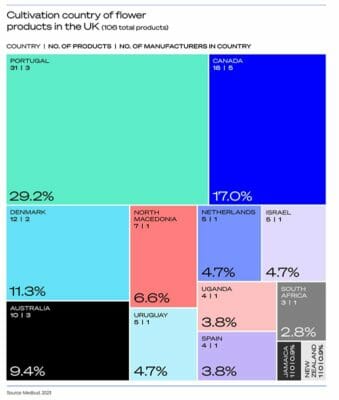
In February 2023 there will be around 90 products on the UK market, including cannabis flowers and extracts.

In August 2022, the average price per gram of flower was €11.4, while oils stood at €7.1 per millilitre.

Origin of medical cannabis in the UK

Origin of medical cannabis in the UK

While there are still only a handful of patients who can access medical cannabis through the NHS, the UK’s growth is being fueled by a ‘proliferation of dispensaries which offer private consultations and prescriptions’ .

These private dispensaries are primarily dedicated medical cannabis dispensaries, although some were pre-existing medical dispensaries that now offer medical cannabis treatment, but all are either online only or offer some form of online service.

In the UK, doctors occupy a unique position in the medical cannabis market when it comes to imports. To import medical cannabis products in bulk, an importer must obtain an ‘advance request’ letter from a prescribing doctor, which costs around £1,000.

This letter specifies the required quantities of products for the needs of the doctor’s prescription during the following months. The importer can only import the exact quantity of each product mentioned in the letter, and each letter can only be used once.

Since only medical specialists are able to initiate treatment with medical cannabis, the number of doctors capable of producing these letters is extremely limited: they would be just over 100.

This unique dynamic means that the relationships between dispensaries, their doctors and the country’s importers and distributors are more crucial than in any other European market.

Therefore, for medical cannabis companies to secure a significant share of the UK market, they must control or be part of an “intertwined web” of dispensaries, doctors, pharmacies, importers and distributors. .

Currently, three such networks cover around 60% of the total market, although around 20 clinics are active in the UK:

  • Lyphe Group, which owns the largest pharmacy and clinic in the UK
  • Curaleaf, which owns importer Rokshaw and manufactures its own products
  • IPS Pharma/Grow Pharma, which operates the Cannabis Access Clinics, My Access Clinic and Integro Clinic

Product availability in the UK remains spotty, largely due to the still difficult and bureaucratic import system.

Of the 202 products currently listed in the UK Product Database, which tracks the development of medical cannabis in the UK, only 88 are currently available to patients.

The price per milliliter of the extracts currently available are between €2 and €12 (with the exception of a Bedrocan product with a high CBD content), most of which are between €4 and €6 per millilitre. Prices for flower products were between €6 and €14 per gram, with most products costing between €8.40 and €9.60 per gram.

Austria bans the production and trade of HHC

As in France, hexahydrocannabinol – better known as HHC – is enjoying growing popularity in Austria with people looking for a “legal high”.

However, the country has just banned its production and distribution on the territory, with possession and consumption going unpunished.

According to the statement of the Federal Ministry of Social Affairs, Health, Care and Consumer Protection, this decision aims to protect consumers from potential health risks in the future, scientific knowledge on the short and long-term HGH consumption by humans is still insufficient. The new regulations came into effect on March 23.

Synthesis and health

Like THC and CBD, HHC can be produced naturally by the cannabis plant and results from the process of natural breakdown of THC, although this process results in very residual amounts. The compound used in the different HHC products available on the market is therefore obtained through laboratory hydrogenation processes of cannabis extracts, from CBD, which makes it a semi-synthetic product.

According to Austrian Health Minister Johannes Rauch, “As a new psychoactive substance, the production and marketing of synthetic HHC is prohibited until we have sufficient knowledge about the health consequences. The possible short or long-term health consequences are still unknown,” he said.

Austria is following the position of other European countries and health experts by including HHC in its list of banned substances. Finland has also classified HHC as a new psychotropic substance, just as Switzerland has banned its use, and Belgium and Hungary are expected to do the same soon.