Home Blog Page 105

Israel to remove CBD from its list of hazardous substances

Israel to remove cannabidiol (CBD) from its Dangerous Drugs Ordinance (Dangerous Drugs Ordinance), thus allowing its use and importation into Israel, the Health Ministry said Monday.

Israel had already considered removing CBD from its list of hazardous substances several times, but never implemented the measure. Last December, the country set up a committee to examine the consequences of removing CBD from the list of restricted substances.

The committee reviewed existing information regarding the safety of products for consumer use. He recommended that the Ministry of Health remove CBD from the list of dangerous drugs, provided that the maximum concentration of CBD products does not exceed 0.2% THC. However, Israeli Health Minister Nitzan Horowitz adjusted the maximum concentration level to 0.3% THC.

However, CBD will not be available over the counter tomorrow in Israel. The committee recommended a 2-year period during which studies will determine the safeguards needed for the incorporation of CBD into foods and cosmetics.

In the meantime, a supervisory and enforcement system for cosmetics and food should be put in place in light of the widespread use and popularity of CBD products, including the purchase of non-CBD products. supervised on the Internet.

“There are a lot of biases for anything related to the Cannabis plant,” Horowitz said of his department’s decision. “We are starting today to release a component on which there is a broad consensus and which should not be defined as a dangerous drug: CBD. »

“For several years, Israel has lagged behind the advanced countries in the world in this regard, and it continues to criminalize and prevent the use of components that are not dangerous to public health,” he said. he declares. “We will now make up for this delay”.

Calling the decision “a required first step, and certainly not the last, in regulating the cannabis market and changing the general attitude towards its effects and benefits”, Horowitz reassured the public on the fact that Israel, like other advanced countries, will soon allow the marketing and sale of consumer products containing CBD.
Luxembourg: illegal cannabis contaminated with mycotoxins

A Luxembourg study, from the Health Protection and Forensic Medicine Departments of the National Health Laboratory (LNS), and published in the journal Mycotoxin Researchstudied the presence of dangerous mycotoxins in 142 samples of illegal cannabis seized by the Luxembourg police.

Using chromatography analyses, which make it possible to separate the different substances present in a product, the study revealed that around a third of the samples were contaminated with ochratoxin A, at concentrations that could reach 16mg/kg.

Ochratoxin is produced by different species ofAspergillus and of Penicillium, molds that can reduce the effectiveness of the immune system and even prove to be neurotoxic. Mycotoxins are also resistant to sterilization and heat. Mycotoxins most often develop during cultivation rather than during storage. These fungi are known to be mutagenic and carcinogenic due to their ability to break DNA strands and inhibit their repair mechanisms.

Maximum levels set by the European Commission in food are 15-20mg/kg.

Among the samples, no significant difference was observed between those of resin and those of grass. Overall, the concentrations remain low and do not suggest a human health problem if cannabis consumption remains moderate.

The Luxembourg researchers write that “Recreational cannabis is legalized in more and more countries, and methods for determining contaminants, and therefore mycotoxins, are beginning to appear in the scientific literature. On the other hand, cannabis continues to be available on the illegal market without any quality control”.

A previous Spanish study had determined that 75% of Madrid hashish was contaminated with faecal bacteria, making it clearly unfit for human consumption.

In January 2022, the US cannabis industry had 428,059 jobs

Leafly, in partnership with Whitney Economics, has released its sixth annual Cannabis Jobs Report.

the Leafly Jobs Report 2022which looked at the 11 states where adult cannabis is legal in the United States and the 27 states where medical cannabis is allowed, finds that jobs in the cannabis sector increased by 33% in 2021.

According to Leafly, 2021 is the fifth consecutive year the industry has experienced an annual growth rate above 27%. Additionally, the analysis found that the cannabis industry currently employs 428,059 Americans and generated nearly $25 billion in sales last year, or about a quarter of the total cannabis market expected in the country.

The report also predicts that the US cannabis industry will one day employ between 1.5 and 1.75 million people, almost four times more than today, and that the sector will generate around $45 billion in annual sales. by 2025.

The 428,059 full-time jobs cover a wide variety of cannabis-related roles, from “plant-touching” jobs like cultivation and retail, to ancillary jobs like accounting, legal, security or construction. In 2021, employment in the cannabis industry was estimated at 321,000 jobs, up from 122,800 in 2017, the first year Leafly released its report.

“In the second year of the COVID-19 pandemic, the U.S. cannabis industry sold nearly $25 billion worth of products and created over 107,000 new jobs – enough to fill the Rose Bowl and more” , says the report in its introduction.

“This represents a 33% increase in jobs in a single year. And this is the fifth consecutive year of annual employment growth above 27%. No other industry in America can compete with this. Last year, the US legal cannabis industry created more than 280 new jobs every day. In 2021, someone was hired for a cannabis-supported job every two minutes or so of the workday. »

The report also provides other means of comparison to put things into perspective, including the fact that there are three times as many cannabis workers as dentists in the United States and that there are more people working in cannabis that there are no hairdressers, barbers and beauticians combined.

The report also presents the top ten cannabis markets by employment, namely California, Colorado, Michigan, Illinois, Massachusetts, Pennsylvania (only for medical purposes), Florida (only for medical purposes), Arizona, Washington and Oregon.

However, the report also recommends that people who would like to find jobs in the cannabis field, Arizona, California, Connecticut, Florida, Illinois, New Jersey, New Mexico and New York are full opportunities, such as potential for market novelty or mature markets with a competing illegal market.

The authors of the report estimate that these numbers will only increase in the years to come.

“In the eight years since the nation’s first adult-use cannabis stores opened, the industry has created hundreds of thousands of new American jobs. And there are still many more to create. Whitney Economics calculates that the total cannabis sales figure in 2021 – just under $25 billion – represents only about 25% of the total potential cannabis market in the United States,” the report states. He goes on to say that 75% of the cannabis industry’s demand is met through illegal cultivation and sale, and that by 2025 the cannabis industry could be worth up to $45 billion.

Is HHC legal in France?

Like the United States, where the legalization of hemp has paved the way for the marketing of cannabinoids present naturally in hemp, but in very small quantities, and therefore synthetically recreated, certain products containing HHC, hexahydrocannabinol , begin to arrive in France. With an essential question: is HHC legal in France?

What is HHC?

HHC was created in 1944 by American chemist Roger Adams, when he added hydrogen molecules to delta-9-THC. This process, called hydrogenation, converts THC into hexahydrocannabinol.

While Adams created HHC from cannabis-derived THC, nowadays HHC is usually derived through a process that begins with hemp.

How is THC made?

HHC can be made from a multi-step process. First, CBD is extracted from hemp as an isolate. From there, things get a little more complicated.

HHC is created from CBD by a chemical reaction inside a chemical reactor using a catalyst. The details of this process are unknown, but toxic chemicals are likely involved.

The HHC contained in marketed products is therefore produced synthetically, without any traceability on the solvents involved and on what is left in the final product.

What are the effects of HHC on the body and mind?

There is no consensus on the potency of HHC. The complication stems, in part, from the fact that when the cannabinoid is made, the end result is a mixture of two different types of HHC molecules: 9R HHC actively binds to the body’s natural endocannabinoid receptors, while 9S HHC , due to its slightly different molecular structure, does not do so well.

“He who binds [aux récepteurs] produces similar effects” to delta-8 THC, but it takes a much larger amount to achieve this, says Richard Sams, of KCA Laboratories, for example. “With a sufficient dose, one can observe effects similar to those of THC”.

In other words, HHC can have similar effects to THC on the body and mind, but HHC is less potent, milligram for milligram, than delta-8-THC. Delta-8-THC itself is generally considered half as potent as standard delta-9-THC.

Is consuming HHC safe?

Like all new hemp-derived cannabinoids (delta-8, delta-10…), there is no standard dose and little or no research on the immediate or long-term effects of HGH consumption.

Since hemp-derived cannabinoids (including HHC) are not properly regulated in France, sellers of HHC products are not required to test the potency and purity of their products.

Is HHC legal?

And now we come to perhaps the trickiest question of all: is HHC legal?

For the moment, hexahydrocannabinol is not classified on the list of narcotics in France nor prohibited as such. Be careful though:

  • HHC is originally a derivative of THC. Its molecular structure very close to the prohibited cannabinoid and its psychotropic effects, even weak, could disqualify it quite easily.
  • HHC shares important similarities with the synthetic drugs K2 and Spice. No traceability is carried out on its production or its composition after manufacture by solvent

At the moment, HHC products exist in a dark area. Until HHC is brought under state regulation, consumers will only be able to assess the risks and benefits of these compounds for themselves.

The first medical cannabis flowers arrive in New Zealand

New Zealand patients will soon be able to receive cannabis flowers after the arrival in the territory of three Australian products.

The company Australian Natural Therapeutics Group (ANTG) is thus the first company to be able to legally sell medical cannabis flower in New Zealand, through the New Zealand company NUBU Pharmaceuticals, which will distribute its products.

“This is a historic moment in medicine for both countries, which means New Zealand patients can finally go to their GP to seek alternative medicine for conditions such as chronic pain and many more,” said Matt Cantelo, CEO of ANTG.

The three approved flowers are Eve (14% CBD and THC < 1%), Rocky (El Jefe, 30% THC) and Mariposa (OG Kush, 14% THC).

Founded in 2015, ANTG holds several cannabis licenses in Australia, including research, cultivation and manufacturing, import and export, as well as a hemp production license, in addition to a GACP certification and GMP.

“We have grown products that have met the required medicinal standards, especially in terms of quality and purity – even more than other countries like Canada, which are leaders in the cultivation of medical cannabis,” said Mr. Cantelo. “Australia’s high standards in the cultivation and production of medical cannabis put us at the forefront of the world. »

While the Medicinal Cannabis Scheme came into force on April 1, 2020 in New Zealand, products are trickling in to patients due to various bottlenecks and demanding bureaucracy for cannabis companies.

For now, New Zealand patients rely mainly on imported products until New Zealand companies, such as Helius Therapeutics and Puro, are able to distribute locally produced medical cannabis.

Myths about pipe smokers

0

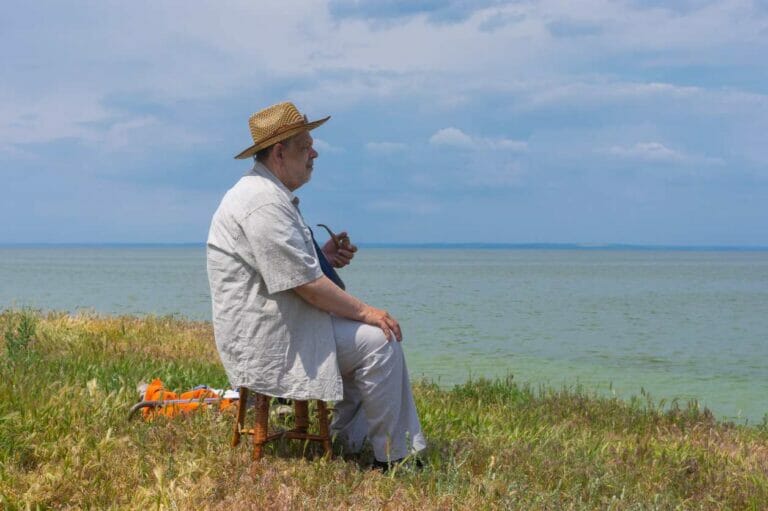
When one thinks of a pipe smoker, one immediately imagines a bearded man, of a certain age, posed on his rockin’ chair to look far in front of him. If we told you that this is a real myth. Here are the common misconceptions about pipe smokers.

No pipe smokers are not all old

Forget that image of the pipe smoker over 60 in his chair. Today many smokers are very young. They generally take over the family pipes used by their ancestors to learn before buying their own pipe.

Pipe smokers are men

As in the world of cigars, that of the pipe has long been reserved for men. But many women showed themselves hot in the mouth. Even today, there are many women who smoke a pipe, without however showing it in broad daylight.

Pipe smokers are budding philosophers or detectives

Forget this idea immediately. It is not because they are represented in movies, series or even in books that it is a fact. Pipe smokers are completely normal people, even coming from all walks of life.

Smoking a pipe is an art

So again, this is totally theoretical. Since in practice, when we see certain pipes, it is clear that this time is definitively extinguished. Between pipes with dubious aesthetics and those that are not cared for by their owner, can we still speak of art? On the other hand, some of course consider the pipe like a ritual !

Pipe smokers used to remake the world

Here again, here is a nice received idea. When a smoker settles down behind his pipe, it’s not to change the world, but rather to treat himself to a moment of peace. Just as some would work out, take a hot bath, go shopping or have coffee with friends, the pipe smoker finds comfort in his piper.

Comment About Misconceptions about pipe smokers Below ..

The Bob Marley Museum, Jamaica’s top tourist attraction

Bob Marley’s 77th birthday was celebrated on February 6 with a conch note abengan animal horn used as a musical instrument, at 6 a.m. at his former home at 56 Hope Road, Kingston, Jamaica.

The Trenchtown home of the world’s most famous cannabis ambassador is now the Bob Marley Museum, Jamaica’s biggest tourist attraction with over 60,000 visitors a year.

Bob Marley’s birthday took place under the theme Roots 77inspired by his song Roots, and was commemorated with a live reggae concert broadcast by radio Tuff Gong. The event was hosted by some of Bob Marley’s descendants, including his sons Ziggy, Stephen, Ky-Mani, Julian and Damian.

Bob Marley’s estate is now worth over $100 million

Marley’s estate is now worth more than $100 million and is largely in the control of his disabled widow Rita and second-born daughter Cedella. It includes the Bob Marley Museum and a recording studio in Kingston (both), a vinyl and CD press factory, record stores and a bookstore, and an avalanche of family-approved merchandise: cannabis and body care products, headphones and other audio devices, coffee, and even a line of “functional mushrooms” that has just been launched. But not his musical catalog.

A few years after Marley died, aged 36, in May 1981, an audit of his assets revealed only $250,000. Today, the family business earns at least $20 million a year, according to figures from Cannabiz Africa.

Cedella Marley said if her father was still alive he would probably be growing cannabis and joked that he would “be in trouble” over compliance issues.

A new live album titled “Easy Skanking in Boston ’78” will also be released this month, according to the Bob Marley Group of Companies. It will include two concerts given at Boston’s Music Hall in June 1978.

Will Bob Marley be declared a national hero of Jamaica?

In Jamaica, where Reggae Month is hailed, calls are mounting for Marley to be named a national hero. Perhaps when the island’s 60th anniversary of independence is celebrated next August, another milestone for Marley will be reached.

No new heroes have been added since the 1980s and a committee has been reviewing nominations for three years, with Bob Marley and former Prime Minister Michael Manley on a list of 10 names mentioned.

“It is high time the government made him our eighth national hero,” said Errol Campbell, 57, a mechanic, also from Kingston. “Bob was a reggae genius who did more for Jamaica than most by popularizing our music,” he added.

Some committee members reportedly opposed Marley because he smoked cannabis and practiced civil disobedience.

An annual “One Love” charity football match was played in honor of Bob Marley on February 18, 2022, with the participation of celebrities such as Olympic sprinters Usain Bolt and Asafa Powell.

Cannabis events of 2022

The year 2022 will mark the return of many cannabis events in Europe and elsewhere. here is the cannabis events calendar for 2022. All exact dates are not yet announced and will be updated. This list is not exhaustive but identifies the main events.

The coronavirus pandemic has, however, turned the agenda of events upside down, which will necessarily be held subject to changes depending on the evolution of the health situation.

January 2022

February 2022

March 2022

ICBC Barcelona

On March 10, the eve of Spannabis, ICBC returns to Barcelona. The ICBC specializes in B2B networking in addition to offering new perspectives on the economic potential of the cannabis sector in Europe. The day will consist of several conferences on various themes. This will be followed by a networking session then an after-party at the Ritz-Carlton in Barcelona.

Website: https://internationalcbc.com/icbc-buy-tickets/

Spannabis from Barcelona

Surely the most anticipated event in the world of Spanish cannabis, the 18th edition of Spannabis will take place from March 11 to 13 in Barcelona. The fair will give pride of place to exhibitors of all types related to cannabis: tools for growing, accessories for consumption, clothing brands, seeds and other solutions for testing the quality of cannabis.

Site : http://spannabis.com/

April 2022

May 2022

WeedFest Warsaw Festiwal

On May 28 and 29, Warsaw will host the WeedFest Warsaw Festiwal, for the third edition of this fair. The first two years the fair was only for Polish companies, but today the event will welcome more European companies to celebrate the event together.

Website: http://www.weedfest.pl/

June 2022

The call of the 18 joint

As every year, June 18 will be an opportunity to campaign for a change in French cannabis legislation.

More information on http://18joint.fr/

July 2022

ICBC Berlin

The ICBC will meet in Berlin on July 18,19 and 20, 2022.

August 2022

September 2022

ICBC Zürich

The ICBC will meet in Zurich on September 8 and 9, 2022.

HempZon

On September 10 and 11, the third edition of the Luxembourg hemp and CBD exhibition will be held to promote hemp in all areas, from industry to ecology and its therapeutic virtues. As the country is in the process of legalization, the event should grow quickly.

Facebook page : https://www.facebook.com/hempzon/

October 2022

November 2022

December 2022

Your event is not listed? Send us an email via our contact form.

The Emerald Cup Changes Its Cannabis Strain Classification System

A revolution is underway at the Emerald Cup in how cannabis excellence is judged. The competition that meets every year to elect the best outdoor organic weeds, and their derivatives, will now use a new classification system that is intended for everyone. Consumers, budtenders, dispensaries, judges or growers will be able to use this system which will universally classify cannabis according to its terpenes, its flavor and its effects.

Abandoning cannabinoid levels alone

Until now, the main indicator of potency and effect was based on THC. However, science has converged to prove that terpenes play a major role in the entourage effect sought by consumers.

However, terpenes, with their unfamiliar names and mysterious effects, have mostly added another layer of confusion for consumers, already complicated by overly broad Indica/Sativa/Hybrid terminology, fancy strain names, THC percentages irrelevant CBD/CBD, and other ambiguous factors that make the process of selecting the best or right strain a less than satisfying ordeal for the most seasoned cannabis connoisseur.

In early 2021, recognizing the early signs of this cultural shift and projecting themselves into the 18th Annual Emerald Cup Awards, co-producers Tim and Taylor Blake assembled a panel of leading experts, scientists and experts. former judges – right down to founder Tim Blake himself – to implement a new terpene sorting system that will serve as the basis for judging the competition.

The 2021-2022 Emerald Cup competition will serve as a proving ground to test a new way of categorizing cannabis flowers. Always seeking to level the playing field and eliminate as much bias as possible in the blind sampling performed by Emerald Cup judges each year, event organizers and their testing partners at SC Labs decided to divide the flower categories based on the chemometrics of each cultivar, better known as “chemovar” – the evolution of the term “dominant terpene”.

The all-new classification system builds on last year’s approach of sorting flowers by their primary terpene content, taking advantage of a decade of combined research into cannabis phytochemistry between PhytoFacts®, developed by Napro Research in 2013, combined with a powerful database of over 250,000 terpene tests and aggregated by SC Labs, dating back to the launch of their cannabis terpene tests in 2013.

The main class names have been chosen to reflect current vocabulary. They are already more or less used in industry and are familiar to dispensaries and consumers. To enhance understanding and adoption, each class is further explained using tasting notes, effects, and common strains or cultivars.

Classes in the Emerald Cup cannabis classification based on PhytoFacts® powered by SC Labs include:

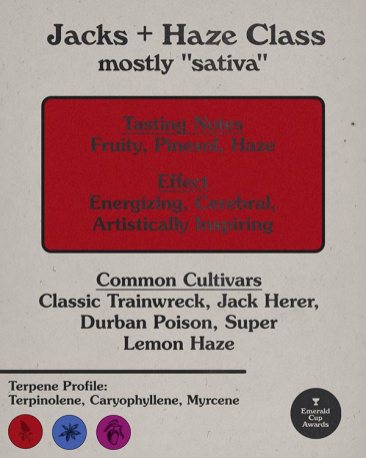
“Jacks + Haze” class

  • Mainly ‘Sativa’ oriented strains
  • Tasting Notes – Fruity, Pine, Haze
  • Effects – Energizing, Cerebral, Artistically Inspiring
  • Common cultivars: Classic Trainwreck, Jack Herer, Durban Poison, Super Lemon Haze
  • Terpene Profile: Terpinolene, Caryophyllene, Myrcene

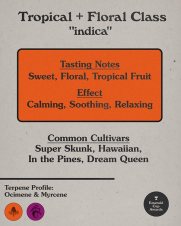
“Tropical + Floral” class

  • Mainly ‘Indica’ strains
  • Tasting notes: sweet, floral, tropical fruit
  • Effects – Calming, Soothing, Relaxing
  • Common cultivars: Super Skunk, Hawaiian, In the Pines, Dream Queen
  • Terpene Profile: Ocimene, Myrcene

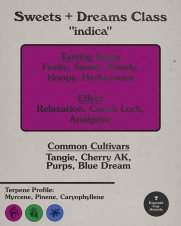
“Sweets + Dreams” class

  • Mainly “Indica” type varieties
  • Tasting Notes – Fruity, Sweet, Woody, Hopped, Herbal
  • Effects – Relaxation, Couch Lock, Analgesic
  • Common cultivars – Blue Dream, Tangie, Forbidden fruit, Grandaddy Purple, Purple Urkel, Grape Ape, Cherry AK, God’s Gift, Purple Punch
  • Terpene Profile: Myrcene, Pinene, Caryophyllene

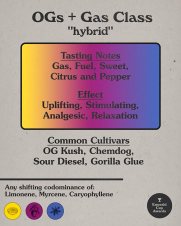
“OGs + Gas” class

  • True “hybrid” grape varieties
  • Tasting notes: gas, fuel, sweet, citrus and pepper
  • Effect: euphoric, stimulating, analgesic and relaxing
  • Common Cultivars: Classic OG Kush, ChemDawg, Sour Diesel, Gorilla Glue
  • Terpene Profile: Any changing combination or codominance of Caryophyllene, Limonene, Myrcene

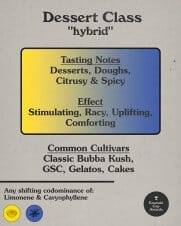
Class “Desserts”

  • True hybrid varieties
  • Tasting Notes – Deserts, Pasta, Citrus and Spicy
  • Effects – Uplifting, racy, uplifting, uplifting
  • Common Cultivars – Classic Bubba Kush, GSC, Gelatos, Cakes
  • Any change in the codominance of Caryophyllene and Limonene

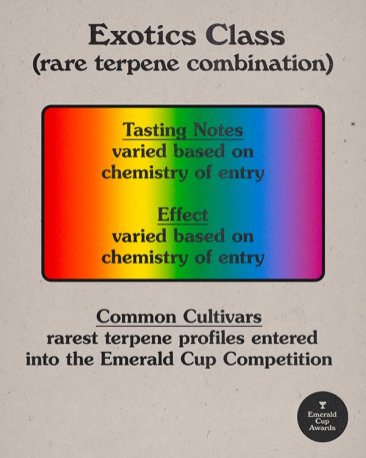
“Exotic” class (rare combinations of terpenes)

  • Truly “hybrid” varieties
  • Tasting notes – vary based on weed chemistry
  • Effect – varied depending on the chemistry of the herb
  • Common cultivars – rarest terpene profiles featured in Emerald Cup competition

The system will be used for the first time at the 18th Annual Emerald Cup by four expert judging teams in the Flowers, Pre-rolls, Solventless Concentrates and Hydrocarbon Solvent Extracts categories.

This breakthrough in cannabis classification levels the playing field in the 2022 Emerald Cup competition as well as the competition between brands in the market. With six easy-to-understand classes/names/descriptions, the system aims to become an open and globally recognized cannabis classification solution. Just as in the wine industry, where you don’t judge a Chardonnay against a Merlot, this new system allows varieties with a similar profile to be judged against each other. The California State Fair Cannabis Awardswhich will take place in July 2022, will also use this new classification system.

The 2022 Emerald Cup awards will be presented on May 14 at the Green Street Festival in downtown Los Angeles, California. The deadline to submit cannabis products in one of the 50 different Emerald Cup categories is February 25, 2022.

Over 73% of Americans have legal access to cannabis

More than 188.7 million people over the age of 18 in the United States live in a state or territory where cannabis has been legalized, whether for medical or adult use. This means that more than 73% of the US adult population has some access to legal cannabis in some way, according to an analysis by GrownIn.

California and Illinois have the largest number of adults over the age of 18 accessing the medical consumer and adult consumer markets. New York, which rivals Illinois, could open its sales this year and swell the ranks of adult consumers.

More purely medical states

Of the states that report cannabis patient numbers, the average enrollment rate in states where only medical cannabis is legal is 1.84%, with Oklahoma leading the way with more than 12%. of its population enrolled in the medical program. The state with the lowest number of patients is West Virginia, with 0.37% of the population over 18 enrolled.

For states that have both a medical market and an adult-use market, the average medical patient enrollment rate is 2.16%. The state with the highest percentage of its adult population registered as medical patients is New Mexico, at 7.97%. The lowest is Alaska, with only 0.07% of the adult population registered.

This portion of the data is limited, however, as seven states with a medical program did not report their numbers. Two states — California and Louisiana — also don’t keep track of those numbers. Also, the patient numbers for the Virginia and South Dakota medical programs are not public records.

Unconditional support for legalization

According to the most recent survey of Pew Research Center published in April 2021, 91% of Americans believe that cannabis should be legalized for medical or recreational use. Regarding the legalization of cannabis for adults alone, 69% of Americans were in favor of it on the same date.

In 2016, “only” 75 million Americans had legal access to cannabis.