Home Blog Page 103

The terracotta pipe, an institution in Saint-Omer

Saint-Omer is known for its know-how in the manufacture of clay pipes. A look back at this 400-year-old institution. Decryption.

Tobacco in Saint Omer

In 1635, the first tobacco plants were grown in Saint Omer and its surroundings. However, it was only 25 years later that the first manufacture was born. At the end of the 18th century, the number of factories rose to 30 and no less than 450 people were employed there.

This French tobacco is all the rage with amateurs, so much so that the manufacture of by-products such as tobacco jars or even clay pipes quickly come to market.

Pipemakers from father to son

The art of being a pipemaker is passed down from father to son in Saint Omer. One of the best-known families remains the Fiolet house. Towards the end of the 18th and the beginning of the 20th century, production became industrialised. Even children are quickly exercised since the manufacture of pipes is entrusted to them from the age of 10! In all, the Fiolet family produces 80,000 pipes a day.

A second pipe house was born in Saint Omer: Constant Duméril. Between them, they produce 50 million pipes that are shipped around the world. However, with the arrival of cigarettes and wooden pipes, the Fiolet house was forced to close its doors in 1919.

The First World War virtually erased all vestiges of this glorious era since the factories were bombed and then razed in the 1960s and 1970s. Only the Fiolet house has survived the years and has now become a school: the Saint-Bertin school. The Pipers chapel on rue de la Commune-de-Paris has become the Perpignan neighborhood centre. It is still possible to find some traces in the street of the pipe makers where the police station is located.

Comment About The clay pipe, an institution in Saint-Omer Below ..

5 years of legalization of medical cannabis in Germany: what results?

Five years ago, the Bundestag paved the way for prescription cannabis in Germany. Since then, doctors can prescribe medical cannabis to patients with serious illnesses and in the absence of any alternative therapy.

Around 100,000 patients are currently treated with cannabis according to the latest estimates, 100 times more than before legalization where 1,000 patients had an exemption from the Narcotics Act which allowed them to enjoy access to Dutch medical cannabis. .

The German system

With the amendments made in March 2017 to the Narcotic Drugs Act (BtMG) and the Narcotics Prescription Ordinance (BtMVV), cannabis flowers and extracts as well as pharmaceutical preparations such as dronabinol can be prescribed on a dedicated prescription. narcotics at the expense of health insurance.

Patients with a serious illness are entitled to medical cannabis. Doctors must obtain the agreement of the health insurance fund before starting treatment, which can only be refused in justified exceptional cases. Patients are entitled to a maximum of 100g of flowers for 30 days or 1g of pure THC extract.

The country is supplied almost exclusively from abroad, the national production licenses having taken their time to be awarded. Cannabis imports have thus increased by 75% between 2020 and 2021 to around 30 tonnes per year, combining flowers and extracts.

Constraints to be resolved

The German market is now the largest European medical cannabis market, pending France. On the supply side, in 5 years, the supply of medical cannabis has expanded: there are now around 150 varieties and 60 different extracts available on the German market. In addition to supply difficulties based on the importation of non-negligible quantities of narcotics, patients still have difficulty accessing cannabis.

The treatment of medical cannabis by a doctor is not always easy. There is therefore no single form of therapy for all patients, who require individual and increased follow-up. The training of health professionals plays ultimately much in the accessibility of medical cannabis. If German doctors have additional training in “special pain therapy” or are trained in “palliative medicine”, they can now more easily prescribe medical cannabis products to their patients after a training session of 20 hours and continuous learning.

Medical cannabis also weighs heavily on health insurance funds. Imported, often sold to pharmacies by wholesalers who drive up the final price of the drug, it is charged almost 3 times the price of medical cannabis in the Netherlands, a significant financial burden for health insurance companies who reimburse the drug to patients.

Will the future legalization of cannabis for adults in Germany open up access to medical cannabis or, on the contrary, cause a shortage of available cannabis? See you in 5 years for the answer.

Poll: More Americans Say It’s Better To Use Cannabis Than Alcohol

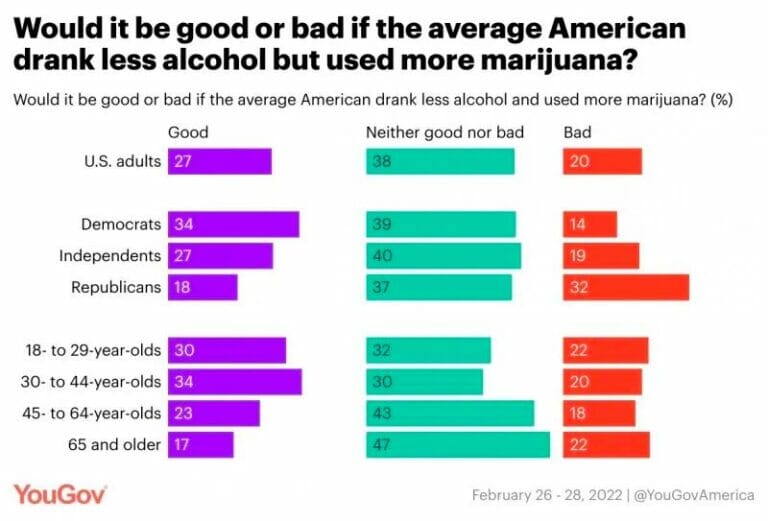
According to a new YouGov poll, 27% of Americans surveyed said it would be ideal for people to use more cannabis rather than alcohol, while 20% said it would be a bad idea.

However, most respondents (38%) said it would be neither good nor bad, with a further 15% saying they weren’t sure.

The demographic breakdown of the poll, which was conducted among 10,412 Americans on February 28, found that Democrats were more likely to say switching from alcohol to cannabis would be a good thing (34%), compared to Democrats. Republicans (18%) and Independents (27%).

People aged 30-44 were the most likely to say cannabis substitution would be a good thing (34%), while only 17% of people aged 65 and over felt the same way.

YouGov poll on alcohol and cannabis

Although the pros and cons of alcohol versus cannabis have been much discussed, alcohol consumption is strongly associated with long-term health problems even as alcohol can cause overdoses . According to a 2018 World Health Organization (WHO) report, alcohol is responsible for 3,000,000 premature deaths a year, with the poorest and most disadvantaged communities bearing the bulk of the burden. burden.

Conversely, no cannabis overdoses have ever been documented and compounds from the plant are used medicinally for a number of health conditions.

Regardless of public opinion, it seems that states where cannabis is legalized for adult use see a stronger trend in cannabis sales over time. For example, Massachusetts officially collects more tax revenue from cannabis than from alcohol, according to state data released last month.

Illinois also saw cannabis taxes beat alcohol for the first time last year, with the state collecting about $100 million more from recreational cannabis than alcohol in 2021.

A 2019 report separately found that the number of drink-driving crashes in Idaho declined after cannabis was legalized in neighboring Washington state.

Canada’s Supreme Court agrees to review the constitutionality of Quebec’s cannabis law

The Supreme Court of Canada will examine the constitutionality of the Quebec law which prohibits the cultivation of cannabis for personal purposes while cannabis is legal at the federal level and in each province.

Four years ago, the Government of Canada legalized cannabis, allowing anyone of legal age to grow up to four cannabis plants per residence for their own use.

However, Quebec’s Cannabis Regulation Act prohibits possession of cannabis plants and cultivation for personal use in the province.

Janick Murray-Hall, a Quebec citizen, successfully challenged the province’s law, which was declared unconstitutional in 2019 by the province’s Superior Court on the grounds that it infringed on federal jurisdiction.

However, the decision was overturned last year by the Quebec Court of Appeal, prompting Murray-Hall to head to the Supreme Court.

The High Court has not given reasons for agreeing to hear the appeal, and no hearing date has yet been set.

The office of Quebec Justice Minister Simon Jolin-Barrette said no comment would be made “given the ongoing legal process.”

“That being said, Quebec will always defend its jurisdictions. The law in question aims to protect the health and safety of the population, in particular that of young people,” said the Minister’s press attaché, Élisabeth Gosselin, in an email sent to The Canadian Press.

Cannabis sales still blocked in Washington

While Washington DC voted overwhelmingly to legalize cannabis in 2014, Congress still refuses to let the nation’s capital create a regulated market. As it stands, residents can possess, grow and donate various amounts of cannabis, but not sell or buy it, which has given way to a “gray market” where vendors sell other products and offer cannabis with each sale.

Democratic Mayor Muriel Bowser and the Washington DC City Council attempted to regulate the industry but were stymied each time by congressional inaction. Local lawmakers say they are looking for an alternative to making the gray market legal.

According to a report by Politico, Congress just passed an amendment in its “spending package” to continue prohibiting the development of a cannabis market. The surprise addition of the text was only discovered when the bill was released on Wednesday and had been absent from previous budget proposals. It was eventually included in the budget by President Joe Biden.

In a statement, the CEO of theUS Cannabis Council (USCC), Steven Hawkins, said the organization was “deeply disappointed with Congress’ failure to act on cannabis reform in this year’s budget bill.”

“Congress was poised to make real progress, including removing barriers put in place by Rep. Andy Harris that prevent the District of Columbia from implementing regulated cannabis sales after a successful legalization referendum. This has created a harmful underground market that operates without any standards or guarantees and is at odds with the will of local voters,” explained Steven Hawkins in a press release.

Toi Hutchinson, President and CEO of Marijuana Policy Project, said, “We are very disappointed that Congress continues to prevent DC residents from regulating cannabis despite their urgent and repeated calls for reform. Instead, Congress requires the District to maintain a gray market in which cannabis can be legally possessed and consumed by adults, but cannot be legally sold, regulated, or tested. This puts consumers at risk, and entrepreneurs who live in this majority minority community are denied the ability to open businesses that are available in all other jurisdictions where cannabis is legal. »

The “spending package” could also have granted adult markets the same legal protections that surround medical cannabis programs in states that have approved the reforms. However, they were deleted in the Senate version of the bill.

Event on March 16: “Presidential candidates & drug policies”

LEAP France, the branch of the international movement of police officers and members of the criminal chain which pleads in favor of a public drug policy based on scientific facts and the evaluation of public policies, is organizing on March 16 in Paris a meeting between candidates for the presidential election (or their representatives) and members of civil society on the issue of drugs.

On one afternoon, from 1 p.m. to 5 p.m., and around 6 round tables, the various speakers from universities, police, politicians, activists, journalists… will cover the vast subject of drugs, with a focus on questions relating to drug policies. in the run-up to the presidential elections, via a mapping of the positions of the 2022 presidential candidates.

The round tables will then host:

  • “Impact of penalization of use on society” with Marie Jauffret-Roustide and Omer Mas-Capitolin
  • “Daily safety under prohibition” with a representative of the “Moms Brigade” and Emilie Petit
  • “On the front lines of the war on drugs” with Alternative Police CFDT and Victor Martin
  • “Deal Economy(s)” with Christophe Seltzer and Sarah Perrin
  • “Investigation into a State Scandal” with Emmanuel Fansten and Fabrice Rizzoli
  • LEAP France Round Table with Serge Supersac, Jean-Pierre Havrin and Fabien Bilheran

Registration is required and is done on Eventbrite.

New Yorkers already convicted of cannabis will obtain the first sales licenses

The New York authorities want to favor people who have already been convicted of possession of cannabis, or whose family members have been harmed by prohibition and criminalization, and allow them to obtain the first retail cannabis licenses, before existing medical cannabis companies come into play.

The proposal to create these conditional licenses will be reviewed and announced today by the New York State Cannabis Control Board (CCB). The move would set the state apart from other states that have legalized cannabis but have been criticized for failing to deliver on social justice promises.

Promote equity

To obtain a conditional license, the applicant must have been convicted of a cannabis-related offense before March 31, 2021, the date the state law on legalizing adult use was enacted. Persons whose “parent, legal guardian, child, spouse or dependant” has been the subject of such a conviction are also eligible, as are those who are themselves dependents of a convicted person.

Eligible applicants must meet other requirements. For example, the measure stipulates that they must “hold or have held, for at least two years, an interest of at least 10% in an eligible company and have control over it, that is to say a company which made a net profit for at least two of the years it was in business”.

Nonprofits could also be eligible to hold the licenses if they “intentionally serve people and communities engaged in justice and with historically high rates of arrest, conviction, incarceration, or other indicators of Enforcement Activity for Marijuana-Related Offenses.

Existing medical cannabis operators, called “registered organizations” under the state’s cannabis code, would not be able to obtain the proposed conditional licenses. This appears to be part of the overall state goal of ensuring that the emerging industry is fair and not dominated by multi-state operators.

“I could press the green button right now and have 40 dispensaries online,” said CCB executive director Chris Alexander, referring to the state’s medical cannabis companies.

“But instead, we decided that those most affected had the space and leeway to participate in a meaningful way. »

To ensure that those most affected by criminalization can compete as the market opens and matures, conditional licenses should be reserved for applicants with at least 51% ownership by persons affected by criminalization. criminalization of cannabis, as provided for in the measure.

But why are e-cigs banned in some countries?

If the electronic cigarette proves to be an alternative to cigarettes, it remains relatively controversial. Indeed, all countries are not on the same footing when it comes to e-cigarettes. Explanations.

The e-cigarette: a controversial device

Since its launch, the electronic cigarette has attracted more and more smokers. Some even found it a means of weaning off the classic cigarette. It must be said that the variety of tastes, but also the possibility of choosing an e-liquid with or without nicotine is a major asset.

Nevertheless, the WHO report and certain other health organizations such as Santé Publique France have reservations about the potential toxicity of these famous e-liquids. Indeed, the steam released from the e cigarette does not contain tobacco, no tars and also no carbon monoxide, but particles suspected of being carcinogenic.

Some countries prefer to play it safe

If France is one of the countries that have authorized the e-cigarette, others oppose it. Thus in Brazil and India for example, the mere marketing of these products is totally illegal and India goes even further by banning vaping in many states.

Other countries ban e-cigarettes, such as the United States, Qatar, United Arab Emirates, Venezuela, Mexico and many others. In Europe, Austria, Finland, Croatia, the Czech Republic, Sweden and Norway remain firmly opposed.

If you like to travel in Thailand, know that it is strictly forbidden to appear with an electronic cigarette. Cambodia is even stricter by banning the import of e-cigarettes, just like Indonesia, which only allows their use on prescription.

Some countries tolerate e-cigarettes, but with certain restrictions. This is how in China, Australia, Tasmania or Japan, nicotine e-liquids are prohibited. The same is true for some states in Malaysia.

In the event of non-compliance with these rules, customs may confiscate products that attempt to cross fraudulently. Fines can vary between 200 and 2,000 euros depending on the country. In some countries like Malaysia, vaping is punishable by 2 years imprisonment and 10 years for Thailand!

Comment About But why are e-cigs banned in some countries? Below ..

WNBA player detained in Russia for THC cartridges

Basketball star Brittney Griner, WNBA (women’s NBA) champion and Olympic gold medalist for the United States, has been detained in Russia for days or even weeks after customs officials in Moscow allegedly found cartridges THC to vape in your luggage.

The timeline of Griner’s arrest isn’t entirely clear, with current tensions around Russia not helping matters. Customs authorities released security footage of a 1.80m tall person who appears to be Griner going through security checks at Moscow’s Sheremtyevo airport in February, but did not give his name or exact date of arrival. his arrest.

Griner usually travels to Russia to work during the WNBA off-season. Many WNBA players supplement their income by playing for foreign teams during the winter. In recent years, Griner has played for Russia’s UMMC Ekaterinburg in the International Basketball Federation (FIBA) Women’s EuroLeague.

His detention highlights the risks for American athletes, such as Sha’Carri Richardson, of using cannabis even as cannabis legalization spreads across the United States, Canada, Mexico and many more. other countries. The American leagues also authorize the use of cannabis for their players.

The Russian government has reportedly opened criminal proceedings against the seven-time WNBA star due to national laws that prohibit the possession of cannabis for recreational or medical purposes. In Russia, canisters of cannabis like those allegedly found in Griner’s luggage could earn him a 10-year prison sentence for just two grams.

What will happen to Brittney Griner?

The Phoenix Mercury, Griner’s WNBA team, released a statement on Instagram Saturday, March 5, acknowledging Griner’s detention. But the question that arises is obvious: how did this news remain silent for so long?

Griner is one of the WNBA’s biggest stars. Headlines about Russia may have dominated world news for weeks, but its “demise” may have been purposely underreported.

“Whenever an American is detained anywhere in the world, we are, of course, ready to provide any assistance we can, and that includes Russia,” Secretary of State Antony Blinken told ESPN. . “We have an embassy team working on the cases of other Americans who are detained in Russia. We do everything we can to ensure that their rights are upheld and respected. »

Evelyn Farkas, a former senior Pentagon official who served as U.S. assistant secretary of defense for Russia and Ukraine from 2012 to 2015, told Yahoo Sports that Russia could use Griner as a “high-level hostage as tensions between the United States and Russia come to a head over the war in Ukraine.

“If we want her out of prison, Russia is going to have conditions,” Farkas said. “It could be an exchange of prisoners. They could also use it as an implied threat or blackmail to get us to do something or not do something. Either way, they find it helpful. »

International cannabis sales are expected to reach $35 billion in 2022

Cannabis sales are on the rise as countries legalize its medical and adult uses. A new report BDSA Analytics shows a 22% increase in sales compared to 2021, capping the market at $35 billion.

Strong growth in the United States

According to the analysis firm, the opening of new markets in the United States of cannabis actually increases the output of the industry, and generates more money and activity in the United States. Leafly notably counted nearly 430,000 people now working in the cannabis industry in the United States.

“New Jersey’s launch of the sale of adult-use products, expected in the second quarter, will likely cause the biggest jump of any market in the United States in 2022,” said Jessica Lukas, chief commercial officer of BDSA.

In the United States, the fastest growing region is the Midwest, with Illinois and Missouri recently legalizing cannabis. The report predicts that within five years, states like Florida, New Jersey, New York and Michigan will also experience strong growth.

One thing that should remain constant is California’s dominance in the cannabis market. “California is, and will remain, America’s largest cannabis market and the world’s largest cannabis market,” said Jessica Lukas, assuming the state manages to simplify market access for businesses, until here heavily taxed, and for consumers. Only 23% of Californian cities indeed authorize the presence of cannabis companies on their territory, a blockage which in fact benefits the black market.

The International on Therapeutics

Canada’s domestic market now weighs $4.7 billion in sales. Mexico will soon be a close second, with a growing medical industry and adult use being regulated.

International markets, which only allow the sale of medical cannabis, reached $1.4 billion in sales in 2021. In 2022, this figure is expected to reach $2.2 billion.

According to the report, countries such as Germany, France and the United Kingdom could also interfere in the medium term in international cannabis sales, “progressing slowly but surely”.