Home Blog Page 42

Maryland legalizes the sale of cannabis

The governor of Maryland has signed the bill to regulate cannabis sales, paving the way for statewide legalization.

The governor said during the signing ceremony that the law “will ensure that the deployment of recreational cannabis in our state promotes opportunity in an equitable manner.”

“The criminalization of cannabis has deeply harmed low-income communities and communities of color,” he said. “We want to make sure that the legalization of cannabis affects these communities in a profound way. »

State lawmakers worked quickly to put the cannabis regulation legislation in place before the state’s voter-approved legalization law took effect in July.

Sales will begin on July 1 at current medical cannabis dispensaries.

The Legalization of Cannabis in Maryland

Here are the outlines of cannabis regulations in Maryland, passed by lawmakers as SB 516 and HB 556:

  • Cannabis will be taxed at 9%. Sales of cannabis for medical purposes will be exempt from this tax.
  • 35% of taxes will go to a community reinvestment fund, the counties, a cannabis public health fund and a cannabis business relief fund
  • A new independent administration, the Maryland Cannabis Administrationwill be responsible for regulating the program
  • Existing medical cannabis dispensaries will be converted to dual licenses when legalization takes effect on July 1 if they have paid a fee
  • Regulators to start approving additional cannabis licenses by July 1, 2024
  • Eventually, the number of licenses will be limited to 300 dispensaries, 100 processors and 75 growers. For smaller micro-enterprises, the limit will be 10 dispensaries, 100 processors and 100 growers
  • Social equity applicants will need to be 65% owned by people who have lived in disproportionately affected areas for at least five of the past ten years, attended public school in such an area for at least five years or meeting other criteria based on a study of disparities
  • A capital access program will be established under the aegis of the State Department of Commerce to promote industrial opportunities for social equity applicants and provide low interest loans
  • Legislation will end the sale of hemp-derived delta-8 products and require all psychotropic cannabis products to be sold through licensed cannabis businesses
  • Patients who use cannabis for medical purposes will be able to grow up to four plants for personal use, up from two under the current law
  • Smoking will be prohibited inside on-site consumer establishments, but will be permitted outside of licensed establishments
  • Regulators to set rules for online cannabis sales by July 2025

Cannabis use among teenagers is down since legalizations in the United States

Even as more U.S. states legalize cannabis, rates of current and lifetime cannabis use among U.S. high school students continue to decline, as recently released federal data shows.

The Centers for Disease Control and Prevention’s (CDC) Youth Risk Behavior Survey (YRBS), released last week, finds that teens’ use of all monitored substances – including cannabis, l alcohol and prescription drugs – has “linearly declined” over the past decade.

When it comes to cannabis, the federal study shows that high school students’ use tended to increase between 2009 and 2013, before legal cannabis dispensaries began to open in the first states that legalized, but ‘It’s been generally down ever since. The first cannabis legalization laws in the United States were approved by voters in 2012, and regulated retail began in 2014.

The latest data from the biennial survey shows that 15.8% of high school students said they had used cannabis at least once in the past 30 days in 2021, down from 21.7% in 2009 and significantly lower than the record high of 23 .4% reached in 2013.

Health authorities have been encouraged by this trend, although they have pointed out that social isolation policies resulting from the coronavirus pandemic have likely played a role in the extent of the decline in substance abuse among young people in the world. over the most recent two-year period measured.

“Substance use among youth has declined over the past decade, including during the COVID-19 pandemic,” says a CDC companion report. “However, substance use remains common among American high school students and it is important to continue to monitor it in the context of the changing market for alcoholic beverages and other drugs. »

“The expansion of tailored, evidence-based policies, programs and practices aimed at reducing the factors that contribute to the risk of substance use among adolescents and promoting the factors that protect against risk could help strengthen recent declines,” the report said.

In 2021, a study funded by the National Institute on Drug Abuse (NIDA) and published in theAmerican Journal of Preventive Medicine showed that state-level cannabis legalization is not associated with increased use among youth.

The study found that “youth who spent more of their adolescence under legalization were no more or less likely to have used cannabis by age 15 than adolescents who have spent little or no time under the legalization regime”.

Another federally-funded study by researchers at Michigan State University, published last summer in the journal PLOS One, found that “cannabis retail may be followed by an increase in the occurrence of cannabis use among older adults” in legal states, “but not among minors who cannot purchase cannabis products at a retail outlet.”

Another study released by Colorado authorities in 2020 showed that youth cannabis use in that state “has not changed significantly since legalization” in 2012, although consumption methods are diversifying.

The DGCCRF launches checks on CBD products

For a couple of weeks, the General Directorate for Consumer Affairs, Competition and Fraud Prevention (DGCCRF) has been controlling suppliers of CBD products.

However, there are no more regulations governing CBD today than yesterday. On what basis are these checks carried out? On that of an internal note from the Directorate General for Food (DGAL) which would now only tolerate CBD products containing less than 50 mg / day as the recommended daily dose of CBD or 20% in concentration of CBD.

If these new directives do not mean anything to you, it is normal: no regulation or no law supports them. However, their origin is known. These unofficial “limits” have been defended by the Union of Industrialists for the valorization of hemp extracts (UIVEC) with the food authorities, as the UIVEC explained during the recent symposium at the National Assembly or with the Monitor pharmacies.

“It is a set of criteria and legal interpretations shared by certain administrations”, explains Ludovic Rachou, president of the UIVEC.

This threshold would have been determined to avoid confusion of uses – and in particular with the drugs of the experimentation of medical cannabis – and to avoid, as a precautionary principle, the risks of drug interactions with CBD. Because “it is in the most concentrated products that we have the most problems. There is also more risk of traces of THC. Hence the 20% limit” he adds to the Monitor.

From our understanding, the checks focus on the traceability of stocks (batch numbers, etc.), the absence of therapeutic claims or indications for daily dosage which must therefore not exceed 50 mg/day.

The term Novel Food is also widely used during controls. However, this classification, which France does not apply, only concerns CBD isolates, not whole plant extracts of the broad spectrum or full spectrum type. However, some checks have focused on oils full spectrum 10 and 20%, therefore below the DGAL reference thresholds, others on food in general, such as 30% CBD oils, herbal teas or CBD sweets.

According to the declarations of the administration to one of the controlled companies, the analyzes should require one month (for a manufacturer) and cover ultimately all products placed on the market in France.

Asked, the DGCCRF has not yet answered us.

Cannabis Europa London 2023 – Day 2

After a lively first day of talks focused on the future of the cannabis industry, day two of Cannabis Europa London 2023 opened with a look back at the very beginnings of the industry.

Esther Farkash, a regulatory consultant, opened the first session in the Barbican theater by paying tribute to Raphael Mechoulam, the “father of cannabis research”, who died last March at the age of 92.

Industry Pioneers

She recalled that Professor Mechoulam, who studied cannabis and the endocannabinoid system for 60 years, began his prolific cannabis career by befriending officers from his local police station, who gave him 5 kg of cannabis from the exhibit room to begin his work.

“That’s why we now understand THC and CBD,” Ms. Farkash explained.

After determining that there must be a “built-in system in our body that reacts so strongly to these compounds”, he worked for 30 years researching the endocannabinoid system, publishing over 700 scientific papers in the leading scientific journals. most prestigious institutions in the world and writing the guidelines on how patients are treated with medical cannabis.

“I’d like to end with a sentence that he kept mentioning: ‘Modulation of the endocannabinoid system may have therapeutic potential to treat all forms of disease.’ Thank you all for continuing his work and his vision.”

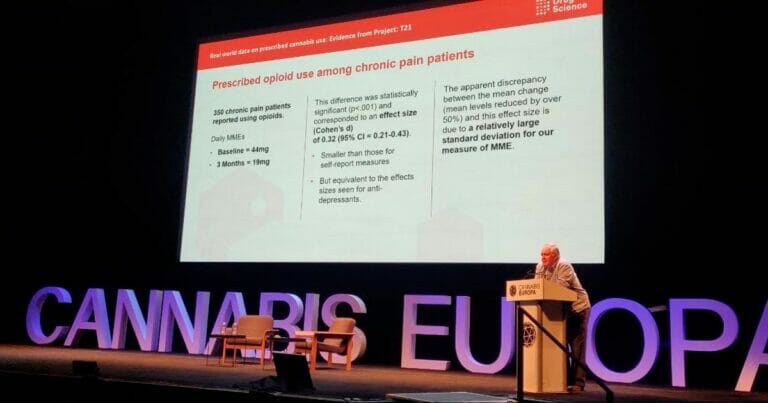
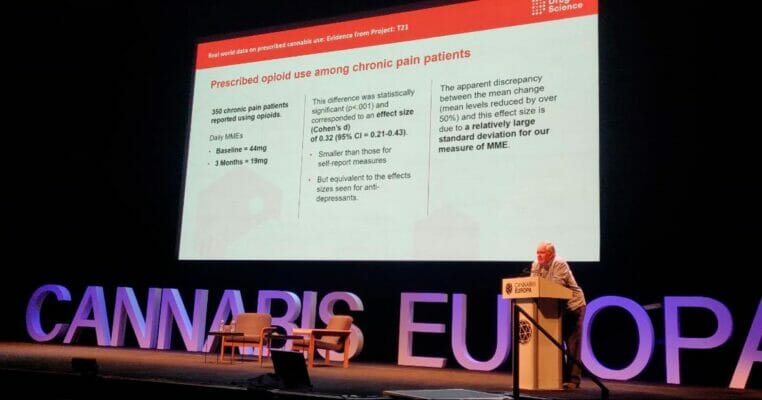
The day ended with a keynote from fellow cannabis industry pioneer, Professor David Nutt, who gave the audience an exclusive insight into the groundbreaking Project Twenty21 initiative spearheaded by drug science.

Professor Nutt presented the “truly remarkable” results of the three-year study involving around 3,000 patients looking at the effects of regular cannabis use on a range of specific conditions and on well-being general patient.

Cannabis Europa Conference

After three months of regular use, patients, approximately 50% of whom suffered from chronic pain and 41% from psychiatric disorders such as anxiety, saw a marked improvement in their overall health.

The improvement in sleep quality was also “very significant” and patient-reported measures of anxiety were reduced by nearly half.

” It is enormous. I doubt an anxiety trial would have had such a large effect.”

Patients with chronic pain and PTSD have also seen marked improvement, news that will be “very, very satisfying for patients”.

In addition, patients who were also using opioids to treat their disorders saw a significant reduction in their use, with the baseline milligram equivalent morphine (MEM) dose reduced from 44 mg to 19 mg.

“We have not changed the medication. I want to emphasize that these are patients who choose not to use opiates. And it’s not targeted. It is almost certain that we could do better if we bothered. »

“I believe this is now sufficient evidence to warrant proper systematic review, as the evidence we have provided regarding tolerability and efficacy is unquestionably outstanding. »

Broadening of the search

This isn’t the only groundbreaking cannabis research conducted by drug science which was on the agenda for day two, as a panel of experts looked at the potential of cannabis to treat long-term COVID, which is estimated to affect around 2 million people in the UK United from January 2023.

Hannah Thurgur, Head of Research at drug sciencebegan by explaining that the six-month, phase two feasibility study was primarily aimed at establishing the safety of treating these patients with a CBD-dominant compound, but also sought to explore the effects of cannabis on their quality of life, fatigue, depression and anxiety.

She explained that although the sample size was “smaller than we would have liked” (12 participants), the study showed promise in terms of worsening symptoms, even after stopping. of the treatment.

Dr. Dani Gordon, founder and medical director of the London Resilience Clinic, said: “At least you have prepared the ground for someone else to come and do the next phase of this study. These things are so bureaucratic, so it’s a very important job.”

Dr. Gordon went on to explain that she has found treating chronic fatigue with cannabis as part of an integrative medicine approach to be effective in helping patients engage with their treatment programs.

“If we manage to give them a bit more energy, then they can commit to the rest of the program. Cannabis is a catalyst that allows them to engage in the next steps of their program. Cannabis is the only thing I’ve found that can do that.”

This conference also opened a debate, which continued throughout the day, on the type of research carried out on medical cannabis, its cost and its value for patients and the medical industry.

Ms Thurgur suggested that despite some speakers dismissing real-world evidence in favor of randomized controlled trials, there was “real value in trying to see how more thoughtful representative populations of patients respond to different types of cannabis-based products, as well as being able to have a more personalized approach to this diversity”.

Cannabis Europe 2023Cannabis Europe 2023

A trio of one-on-one interviews on the changing role of the pharmaceutical industry in the European cannabis industry delved into this topic.

Robin Emerson, Managing Director of Jorja Emerson Centersaid the industry needs to “work a lot harder” to provide the clinical evidence we need to move the industry forward in the UK.

Terry O’Regan, of Brains Bioceuticalslargely agrees with this view, stating that the industry is “limited because nobody is doing these clinical studies,” which means starting from scratch.

“It breaks my heart to see these failed cannabis studies, and I wonder if it didn’t really work or if they just didn’t do the due diligence when it came to the dosage. These studies give a negative impression of this industry, and the last thing we want is for it to be relegated to some kind of homeopathic medicine.”

He suggested that involving the pharmaceutical industry was essential to obtain funding for this “expensive clinical research”, but that to do so the industry had to “hold itself to the highest standards”.

Finally, Dr. Mikael Sodergren, Curaleaf’s chief medical officer, spoke out against this idea, pointing out that the real data is now more widely accepted by the medical community.

“The MHRA, EMA and FDA have all issued press releases indicating that they are very happy to use real data to accelerate drug development. This data will never replace clinical trials – it won’t happen – but it certainly has a role to play in making the process faster and cheaper. »

“We have a feedback loop that is not available to the pharmaceutical industry in traditional drug development, which is real-world data. This type of registration program can be uniquely applied to medical cannabis. »

Lessons to be learned

Despite the growing momentum of cannabis research across the continent, the parallel momentum of adult-use markets threatens to undermine the former’s progress.

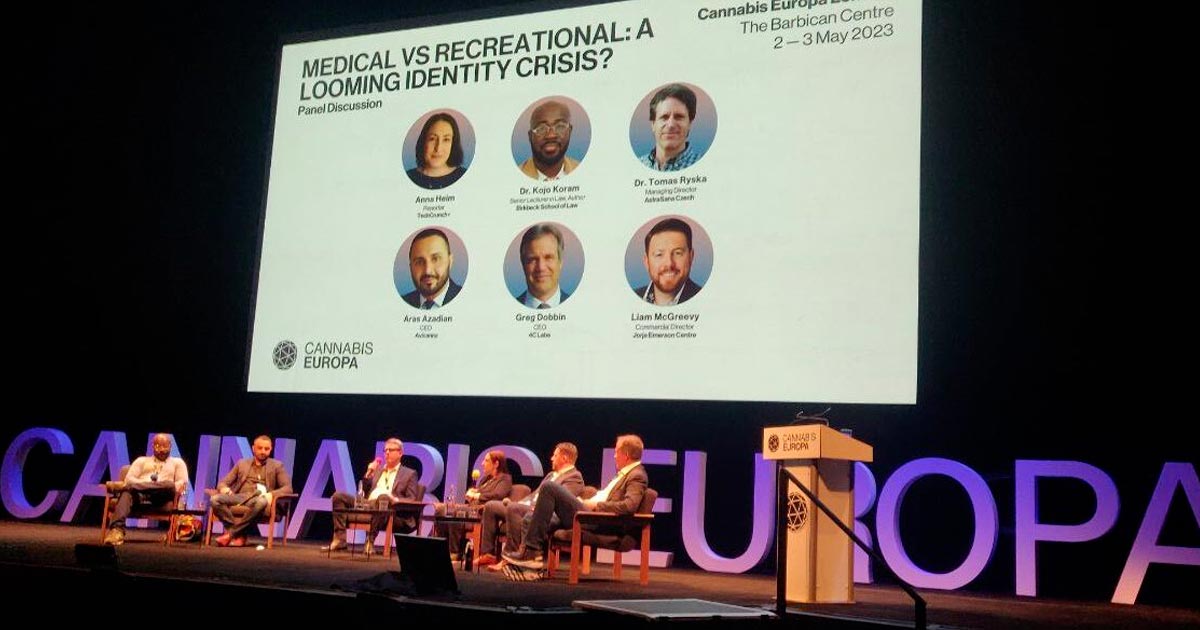
Aras Azadian, CEO of Avicanna, told a panel discussion about the growing “identity crisis” surrounding the adult and medical use markets that there was “much to learn from Canadian mistakes.”

“We have always insisted that medical use should come first, but we have seen the opposite. The industry has been so focused on enriching recreational use, which has never happened, that the medical market has been neglected. »

“Because we knew recreational cannabis was coming, we had medical companies that were actually just recreational companies. The medical community was deceived into believing that there would be investment in trials and no one realized…The medical community was completely shocked by what happened”.

European CannabisEuropean Cannabis

According to him, after the arrival of the recreational market, physicians no longer engaged in the industry or wanted to be trained, many of them assuming that potential patients would simply turn to the recreational market.

Regarding Germany’s decision to “step back from recreational use”, he said he thought the news was “fantastic for patients”.

Dr Kojo Koram, from the University of London, insisted on this point: “I think that some policymakers feel that the problems with medical cannabis could be solved by a recreational market, allowing patients to access this drug through these routes. This risks undermining the legitimacy of both markets.”

In a later session on reasons to be optimistic about recent developments in Germany, Boris Moschowitz of Alephsana explained that he believed Germany could still be a leading example of regulation of the cannabis.

Unlike countries like Luxembourg, Spain and Portugal, where the legislation is “not well enforced”, he suggested that in Germany there was at least a “genuine will to enforce what they put down on paper”.

“If we manage to infuse this energy into all the other European countries, in one and the same direction, I am sure that we will succeed. »

To learn more about the first day, click here.

An LR MP wants to increase the cannabis fine to €10,000

MP Christelle D’Intorni, member of the Les Républicains party and elected representative of the Alpes-Maritimes, wishes to table a bill which would considerably increase the fines for cannabis consumption.

Currently, people caught in the act of consuming or possessing cannabis on the public highway are punished with a fine of 150 euros and a criminal record, as long as they respect a few conditions – having their identity card on oneself and being of legal age, for example.

Ms. D’Intorni, however, believes that this device is not a deterrent and wants to create “a real electric shock” by attacking consumers more broadly to reduce traffic.

In order to crack down more harshly on cannabis consumption, it proposes increasing the fine to 10,000 euros, and 15,000 euros in the event of a repeat offence, but also confiscating vehicles which have been used to purchase illicit substances, abolishing consumer grants and family allowances for parents of minor children caught in a situation of recidivism.

Beyond the fine, instead of the “one year in prison and a €3,750 fine” to which the use of cannabis in France is still liable, she wishes to increase the penalties to 2 years in prison and 45,000 € fine.

While there is no doubt that cannabis use is rampant in France, the question of whether increasing fines is the best way to tackle the problem will be debated. Today, only 34% of fines are actually paid. They are also mainly addressed to young people in the suburbs and have so far had no other effect than to impose fines.

Ms. D’Intorni’s proposal can be seen as a nod to the security side of the current drug policy, without any proposal for the health part. She will also be received soon by the Minister of the Interior Gérald Darmanin and not by the Minister of Health François Braun, who theoretically deals, like his European counterparts, with addictions and drugs.

It will then remain to be seen whether the proposal will actually be tabled and whether it would then find enough votes in the Assembly.

Cannabis Europa Londres 2023 – Jour 1

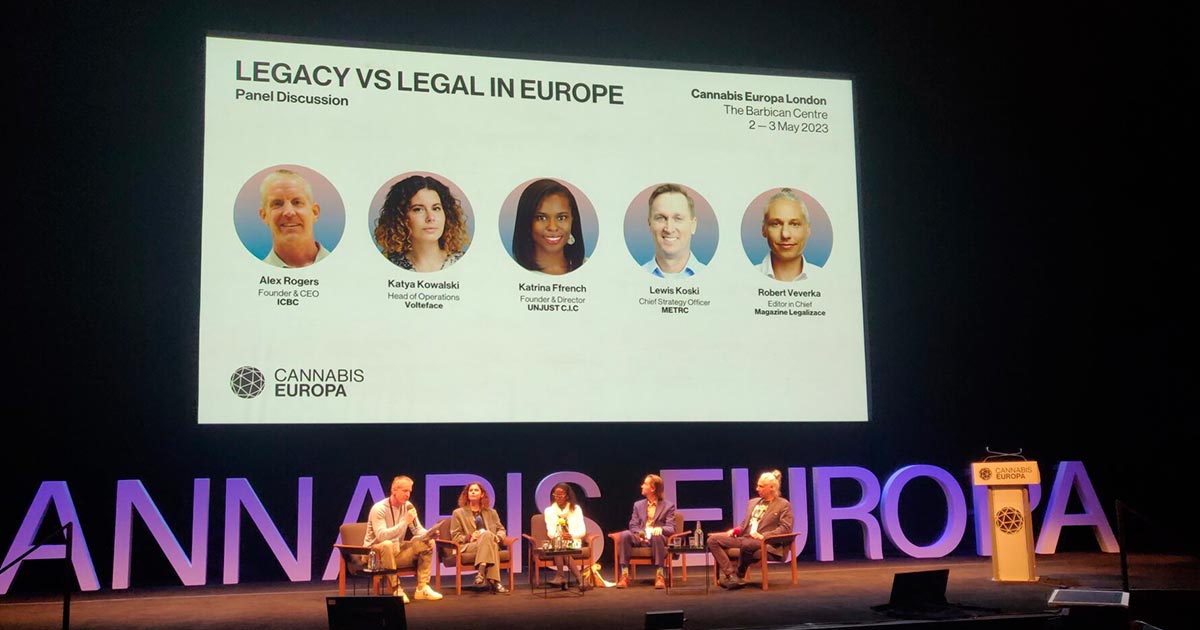
La neuvième édition de la principale conférence européenne sur le cannabis, Cannabis Europa, est revenue cette semaine au Barbican Centre pour la première fois depuis sa création en 2018, réunissant plus d’un millier de dirigeants de l’industrie, de décideurs politiques clés de toute l’UE et de représentants de patients.

Remarques préliminaires

Stephen Murphy, PDG de Prohibition Partners, a accueilli les participants dans le théâtre du Barbican le mardi matin, soulignant que le lieu était un « phare de la créativité » au Royaume-Uni, et déclarant que le besoin de « créativité dans l’industrie du cannabis » était aussi « essentiel ».

Revenant sur la première édition de Cannabis Europa en 2018, M. Murphy a rappelé qu’il y avait « peu ou pas de patients, d’entreprises ou de réglementations » dans l’UE.

Il a ajouté que s’il est facile de se sentir frustré par le manque de changement et de rythme dans l’industrie, nous devons nous rappeler le chemin parcouru en si peu de temps.

En outre, il a souligné qu’il est encore nécessaire d’intégrer les patients dans l’ensemble du secteur et que celui-ci doit continuer à placer les patients au centre de ses modèles d’entreprise.

C’est dans cet esprit qu’il a accueilli sur scène le sponsor principal de l’événement, Robin Emerson, directeur général du Centre Jorja Emerson.

Au cours de son discours, M. Emerson a déclaré au public qu’il s’agissait d’un « moment surréaliste » pour lui, après avoir commencé, comme de nombreuses personnes dans l’assistance, en tant que membre de la famille d’un patient ayant consommé du cannabis à des fins médicales.

Il a raconté l’histoire de sa fille, Jorja, et les améliorations que le cannabis médical avait apportées à sa vie, déclarant que « naturellement, j’ai décidé de faire du cannabis médical ma vie ».

Ensuite, il a révélé en exclusivité à Cannabis Europa que l’histoire de Jorja sera bientôt racontée dans un documentaire, dans le but d’accroître la sensibilisation et l’accès, et d’aider son entreprise à « secouer l’industrie ».

État des lieux – Allemagne, République tchèque et Suisse

Le premier d’un trio de discussions sur l’état de la situation dans la session du matin était centré sur l’Allemagne, qui, suite au changement de cap spectaculaire annoncé par le gouvernement du pays le mois dernier, a attiré une foule nombreuse.

Le modérateur du panel, le rédacteur en chef de Krautinvest Moritz Förster, a commencé par poser une question directe sur le degré de satisfaction du panel à l’égard du document d’orientation récemment annoncé, et Dirk Heitepriem de BvCW a déclaré : « En tant qu’industrie, nous espérions davantage, mais nous avons toujours su qu’il s’agissait d’un marathon et non d’un sprint. »

Reconnaissant que tout ce qui concerne la libéralisation du cannabis est un pas en avant, il a précisé que le « premier pilier ne sera pas facile » à mettre en œuvre.

En tant que structure à but non lucratif, l’industrie ne semble pas avoir d’autre rôle que celui de soutien », a-t-il ajouté, déclarant que le deuxième pilier de l’étude pilote constituait à l’inverse une « énorme opportunité ».

« Nous devons aller de l’avant très rapidement, faute de quoi nous laisserons le marché illicite prospérer. »

Julian Wichmann, cofondateur du Bloomwell Group, a déclaré que, pour lui, la partie la plus importante de la nouvelle législation était la « reclassification », mais il a ajouté que cette reclassification pourrait intervenir en 2024 ou plus tard.

En ce qui concerne le rôle de l’industrie dans un marché centré sur les Cannabis Social Clubs, le panel a convenu que, bien qu’il ne s’agisse « certainement pas d’une structure qui remplacera le marché illicite », l’industrie a un rôle clé à jouer en partageant la base de connaissances qu’elle construit depuis six ans, en veillant à ce que le projet ne « parte pas de rien ».

Bien que les spéculations sur les projets pilotes à venir soient timides, étant donné le manque de détails fournis par le gouvernement jusqu’à présent, le panel a déclaré que les données obtenues au cours de ce processus seraient cruciales pour « convaincre davantage d’États membres de l’UE de changer de politique ».

République Tchèque et Cannabis Europa

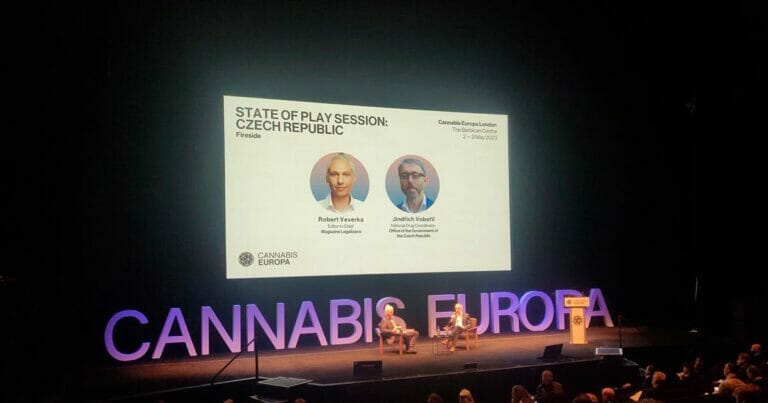
Le panel suivant s’est intéressé à la République tchèque, où le coordinateur national des drogues, Jindřich Vobořil, a déclaré qu’il pensait désormais qu’il y avait suffisamment de données sur les marchés de l’alcool et du tabac pour prouver que la prohibition ne réduisait pas les dommages, mais que la réglementation les réduisait.

Il a ajouté que la République tchèque était désormais  » seule dans sa quête  » pour lancer un marché commercial à part entière, et qu’il était « en train de rédiger une proposition pour un marché commercial et la vente dans les dispensaires et les pharmacies ».

Tout en déclarant qu’il n’y avait pas encore de consensus au sein de sa propre coalition sur la manière d’aller de l’avant, il « croyait que c’était possible, sinon je ne ferais pas pression en ce sens ; je suis trop vieux pour perdre mon temps sur quelque chose que je ne peux pas faire ».

« Il est très difficile d’avoir un débat au niveau de l’UE sur ce sujet car les pays ont des opinions et des cadres juridiques très différents. L’UE est une grande idée, mais elle est très bureaucratique et, à bien des égards, très en retard sur ce sujet. »

« La voie à suivre est celle que nous suivons. Chaque État modifiera sa législation et fera pression sur l’UE. »

« Les conférences sont une bonne chose, mais nous devons prendre des mesures concrètes. Je le dis franchement, nous avons besoin d’un lobbying fort et de campagnes, de mettre de l’argent sur la table et d’éliminer l’anxiété inutile des politiciens en les éduquant ».

La dernière session « État des lieux » a porté sur la Suisse qui, comme l’a souligné Luc Richner, PDG de Cannavigia, est désormais considérée comme un précurseur européen dans ses efforts de libéralisation du cannabis.

Il a ajouté que l’un des aspects du modèle suisse qui « passe souvent inaperçu » est que les autorités du pays « ont permis à tout le monde de se réunir et de proposer des études sur la manière dont cela pourrait fonctionner », ce qu’il considère comme une approche très « orientée vers l’avenir ».

« Même dans un petit pays, il y a tellement d’approches sur la façon dont cela va se passer, et je pense que c’est très important pour ce qui se passe en Europe. Je ne pense pas que nous ayons la réponse, car personne n’a la réponse. Je pense que nous pouvons contribuer à l’éclairer. »

La réduction des risques et le marché traditionnel

L’accent a ensuite été mis sur l’impact potentiel des politiques sur les patients et les consommateurs de cannabis.

Lors d’une table ronde consacrée à la réduction des risques, Lisa Townsend, commissaire de police et de la criminalité du Surrey, a déclaré qu’elle craignait que les deux principaux partis politiques du Royaume-Uni ne se préparent à une « guerre contre la criminalité… une course aux armements qui, en fin de compte, ne profitera à personne ».

Elle a ajouté que, bien qu’elle ne souscrive pas à l’argument selon lequel le cannabis est une drogue d’introduction, il est en train de devenir une drogue d’introduction pour les gangs criminels qui se sont traditionnellement concentrés sur le commerce de la cocaïne, mais qui se tournent de plus en plus vers le cannabis.

En ce qui concerne les développements actuels en Irlande, le député européen Luke Ming Flanagan a déclaré qu’il espérait que l’Assemblée des citoyens sur le cannabis aurait un impact positif sur l’opinion publique et la politique du gouvernement, citant le succès d’initiatives similaires sur le mariage homosexuel et l’avortement.

« Beaucoup de gens étaient sceptiques quant au groupe d’experts (de l’assemblée des citoyens), mais après avoir suivi les premiers débats, il est clair que les citoyens irlandais sont très en avance sur la norme politique sur ce sujet. Il n’y aura pas de référendum sur le sujet, mais cela mettra la pression sur les politiciens. »

« Ce n’est pas aussi progressiste que je le souhaiterais, mais l’assemblée des citoyens fera avancer les choses. En Irlande, les hommes politiques légaliseraient la consommation de poulet cru si une assemblée de citoyens le recommandait. »

Cannabis Europa conférenceCannabis Europa conférence

« Si l’on en croit les sondages d’opinion au Royaume-Uni, il n’a jamais été aussi facile, d’un point de vue politique, de parler de la légalisation du cannabis. J’ai du mal à comprendre pourquoi un grand parti politique britannique ne se prononce pas en faveur de cette mesure – vous perdrez des voix et vous ne saurez pas quoi en faire. »

Bell Ribeiro-Addy, députée du parti travailliste, a déclaré qu’il y avait actuellement un « message très contradictoire » sur le cannabis, qui est toujours dépénalisé malgré l’existence d’une industrie médicale privée florissante.

Elle a également soulevé la question de la criminalisation disproportionnée au Royaume-Uni, bien qu’il n’y ait aucune preuve d’une augmentation de la consommation de drogues dans les communautés de couleur.

Ce point a été approfondi lors de la dernière session de la journée par la fondatrice d’Unjust CIC, Katrina Ffrench, qui a déclaré : « En tant qu’homme noir, vous êtes considéré comme un criminel : « En tant qu’homme noir, vous avez neuf fois plus de chances d’être arrêté et fouillé pour du cannabis. »

« Il incombe aux entreprises et aux gouvernements de comprendre comment la prohibition a nui à ces communautés ».

L’accent mis sur les investisseurs

L’après-midi a commencé par une succession de panels consacrés au point de vue des investisseurs.

Les participants à la première session, intitulée « Un changement de vitesse pour le cannabis en Europe », ont plaisanté en disant qu’il s’agissait plutôt d’un « frein à main » au cours des 12 derniers mois.

Après avoir prévenu qu’il était peu probable que la session connaisse un « démarrage dynamique », Sam Volkering, rédacteur en chef et directeur des investissements chez Southbank Investment Research, a suggéré que si une entreprise « n’a pas été rentable ou n’a pas assez de liquidités, personne ne veut placer de l’argent près d’elle ».

Sean Stiefel, PDG de Navy Capital, a déclaré qu’à son avis, « le plus grand obstacle à l’investissement est le manque de clarté réglementaire ; même si vous pensez que l’entreprise est solide, vous n’avez aucune idée de sa durée de vie ».

« Il ne faudra pas grand-chose pour redonner de l’enthousiasme au secteur. D’un autre côté, au cours des deux dernières années, on a vu des modèles d’entreprise qui ne fonctionnaient tout simplement pas. »

Pour les entreprises qui ont échoué, il a laissé entendre que la consolidation n’était pas un sujet sur lequel son entreprise était « optimiste », étant donné qu’il restait d’importants obstacles au transfert des licences et que bon nombre de leurs installations étaient désormais obsolètes.

En ce qui concerne la nouvelle selon laquelle le géant financier Euroclear s’est récemment retiré du cannabis, Nick Davis, de Memery Crystal, a déclaré : « Le ministère de l’intérieur pourrait intervenir très rapidement. Jersey a clarifié la loi sur les produits du crime – ce n’était pas particulièrement difficile à faire. Non seulement l’incertitude règne autour de l’usine, mais au Royaume-Uni, il y a ce problème de produits du crime. »

« Si vous êtes un investisseur en 2023, le cannabis est probablement plus risqué que jamais, et les marchés ont une aversion pour le risque. Il faut être un investisseur d’avant-garde pour prendre ces risques à l’heure actuelle. Je reste persuadé que les rendements sont au rendez-vous ».

Le marché était similaire de l’autre côté de l’Atlantique, selon M. Stiefel, qui a déclaré à l’auditoire : « La liquidité pour les opérateurs américains est la plus élevée de l’Union européenne. La liquidité des opérateurs américains n’a jamais été aussi faible. Il est plus difficile que jamais pour un investisseur de se réveiller et de décider d’investir dans le cannabis. En outre, le nombre d’entreprises intéressantes et susceptibles d’être investies n’a jamais été aussi faible dans le secteur du cannabis ».

En accord avec les déclarations précédentes du panel, il a déclaré qu’il devenait clair que l’industrie du cannabis ne soutiendrait jamais des centaines de milliers d’entreprises, mais qu’à l’instar de l’alcool, il y aurait « quelques conglomérats, un tas d’artisans et de gars régionaux ».

« Je dirais que, au moins aux États-Unis, d’ici à la fin des temps, il y aura moins d’entreprises de cannabis. »

« Je reste persuadé que le marché américain atteindra les 100 milliards de dollars. Nous pensons donc qu’il y a beaucoup d’avantages pour ceux qui vont réussir, et chaque jour, il devient de plus en plus clair de qui il s’agit ».

Moroccan farmers will be able to start growing cannabis legally

Moroccan authorities announced on Sunday the official start of the first season of legal cannabis cultivation in Morocco, two years after the country’s parliament passed a law aimed at regulating an already widespread activity.

The first batch of cannabis seeds, imported from Switzerland, Uruguay, Hungary, Bulgaria, Italy and the United States, was delivered to farmers and agricultural cooperatives in the northern provinces of Al Hoceima, Chefchaouen and of Taounate. The varieties have not been disclosed but the origin of the seeds most likely indicates varieties intended for industrial use with THC levels between 0.3 and 1%.

Local media reported that the cannabis seeds distributed for the 2023 season will cover 105 hectares of land, with over 170 farmers involved in the process.

The Moroccan government says the number of farmers benefiting from these permits will increase to 500 during the next agricultural season.

One of the investors who imported seeds from Switzerland said that the distribution of seeds, around 760,000 seeds, gave the farmers a boost and encouraged them to commit to this ambitious project. He added that in the next crop year, 500 farmers will be targeted.

“Our commitment to this strategic project as investors in the country is natural given that my field of work is agriculture. After reviewing the project and its study, we decided to commit to it,” the investor told Moroccan media Hespress.

The process of importing cannabis seeds is subject to strict rules. Importers must obtain special authorizations from the Ministry of the Interior and the Ministry of Agriculture.

Farmers must be formal members of state agricultural cooperatives. Those who received the seeds had to sign receipts in order to track the quantities distributed.

Only 10 days left until the CannaTrade!

Only 10 days before the CannaTrade and the conference program is now complete.

High-level speakers from all over the world will discuss current topics around the legalization of cannabis in Switzerland and Europe, but also women in the cannabis industry and what cannabis does for women, from prohibition of cannabis and the simplified distribution of medical cannabis in Switzerland.

The conference program is available here: https://www.cannatrade.ch/en/program

Cannabis legalization in Europe is moving slowly

Germany announced its light legalization project with authorization for personal cultivation and Cannabis Clubs, followed by regional pilot projects. The latter, Switzerland already knows them: the Swiss pilot projects have been in progress since January. The Netherlands is also working very actively on the “Dutch Weed Experiment”. This topic and many more will be discussed at CannaTrade!

Cup juror?

The CannaSwissCup 2022/23 Jury Cards featuring the top 32 strains of CBD flower and hashish will be available exclusively at CannaTrade for just CHF 49.

Cannatrade
From 12 to 14 May 2023 in Zürich
All information https://www.cannatrade.ch/fr/

The plan to legalize cannabis in Germany presented to the government

German Health Minister Karl Lauterbach has submitted to members of his government the bill to legalize the possession and self-cultivation of cannabis as well as Cannabis Clubs, the first phase of a two-part reform.

The legislative text must now be proofread and amended if necessary before finalizing it and sending it to the legislators.

“Promise kept. Comments are welcome,” Lauterbach said in response to media coverage of this latest development.

Although the draft legislation is not yet publicly available, sources confirmed to German media RND that the proposal would allow adults to possess up to 25 grams of cannabis and grow up to three plants for personal use. It would also authorize Cannabis Clubs where growers could distribute their harvest, similar to what is done in Spain and Malta.

Mr Lauterbach said last month that adults over the age of 21 could buy no more than 50 grams per month in clubs, and that sales to adults aged 18 to 21 would be limited to a total of 30 grams per month .

The framework provides for a limit on THC content, although the details are to be clarified later, as well as a ban on advertising for associations or for cannabis in general.

On-site consumption would not be allowed in the clubs, but the clubs could distribute up to seven seeds or five cuttings per month to each member for use in their own cultivation.

Although German authorities have apparently backed off from their initial plan to establish a nationwide commercial cannabis market, it is expected that there will eventually be a second complementary framework allowing the sale of cannabis to retailers in certain jurisdictions, as part of a pilot program that would allow the country to evaluate further reforms over a five-year period.

Specifically, authorities will study the impact of stores on consumer trends and the illicit market. Localities will have to choose whether to allow these stores to open.

Germany will ask the European Union (EU) to approve this aspect of the draft law relating to sales “under research”. Provisions for possession and home cultivation will not be subject to European scrutiny.

An African plant produces cannabinoids similar to cannabis

A South African plant with the sweet Latin name of Helichrysum Umbraculigerum is known to produce cannabinoids usually found in Cannabis, some of which may have new medical uses.

In a study published in the journal Nature Plants, researchers from the Israeli Weizmann Institute have identified more than 40 cannabinoids in this variety of Helichrysum. The team revealed the series of biochemical steps the plant takes when making these compounds and also showed how these steps can be replicated in the lab to synthesize or even engineer new cannabinoids.

“We have found an important new source of cannabinoids and developed tools for their long-term production that can help explore their enormous therapeutic potential,” said Dr. Shirley Berman, who led the study, at Jerusalem Post.

This variety of Helichrysum is traditionally eaten in South Africa. German scientists had already studied the plant in 1979 and found cannabigerol (CBG), the cannabinoid that gives rise to the others in Cannabis.

Today, Berman and his colleagues, using a battery of advanced technologies, have confirmed this first report, as well as the presence of CBGa, the precursor of CBG. On the other hand, they found neither CBD nor THC, but sequenced the entire genome of theHelichrysum Umbraculigerum and used advanced analytical chemistry techniques, including high-resolution mass spectroscopy, to identify the types of cannabinoids it contains.

Using nuclear magnetic resonance, researchers have revealed the precise structure of more than a dozen of these cannabinoids and other related metabolites. They traced the entire biochemical pathway involved in the production of cannabinoids and determined where in the plant they are made.

The plant produces its cannabinoids mainly in its leaves, unlike Cannabis where it is the flowers that produce these active ingredients. Despite this difference, scientists have found many commonalities between Helichrysum and Cannabis. In particular, the enzymes used in each step of their cannabinoid production process belong to the same families throughout the first half of the biochemical pathway.

“The fact that during evolution two genetically unrelated plants independently developed the ability to produce cannabinoids suggests that these compounds serve important ecological functions,” Aharoni suggested. “Further research is needed to determine what these functions are. »

Dr. Aharoni’s team has already taken their latest insights into cannabinoid genetics a step further, using them to generate the newly discovered cannabinoid-making enzymes in tobacco plants. Researchers have also successfully used these enzymes to create finished cannabinoids in yeast, hinting at a new method of making the compounds for research and the biotech industry.

In the future, the results of the study may even lead to the manufacture of cannabinoids that do not exist in nature. These could be designed to bind better to human forms of cannabinoid receptors, for example, or to achieve specific therapeutic benefits.

“The next exciting step will be to determine the properties of more than 30 new cannabinoids that we have discovered, and then see what therapeutic uses they might have,” Berman concludes.