Home Blog Page 31

Scotland calls for drug decriminalization

The Scottish government says the war on drugs has “failed” and it’s time to decriminalize currently illegal substances, while promoting harm reduction services such as overdose prevention centres.

At a press conference on Friday July 7, Scotland’s Minister for Drugs and Alcohol Policy, Elena Whitham, called on the government of the United Kingdom, of which Scotland is a part, to adopt a public health approach to drug addiction and to abandon the model of criminalization.

Representatives of the British Prime Minister – and even the country’s Progressive Party – have already rejected this request.

Call for decriminalization

Scotland’s position on the issue is partly supported by a policy paper released the same day, which sets out the country’s position on decriminalization and related issues.

As well as ending the ban on personal possession of controlled substances, Scotland is calling for the legalization of safe drug use centres, greater access to naloxone, a drug to reverse overdoses, and the authorization to expand drug testing services to mitigate the risk of contamination in the illicit market.

“These are ambitious and sweeping, evidence-based proposals that will help save lives,” said Elena Whitham. “We want to create a society where problematic drug use is treated as a health issue, not a criminal issue, thereby reducing stigma and discrimination and enabling the person to recover and contribute positively to society. . »

“We know these proposals will spark debate, but they are consistent with our approach to public health and would contribute to our national mission to improve and save lives,” the minister said. “We are working hard within the powers we have to reduce drug deaths and, although we still have a long way to go, our approach is simply at odds with the law of Westminster in which we have to operate.

The report and Friday’s announcement comes almost four years after Scotland’s ruling party approved a resolution backing the decriminalization of drugs in Scotland.

UK rejection

But the British government in Westminster was quick to reject the reform proposal. Asked if Scotland’s request to review drug laws could be granted, a spokesman for the Prime Minister told STV News the answer was “no”.

The representative said that, although he has not seen Scotland’s report on decriminalisation, “I am confident enough to say that there are no plans to change our tough stance on drugs”.

This is not particularly surprising, with UK Prime Minister Rishi Sunak making it clear that he was aligning himself with the drug criminalization model, saying the government would step up the fight against drugs, implying a ” reinforcement” of the police force and the prohibition of nitrous oxide.

Senior Labor official Rachel Reeves also said Scotland’s proposal was unlikely to go ahead.

“I don’t think it’s good policy,” she said. “I find it quite staggering that this is a priority for the Scottish Government,” amid unrelated government controversy.

The Scottish Department of Drugs and Alcohol Policy report calls for ‘changes to the legal framework within which Scotland responds to the drug death crisis, to enable us to tailor policy decisions to our particular challenges.

“The overriding ambition of the Scottish Government’s national mission is to reduce deaths and improve lives. “Our goal is that no one becomes dependent on substances, but if they do, they are supported and not criminalized for this condition. »

“These goals will continue to guide our drugs policy, whatever legal framework we operate within, and we will work tirelessly to reduce drug harm within Scotland’s devolved powers,” continues the document. “We can and will do much more to reduce deaths and improve living conditions within these powers. »

Spain won’t see medical cannabis regulation until next election

After months of delay by the Spanish government, the country’s health minister has confirmed that the regulation of medical cannabis will not come into play until after elections this month.

In May, Spain’s new health minister, José María Miñones, in his first appearance before the lower house’s health committee, promised to present the long-awaited document before the end of the month.

More than six months after the report was due, progress was halted yet again when Spanish Prime Minister Pedro Sánchez announced he was calling a snap election, which led to the dissolution of parliament.

Speaking to local media last month, Mr Miñones suggested that while he had indeed received the report from the Spanish Agency for Medicines and Health Products (AEMPS) at the end of May, “he is true that with the election period, the hemicycle does not work”.

“As soon as parliamentary activity resumes, my first commitment will be to deliver this report and continue to take action.”

Mr. Bezanilla explained to Business of Cannabis that with the official dissolution of Parliament, it was no longer possible to adopt new laws, and that only a permanent committee of deputies remained for constitutional “emergencies”.

“We don’t have time to regulate cannabis in this legislature. The session period is over. The laws that were under review or in working committee have become obsolete. »

“Formally, for urgent or exceptional reasons, a government could approve what it wants by decree, such as a medical cannabis law. In this case, it would be the next parliament that would vote on whether this decree is consolidated in law or, on the contrary, whether it becomes null and void. »

Regulation in danger with the future government

As speculation swirls about the future of medical cannabis in Spain, Mr Bezanilla says it may hold more promise than the current administration.

“The reality is that this government does not believe in medical cannabis and never intended to regulate it. Why would they do it now, in a hurry, by decree, and in the midst of an election campaign? »

Asked if he thought the PP would continue to press ahead with plans to establish a medical cannabis market in Spain, given that he had voted against the proposals last year, Mr Bezanilla replied: “Yes, without a doubt”.

“This is a supranational issue. The European Union recommends it, and within the next four years medical cannabis will be approved in Spain and the majority of European countries. »

“On the other hand, conservative parties have always been at the origin of the adoption of laws in favor of patients and medical cannabis. »

“We have the governments of Santos in Colombia, of Trudeau in Canada, of Sharon in Israel, of Merkel in Germany, and a long list of countries where Uruguay and Portugal – with progressive governments – have been the exceptions. This is why we must reassure patients”.

However, this position is not shared by all, in particular by Albert Tió, president of the Federation of Self-Regulating Cannabis Associations of Catalonia (FEDCAC), also a member of the Green Light party (Luz Verde).

He declared to Business of Cannabis “I think that if the conservative parties win the elections, it will be difficult to hope for an evolution of the medical regulation project. And even if the PSOE wins, we see the new Barcelona board saying they will try to shut down as many Cannabis Social Clubs as possible, so that’s really a step backwards, and the future doesn’t look very bright. »

“That is why we are going ahead and trying to organize participation in legislative parliaments to try to propose legislative reforms from within. »

Still work to do

If the project is maintained by the new government, it is clear that even with the AEMPS report, there is still a lot of work to be done. As Mr. Bezanilla explains, “even if the government were to urgently approve a cannabis law by decree, there would be no budget for its implementation, which would practically amount to no law at all. . Patients deserve much more. »

“In Spain, we don’t have a draft law, nor a consensual text. A statement of intent was approved by an information committee and someone sold us the idea. The problem is that these intentions have not been very firm,” he continued.

“It is time to build a medical cannabis law from scratch. And we will have to do it through the established parliamentary channels: we must create a legislative committee on the subject, call on experts to provide information, propose a bill, pass this bill through the plenary assembly of Congress for approval , then by the Senate, and finally assenting to it as law and publishing it in the Official State Gazette (BOE). »

“Fortunately, the elections are approaching. Then it will be up to patients and companies to start crafting a law from scratch. Science is on our side. Medical cannabis will be regulated in the next legislature, that’s for sure.”

Germany publishes first draft law on recreational cannabis

The German Ministry of Health has unveiled the first official draft of its bill to legalize cannabis and submitted it for consideration by state officials and the public.

Health Minister Karl Lauterbach said the country “can dry up the black market and fight crime by making it possible to sell cannabis to adults within clear limits”. He also pointed out that safeguards would be put in place to prevent young people from having access to cannabis.

Details of the future legalization of cannabis in Germany

The proposal would allow adults aged 18 and over to grow a maximum of three plants for their personal use. People would not be allowed to make concentrates from the cannabis.

Personal possession would be limited to 25 grams, with exceptions for people working in Cannabis Social Clubs. These Clubs could not be located within 200 meters of a school, and each town or district could only have one club for every 6,000 inhabitants.

The license to operate a Cannabis Club would be valid for a maximum of seven years, with the possibility of obtaining an extension after five years. According to the bill, membership in the Clubs should last at least two months.

After an administrative review, the first pillar of the legalization plan is expected to be submitted to cabinet next month. Authorities aim to separately release the second pillar which will concern the establishment of a pilot program for commercial cannabis sales in the second half of this year.

“Current developments show that cannabis use is increasing, especially among young people, despite existing prohibition regulations,” says the summary of the new bill.

“The law aims to contribute to better health protection, to strengthen cannabis education and prevention, to curb the illegal cannabis market and to strengthen the protection of children and young people. To protect consumers, it is necessary to control the quality of cannabis intended for consumption and to prevent the transfer of contaminated substances”.

“The bill will facilitate the responsible use of cannabis by consumers” can we read. “Private self-cultivation, non-commercial community self-cultivation and the controlled transfer of consumer cannabis to adults for their personal consumption are made possible. »

The 163-page summary of the bill also presents an estimate of the costs of implementing and regulating the program, as well as savings from reduced controls and new revenue expected to be generated from payroll taxes. people working in Cannabis Clubs.

As the German government works to move the first part of the legalization forward, there are plans to send legislation on the separate commercial pilot program to the European Commission for review before passing it into law.

The measure, as previously described by the authorities, would allow the sale of cannabis by retailers in certain jurisdictions in the country and as part of a pilot program that would allow the country to evaluate the continuation of the reform. over a period of five years. Specifically, authorities would study the stores’ impact on consumer trends and the illicit market. Localities will have to choose whether to allow these stores to open.

The health minister first released details of the revised legalization plan in April. The following month, he distributed the legislative text to cabinet members.

Zkittlez will have to change its name

Terphogz LLC, which owns the Zkittlez brand, has accepted a permanent court order agreeing to no longer use the terms Skittles, Zkittlez, or similar terms to sell cannabis-related products. reported Reuters yesterday.

The move follows a lawsuit in which Wrigley, the maker of colorful fruity Skittles candy, accused Terphogz of trademark infringement.

Terphogz LLC accepts permanent injunction

Terphogz will also stop using slogans such as “Taste the Z Train” and “Taste the Strain Bro”, which Wrigley felt were too similar to Skittles’ longtime slogan “Taste the Rainbow”.

Additionally, Terphogz has agreed to relinquish the zkittlez.com domain name, although it may continue to use the letter “Z” if there is no confusion. Terphogz also “already uses The Original Z” on its packaging.

The proposed settlement still needs to be approved by the court. Attorneys for Wrigley and Terphogz have not yet responded to requests for comment.

Wrigley, a subsidiary of privately held Mars, claims Terphogz damaged nearly 50 years of Skittles brand awareness by “unfettered use” of Skittles’ marks to sell cannabis, consumables and other products. products, some of which also carry the rainbow theme.

The announcement of the legal action was made two years ago, in May 2021, followed by a response from the breeder. In November 2021, a judge denied Terphogz’s request to dismiss the case.

Terphogz, headquartered in Mendocino, Calif., said it does not sell cannabis itself, but licenses its intellectual property rights to other companies that sell cannabis legally. , as court documents show.

Other varieties such as Girl Scout Cookies – now GSC – or Gorilla Glue – now GG4 – also had to change their names following legal proceedings.

How is cigarette paper made?

Cigarette paper is not a paper like the others. Its weight varies from 12 to 25 g/m² in order to be able to garnish it with tobacco and roll it easily. But how is cigarette paper made? Let’s take a look in this article.

Everything you need to know about cigarette paper

Cigarette paper or rolling paper was made from flax and hemp fibers, but also scraps of veils or military fatigues. From the start, it was necessary to create specific machines and very quickly, industrial models replaced stones and sandblasters.

Many stories come to tell the manufacturing method of yesteryear. The best known is surely that of Jean Bardou who, in 1838, wrote a tutorial with removable sheets of rolling paper. In 1842, he filed a patent and launched his famous JOB brand.

Making cigarette paper like the good old days

After sorting and tearing the fabric to shreds, it was leached out in hot steam. This pile of laundry then passed under a heavy cylinder to crush and cut it. The “waste” was collected in a small channel (buttons, nails, coins, etc.) and the rest of the laundry continued to be kneaded and then washed in clear water. The role of the washing drum was then to obtain the final defibration. It was only then that the pastry press came into play, allowing the fabric to look like moist, yellow cakes about a centimeter thick. The pulp was then ready to be bleached.

Several chemicals are added to the resulting pulp to whiten it. Then comes the refining stage requiring the intervention of cylinders and tanks. The paste was then sent to the vat room to be mixed before landing in the hourglass to evacuate the remaining impurities. Then it’s time to move on to the purifier. The pulp obtained is then ready to go through the paper machine.

After being crushed and vacuumed, the sheet of cigarette paper was calibrated then rolled up before being packaged.


Florida Governor Bans Medical Cannabis In Healthcare Facilities

Florida Governor Ron DeSantis has signed a bill that prevents residents of health care facilities from using medical cannabis. This prohibition applies even if the cannabis was prescribed by a doctor.

The move follows DeSantis’ admission last week that he would not federally decriminalize cannabis if he won the 2024 presidential election. It was possible that it contained fentanyl and that people “could die just from ingesting it”, despite testing of cannabis products in regulated markets.

The bill DeSantis signed last week – SB 210 – dealing with addiction services, will require anyone seeking a license to establish a recovery center to prove that it does not authorize the use of medically prescribed or adult-use cannabis.

Additionally, DeSantis also vetoed the passage of a criminal justice reform bill — House Bill 605 — that would have changed state law regarding expunging criminal records, despite the announcement. of Biden regarding expunging cannabis-related criminal records.

The governor separately signed another law this month that allows doctors to renew medical cannabis recommendations to patients through telehealth and also takes steps to promote the participation of black farmers in the medical cannabis program of the state.

At the same time, a petition launched in Florida – where adult use is still illegal – in favor of legalizing the adult use of cannabis has collected enough signatures to be put to the vote.

ICBC Berlin: What does “plan B” mean for the German cannabis industry?

IInternational Cannabis Business Conference (ICBC) Berlin 2023 returned to the Estrel Berlin Hotel last week, welcoming thousands of guests, speakers and exhibitors.

A few weeks after the German government announced a major change in its plans to launch a commercial cannabis market, the conference was animated by discussions on the opportunities that remained for companies in the country, and on the next areas of opportunity.

This was naturally reflected in the conference’s speaker sessions and panel discussions, which saw a number of major industry players take the stage to analyze the state of play in detail.

Main lessons:

  • Germany is pursuing its ‘plan B’, a combination of ‘everything it could find’ that was allowed by EU and UN agreements
  • Many questions remain unanswered regarding pillars 1 and 2
  • The school exclusion zone of 250 meters for cultivation and consumption sites would mean that “almost all of Berlin will be an exclusion zone”, and without “floor markings” it would be difficult to enforce it
  • Pillar 1 was supposed to be implemented this year, but it seems to be early 2024 instead. The timeline for Pillar 2 is unclear, but there is motivation to move it quickly
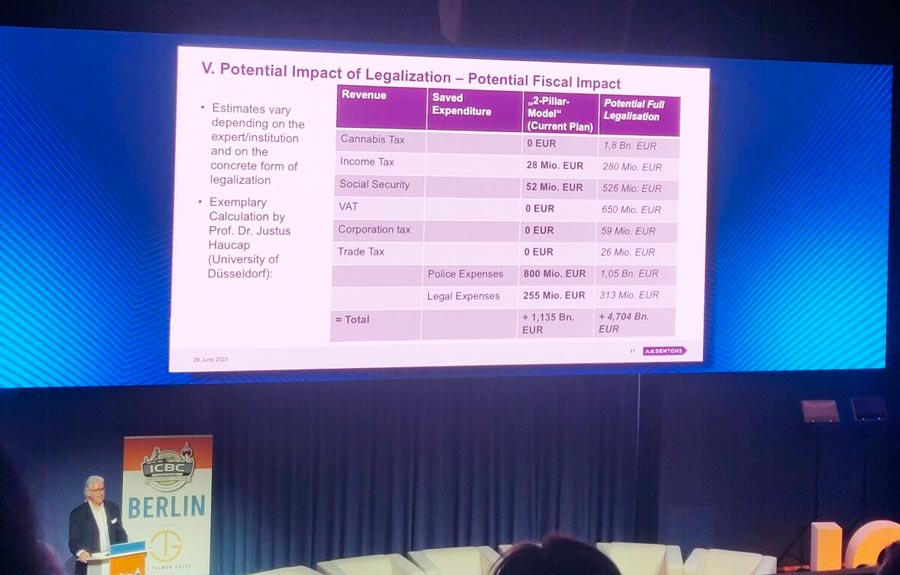
  • The current plan is expected to generate annual revenues of 1.135 billion euros, while the previous full legalization plan forecast revenues of around 4.7 billion euros
  • The most important change to come is the removal of “all cannabis-related active substances” from the list of narcotics and their transfer to a new cannabis law, which could have a significant impact on the medical market.
  • While ‘disappointing’ for business, the new legislation nevertheless means that Germany is ‘spearheading’ European cannabis reform, with no country but Malta – and now Luxembourg – offering such liberal laws. on cannabis.
ICBC Berlin 2023 - report

The opening session, led by Peter Homberg, partner at business law firm Dentons, reviewed what we know, and what we don’t, about the current proposals presented by the German government in April.

Homberg explained that the German government presented its initial proposals for an adult cannabis market to the European Commission (EC) in October 2022, “as part of an informal process asking the EC if we could TO DO “.

He said the move was part of an effort to avoid being reprimanded again by the Court of Justice of the European Union, after recently suffering a “big defeat” for his policies of Data protection.

“What happened, no one says clearly, but I will say it clearly. They said no. »

“They didn’t authorize what we had planned in October… So what happened? A plan B.”

He added that this “plan B” was created by the German government who “looked in the box and took everything they could find” that was allowed by EU and UN agreements, which resulted in a “disappointing for the industry” strategy.

With the new strategy leaked to the press in May, Homberg hinted that a number of practical questions still remained unanswered.

The first question concerns the first pillar of the new proposals and the launch of Cannabis Clubs throughout the country, which, according to Mr. Homberg’s calculations, could be authorized to cultivate 300 kg per year per Club.

Since Cannabis Clubs will need to be located some distance from schools, it would be nearly impossible to find enough space in cities like Berlin, an issue that has been discussed in detail in subsequent panels.

With regard to the second pillar, which offers pilot studies on cannabis in the style of Switzerland, Mr. Homberg said that it was not yet clear whether these studies should be provided by domestic producers, such as the anticipated the initial proposals. If so, he believes that the offer would be very insufficient.

On a more positive note, Homberg referred to proposed changes to Germany’s narcotics law, which will see “all cannabis-related active substances” removed from the narcotics list and transferred to a new cannabis law.

This will have a potentially large impact on the medical cannabis market in Germany, as major barriers for patients and prescribers will be removed.

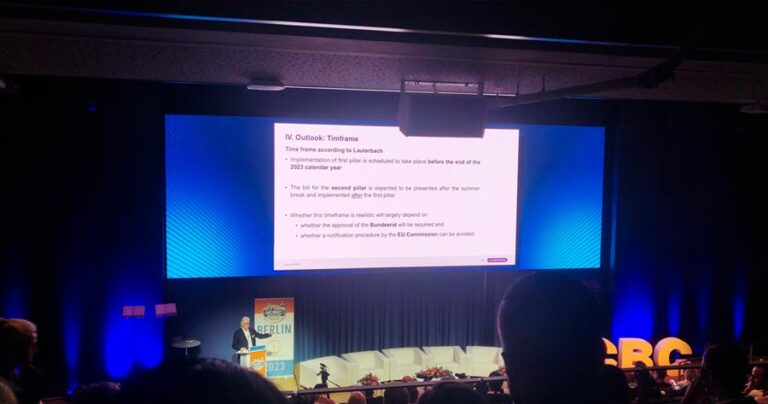
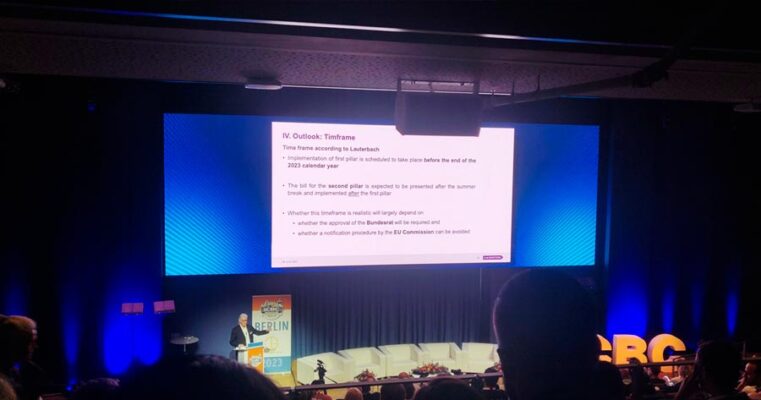
Regarding the implementation date of this new strategy, Mr. Homberg said that the first pillar should be implemented before the end of 2023. However, he said that “so far, we were a bit more pessimistic about the timeline,” suggesting it was more likely to be implemented in early 2024.

The second pillar is expected to be introduced after the summer holidays, another topic which was further explored later in the day.

ICBC Berlin 2023ICBC Berlin 2023

The current plan is expected to generate annual revenue of 1.135 billion euros, while the previous full legalization plan expected revenue of around 4.7 billion euros.

Georg Wurth, Director of the German Hemp Association, then presented his analysis of the current situation in Germany, during a session entitled “Can Germany do it? »

Responding directly to the title of the session, Mr Wurth said: “Germany won’t make it. In my opinion, full legalization will not happen in this decade, and that is disappointing.”

Despite this candid assessment, he went on to suggest that there was still cause for celebration and that even with the new framework, Germany would retain one of the most liberal stances on cannabis in Europe.

“No other country allows the cultivation or possession of small amounts of cannabis in Europe, with the exception of Malta. (The news that Luxembourg has also changed its legislation had just dropped).

“Malta is now spearheading legalization in Europe. Germany, in the first pillar, plans to catch up with Malta, even drawing inspiration from this spearhead. I am sure that Europe will follow Germany”.

“It’s not like in Switzerland where there are 300 people per project, it could allow entire states to benefit from legal cannabis sales, i.e. hundreds of thousands of people. It is really very important. »

On whether each pillar will pass, he hinted that while the upper house could still halt the whole process, he believed it was compatible with EU law, otherwise Malta would have had “much bigger problems “.

Regarding the second pillar, he suggested that the German pilot studies “would not be like Switzerland where there are 300 people per project”, but that they could see entire states and hundreds of thousands of people benefiting of the legal sale of cannabis.

In addition, he said that some municipalities have already applied to host these model projects, “thereby putting pressure on politicians”.

“The discussion is not simmering, it is boiling. So there is good motivation, but we could have more champions in government.

The following round table, entitled Cannabis Policy Reform Efforts in Germany (Cannabis Policy Reform Efforts in Germany), provided an in-depth look at the various issues related to the new legislation, already covered in the two previous sessions.

Moderated by Jürgen Neumeyer of the German Cannabis Business Association, and attended by representatives of several German political parties, the often heated discussion began with the German medical market.

Regarding the current gap between domestic demand and supply in Germany, Roman Rogat of the FDP told the audience that the current domestic production limits should be “seriously discussed, as we are now dependent on imports”, adding that “the idea must be that we can be independent and that we should have a business process where the best company succeeds, regardless of its origin”.

The Greens’ Kirsten Kappert-Gonther said she thought small businesses should also be considered in this process, adding that the current requirements for growers in Germany were ‘ridiculous’, having to take place in bunkers that could withstand it. to heavy weapon attacks.

This raised further questions about the first pillar and the “strange dynamic” between companies that have to grow medical cannabis in a bunker, but Clubs that can do so in a greenhouse.

Mr Rogat added that Germany was now “behind other countries” in terms of regulation, and that the government was “behind our promises” because the legislative process was taking too long.

It was then suggested that during last year’s energy crisis due to the war in Ukraine, a series of brewing German policies, including cannabis reform, took a back seat and were delayed.

Asked about the possibilities for businesses under the second pillar, Ms Kappert-Gonther said: “It is not yet possible to answer the question you are asking, because the second pillar has not yet been defined. Regarding the second pillar, we don’t know what we are dealing with, which must be frustrating for you (the companies). »

Regarding the deadlines, Erwin Rüddel (CDU/CSU) suggested that the series of “outstanding questions on this plan” meant that it was unlikely that any further decisions would be taken during this legislature.

Other panel members challenged this view, saying it was essential to “seize the opportunity now” and do everything possible to ensure that the policy is “set in stone” during this legislative period.

Business of Cannabis will release further information on ICBC Berlin in the coming days.

Join Club Confluence on July 6 in Paris!

Specialist consultancy Augur Associates, in partnership with Newsweed, are pleased to announce the return of the Club Confluence #15 dating series on July 6 in Paris.

These monthly events aim to foster connections that are not only relevant between cannabis and hemp professionals, but also imbued with shared values.

The Confluence Club: a convergence of players

Club Confluence makes it easy to meet new people who work in the field of cannabis and hemp in France. This informal venue helps create meaningful connections and professional partnerships that extend beyond these events.

For the past three years, a community and a meeting place have been created which work for the prosperous development of a professional cannabis network in France. The event is reserved for registered persons and the number of participants is limited. The Club Confluence thus wishes to ensure that the mission and values ​​of the Club are aligned with all those who join the events.

Registration is free and can be done directly on the Club Confluence website (subject to availability). The location and time of the event will be sent directly to registrants.

You can follow Club Confluence activities by registering on the LinkedIn group of the same name.

In Australia, 3 states present their cannabis legalization project

Leaders from three states in Australia – Victoria, New South Wales and Western Australia – introduced bills simultaneously on June 20 to promote the regulation of adult cannabis.

Cannabis remains illegal under federal law in Australia, although a growing number of cities and states have legalized the recreational use of cannabis.

Rachel Payne, MP for the State of Victoria, Jeremy Buckingham, MP for the State of New South Wales, and Brian Walker, MP for the State of Western Australia, introduced a bill to their respective parliaments in three parts that would end the prohibition of cannabis in these states.

THE Regulation of Personal Adult Use of Cannabis Bill 2023 would allow adults who are legally in possession of cannabis to offer it to another adult in these jurisdictions. It would only allow people aged 18 and over to have access and would not change the offense of selling cannabis.

The proposed legislation would allow adults to possess and grow small amounts of cannabis at home, similar to the Australian Capital Territory (ACT) bill that came into force in 2020.

The Australian Capital Territory (ACT) Legislative Assembly has passed historic measures, clearing the way for the possession and cultivation of cannabis by people aged 18 and over from January 31, 2020. The ACT was the first state or territory in the country to legalize cannabis for adult use and plans to further decriminalize the drugs.

Reaction of the deputies of Legalize Cannabis

Several party deputies Legalize Cannabis applauded the bill’s announcement and said they were simply doing what their constituents wanted.

David Ettershank, MP for the state of Victoria, told ABC Radio Melbourne that Australians agree it is time to reform cannabis laws. “The majority of Victorians support cannabis regulation and a large number of them use cannabis regularly,” he said.

Jeremy Buckingham, MP for Legalize Cannabis Party NSW and former Greens MP, said it was the first coordinated attempt to legalize cannabis in the country.

“The bill will allow households to grow up to six plants, give and share that cannabis, and trade in the seeds,” Buckingham said.

“The Greens and Liberal Democrats already support our move…and now is the time for Labor to take action in WA, Victoria, NSW and nationally,” he added.

Rachel Payne, MP for Legalize Cannabis Victoria, said the bill would put state governments “on the right side of history when it comes to cannabis law reform.”

European Commission urged by politicians to pave the way for continental cannabis reform

Members of the European Parliament have called on regulators across the continent to pave the way for comprehensive cannabis reform.

For the first time in its history, the European Parliament held a debate on cannabis during a session entitled “Legalization of the personal use of cannabis: Exchange of good practices”.

The event was co-sponsored by four of the seven major European political blocs, representing almost 50% of the 705 elected members of Parliament.

Organized in Brussels, it was chaired by Irishman Luke Flanagan, Member of the European Parliament, who addressed the following message to the regulatory authorities of the European Union, namely the European Commission.

“Get out of there! »

“The importance of this gathering is not so much to know what we can get from the European Commission, but rather to ensure that it does not get in the way and hinder this process. »

“We are not competent in this area, but it seems that the Commission has the power to put a spoke in the wheels of the countries which try to do so. »

“The best thing we can do is make sure we all know what the Commission is telling us – and that it’s consistent – ​​so we all know exactly what’s going on. »

“As MEPs, we cannot directly change the law, but we can ensure that states that want to go down this road do so as easily as possible. »

The debate was co-organized by Czech politician Mikuláš Peksa, president of the European Pirate Party, which is part of the Greens/European Free Alliance parliamentary bloc, with 73 MEPs.

The Socialists and Democrats, the second largest bloc in parliament, with 143 members from 26 EU countries, also backed the event. The center-right bloc, the group of European conservatives and reformists and the left bloc, which together have around 100 deputies, also gave their support.

The hearing featured speakers from Germany, Ireland and the Czech Republic, all of which are considering proposals to reform their national cannabis laws.

Tomas Sadilek, who helps the Czech government draft its cannabis laws, explained that a majority of people in his home country favor reform and recalled efforts to create a regulated market.