Home Blog Page 10

ICBC B2B Barcelona 2024: dates and program

L'International Cannabis Business Conference (ICBC) Barcelona is a premier event in the cannabis industry, specifically designed for business-to-business (B2B) interactions and networking. The event will take place on March 14, 2024 in Barcelona.

Tickets are priced early bird until February 21 and you can enjoy 25% off via the link above or with the promo code NewsweedTake25.

The following details provide an overview of the event.

Partnership with Spannabis

ICBC Barcelona stands out for its partnership with Spannabis, the largest European cannabis exhibition. This collaboration forms what is known as a “super-conference”, which brings together the best of both events. Spannabis is a well-known expo in the cannabis industry, making this partnership particularly important for attendees seeking in-depth information and networking opportunities in the cannabis industry.

Networking

ICBC Barcelona, ​​like its international counterparts, offers numerous networking opportunities with cannabis industry entrepreneurs. These interactions are essential for professionals looking to grow their businesses, learn about new market trends, and build collaborative relationships within the industry.

Accommodation and event atmosphere

The event is hosted in partnership with Hotel Arts Barcelona, ​​a luxurious accommodation option for attendees that adds an element of comfort and convenience for those traveling to the conference. Additionally, Barcelona's rich cannabis history and culture provide a unique backdrop for the conference, taking advantage of the city's cultural depth in addition to a business-focused event.

Agenda and programming

The ICBC Barcelona 2023 conference covered a series of topics related to the cannabis industry. Discussions included medical cannabis regulations in Europe, advances in cannabis technology and the international cannabis landscape. The event was held in Spanish and English, allowing for a diverse group of participants and speakers.

Official website for more information

For more details, including the full event program, speaker list and registration information, you can visit the official ICBC Barcelona website: https://internationalcbc.com/barcelona/ .

ICBC Barcelona is an essential event for cannabis industry professionals, especially those focused on the European market. It offers a mix of educational sessions, networking opportunities and exposure to the latest trends and developments in the cannabis sector. This event is a must-see for anyone who wants to succeed in the emerging global cannabis industry.

New Thai government moves forward on banning recreational cannabis use

Thailand, a pioneer in Asia in the decriminalization of cannabis in 2022, has been considering real regulation of the sector for several months. Decriminalization has in fact opened the doors to the market and to local and foreign consumers, with all the consequences linked to the lack of regulation: unregulated growth of the cannabis market, illegal imports, lack of quality control and absent health policy.

The newly elected government, led by Prime Minister Srettha Thavisin, is therefore advocating a paradigm shift, by officially restricting cannabis to medical use.

Thailand's Minister of Public Health, Dr. Cholnan Srikaew, has signed a proposed cannabis law that has a clear focus on medical applications. The law aims to discourage recreational use, by introducing measures to control and prevent abusive use. The bill must now be submitted to the Lower House for approval.

Under the proposed bill, anyone smoking cannabis for recreational purposes will be liable to a fine of up to 60,000 baht (€1,500). People who sell cannabis or its extracts for recreational purposes could face a year in prison or a 100,000 baht (€2,600) fine, or both.

The glut of supply in the market has led to a significant drop in cannabis prices, raising questions about the quality and credibility of the products. Soratat Pongsangiam, president of Greenhead Clinic, hopes that stricter regulation will restore control and credibility to the sector. Industry experts expect a crackdown on unlicensed pop-up shops, potential banning of some cannabis products and mandatory monthly sales reporting to monitor product types and consumers.

However, not everyone is in favor of these changes. THE Thai Cannabis Future Writing Network criticized the proposed legislation, saying it was signed without consulting stakeholders, as the government had committed to doing.

The evolving political position on cannabis, particularly from figures like Anutin Charnvirakul, the former health minister who played a key role in decriminalization, makes the debate even more complex. The influence of Charnvirakul, now interior minister, could call into question the move towards stricter regulations.

As the Thai government engages in this regulation, balancing the interests of stakeholders, public health and the cannabis industry will be crucial to the success and sustainability of Thai cannabis policy. .

New autoflowering CBD hemp seeds legal in Europe!

The European Commission has approved a new auto-flowering variety of hemp, which its creators say could be a game-changer for farmers in cold regions.

According to CBD Seed Europe, who registered these autoflowering feminized CBD hemp seeds, these seeds will not only lower the bar for farmers hoping to break into the market, but also enable those living in colder climates in Europe Northern countries, such as the United Kingdom, to significantly reduce the costs of hemp cultivation and CBD extraction.

Americo Folcarelli, founder of CBD Seed Europe, spoke to Business Of Cannabis : “I am very proud of the hard work of our breeders and genetic research team, who managed to achieve what everyone thought was impossible under the strict requirements of the European Union. »

What are autoflowering seeds?

Cannabis Sativa plants are traditionally “photoperiodic” species: they rely on changes in the duration of light and darkness to trigger flowering.

In the wild, plants flower towards the end of summer, when the days get shorter. For growers, especially in colder climates with less sunlight, one of the biggest and most expensive hurdles is controlling the light environment.

However, as their name suggests, auto-flowering species are able to transition from vegetative to flowering stages depending on their age and overall growth, without depending on changes in light cycles.

This transition usually takes place between two and four weeks after germination and, in the case of CBD Seed Europe's product, the total growth period is 75 days.

While these seeds have been readily available in North America for some time, stricter quality control procedures in the European Union have until now prevented these seeds from being legally available.

Mr. Folcarelli explained to Business of Cannabis: “One of the main obstacles to listing a genetic seed in the European Union catalog is that it has to be very, very stable. This means that there cannot be a whole series of phenotypes. »

“Typically autoflowering strains have these kinds of problems and have five or six different phenotypes. We've managed to narrow down the number of phenotypes to the point where we technically have three, but it's impossible to distinguish them from one another. »

In Europe, any seed, whether hemp or tomatoes, must undergo a two-year registration procedure to be included in the common catalog, with producers subject to regular audits for ensure that seeds continue to meet the standard.

Advantages and disadvantages of autoflowering

These autoflowering strains have a number of benefits for farmers. Less dependent on light, they allow cultivation during the winter months. They are also much better suited to outdoor growing operations, where there is no precise control of light conditions.

For those growing indoors, reducing the amount of light needed can significantly reduce growers' expenses and carbon footprint.

Additionally, the short life cycle allows farmers to grow multiple plants in a single season, while the compact size and rapid flowering allow plants to be planted more densely, doubling the number of plants to grow.

These factors combined make autoflowering strains much more attractive to farmers who are starting out in hemp cultivation for the first time.

Of course, there are also disadvantages compared to traditional varieties. As described above, the genetics of auto-flowering strains may be less stable, resulting in more variation between individual plants with a large number of phenotypes.

While the automatic nature of the flowering process has its advantages, it also means that there is less opportunity for control, limiting the ability to manipulate plant size or remedy problems such as clipping or pruning.

Although plants can be grown much more densely, auto-flowering plants tend to produce lower yields and often have lower CBD levels than traditional photoperiod varieties. But CBD Seed Europe has also approved CBD hemp seeds whose plants develop up to 12% CBD while remaining below 0.3% THC.

The culture of excellence: The Happy Pousse journey – from consulting to premium cannabis

In the heart of France, away from prying eyes, Happy Pousse mixes genres. Consulting agency? Cannabis grower? Searcher ? Product manufacturer? Happy Pousse is in any case trying in its own way to cultivate the best possible cannabis in France while supporting other companies to give their full potential. From humble beginnings to a grandiose vision of the future, Happy Pousse is a testament to innovation, dedication and a relentless pursuit of quality.

The genesis of Happy Pousse

Happy Pousse was not born out of a desire to join the cannabis industry; it was born from passion, expertise and the quest for excellence around plants. The founders started by growing aromatics, before launching into urban bioponics on vertical supports. Then, a first research work with the fertilizer brand Hesi on fertilizer recipes, thus marking their first foray into the cultivation of Cannabis.

The real turning point came when they took a stake in a Canadian cannabis farm as part of a consulting project. This is the birth of Happy Pousse's expertise in consulting and project management in the Cannabis sector, both internationally and in France. The COVID-19 pandemic slows down their Canadian adventure and leads them to consider creating their own production unit in France.

Happy Pousse expertise

Happy Pousse's expertise goes well beyond Cannabis cultivation. It involves research and development, particularly in the field of lighting. Four years ago, they set out to perfect LED lighting recipes, with their partner RED Horticulture, challenging the conventional reliance on HPS lamps. Today, they present themselves as at the forefront of the field, using custom lighting to improve the growth and quality of their Cannabis plants.

In the greenhouse too, Happy Pousse cultivates organically, in open ground, with different prophylaxis techniques to avoid pathogens such as fungi or insects. And in the event of the arrival of insects, the use of Integrated Biological Protection (IBP), which consists of producing auxiliary insects which will prey on insects which could pose a problem.

With an increasingly large team, specialized in horticultural production, biotechnology and varietal creation, and advanced technology, Happy Pousse has transformed its indoor cultivation center into a laboratory of excellence. Their commitment to organic cultivation, without pesticides, and the meticulous attention to detail at each stage of the cultivation process now make them true artisans of the Cannabis industry.

Growing the best possible cannabis in France

What ultimately sets Happy Pousse apart from the competition and positions it at its level is its unwavering commitment to an ultra-premium culture. Their techniques are steeped in tradition, rooted in biological principles and adapted for the modern era.

Happy Pousse cultivates its Cannabis in the ground, using soil enriched with organic amendments, a methodology which not only ensures robust growth but also gives a unique terroir to their products. The production approach is as eco-responsible as possible, with precise control of energy and water, the elimination of single-use objects or the future installation of solar panels.

Another guarantee of quality is the meticulous control of environmental factors. Temperature, humidity and light spectra are rigorously managed to optimize each stage of growth. Using cutting-edge LED lighting technology, light intensity can be precisely tailored to the specific needs of each cannabis strain, resulting in truly exceptional flavors and aromas.

But what really sets Happy Pousse apart is its relentless pursuit of perfection. Each plant undergoes a carefully designed life cycle, from a brief growth phase to flowering, with a precisely controlled photoperiod.

This attention to detail continues throughout the flowering phase and culminates during the maturation period, where the scents reach their peak. Harvesting is labor intensive, carried out by hand and followed by a delicate drying process on branches in an environment where temperature and humidity are meticulously controlled. The result is Cannabis of unrivaled quality, with every detail taken care of and every step carefully studied.

It is this unwavering commitment to organic and artisanal growing methods, combined with cutting-edge technology, that makes Happy Pousse a UFO in France. Their products are not just Cannabis; they are a testimony to the art and dedication they demonstrate, to try, at their level, to grow the best possible cannabis in France today.

Consulting services that shape the industry

But their indoor cultivation facility is ultimately just a showroom of their capabilities. Happy Pousse's core business lies in consulting and project management for companies around the world. They collaborate with industry leaders such as Red Horticulture, Hesi and Royal Queen Seeds, offering not only research but also advice on seed sales, project support and technical advice.

Happy Pousse's reach extends globally, from designing the Royal Queen Seeds cultivation site in Thailand to managing small and medium-scale projects in France. Their expertise covers all aspects of cultivation, from technical installation to cultivation management, making them invaluable partners in the cannabis industry.

The brand and products: Happy Pousse in France

Happy Pousse has carved out a unique place for itself in the French Cannabis market by favoring quality over quantity. Their range of 8 to 10 high-end products – from e-liquid to CBD honey, including HTFSE vapes with their zirconium cartridge and of course their CBD flowers – highlights French know-how in Cannabis cultivation. Like a great champagne, their products demonstrate French quality and their attachment to exceptional standards.
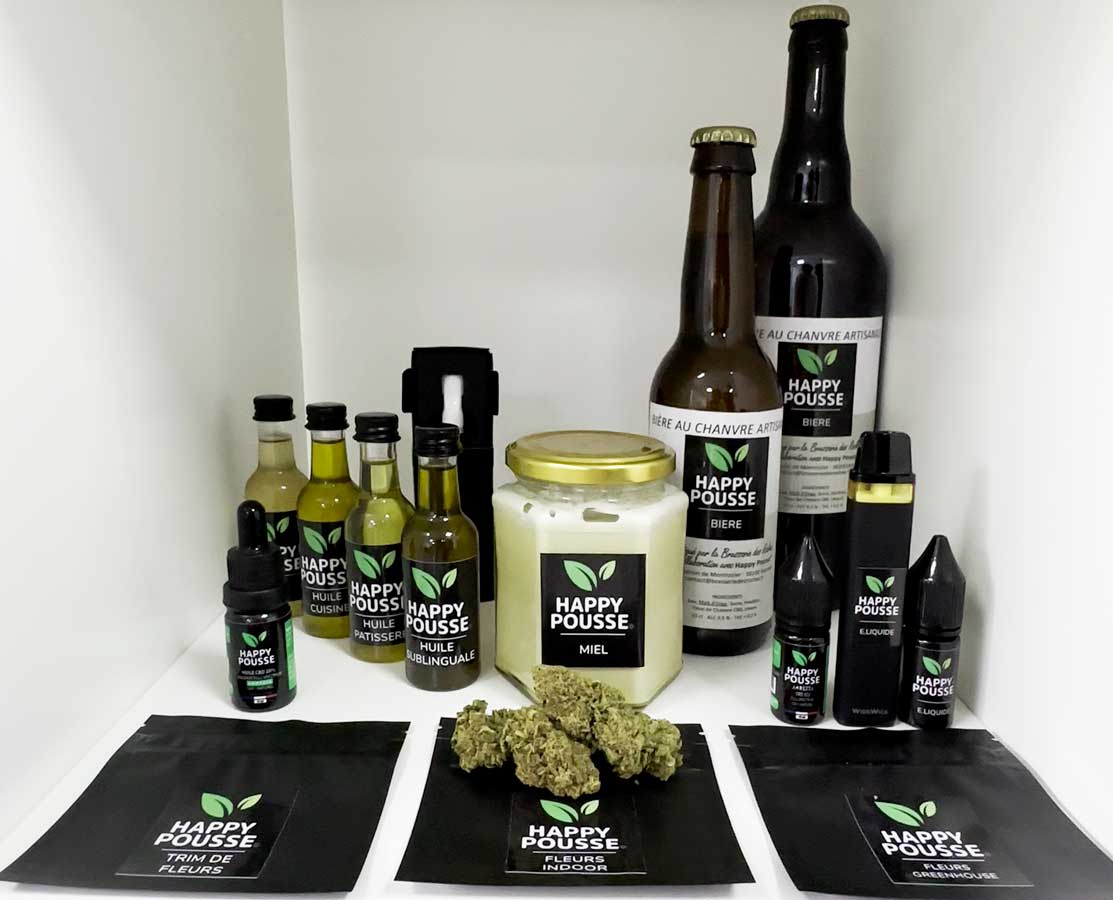
Happy Grow Products

Their products are currently available in around ten stores in the Lyon region. However, they have ambitious expansion plans and wish to establish a presence in several departments within a radius of 50 to 100 kilometers to expand locally.

Their vision goes beyond banal mass production; they wish to work with partners who defend French, transparent, traceable and fair trade products, with the possibility of working under their own label, white label or in bulk.

Future plans and the pursuit of medical cannabis

Happy Pousse's dreams go beyond premium cannabis products. The company indeed wishes to launch into the field of medical cannabis, relying on its infrastructure and expertise. Having already ventured into the cultivation of medical cannabis in Canada and Macedonia, where they support a medical cannabis producer whose production is distributed to German patients, they await the day when France will embrace the possibilities of medical cannabis.

In the ever-changing landscape of the cannabis industry, Happy Pousse is a symbol of innovation, quality and dedication. With a strong commitment to organic cultivation, groundbreaking research and a vision for the future, this French gem is ready to leave an indelible mark on the world of Cannabis. Happy Pousse's journey is a testament to what passion, expertise and the relentless pursuit of excellence can achieve in a growing sector.

Find Happy Pousse on Instagram, Facebook and LinkedIn.
https://happypousse-france.com/

The Hague validates its participation in the experimentation of legal cannabis production for coffeeshops

A motion from The Hague City Party, carried by municipal councilor Fatima Faïd, was tabled at the end of December, asking the municipality to “get to work” to participate in the production experiment legal cannabis for coffeeshops. The motion was adopted by the municipal council by a majority of votes, reports CannabisIndustrie.nl.

The “Join weed trial” motion adopted by the municipal council

The Hague City Party website justifies the motion in these terms:

“Dutch soft drugs policy is now hopelessly lagging behind. Building tolerance leads to very crazy situations where the front – the coffee shop – is regulated but the back – the production line – is not. The National Cannabis Trial is changing that.

So far, only small municipalities participate. One city missing from the G-4 [ndlr: les 4 grandes villes des Pays-Bas : Rotterdam, Amsterdam, La Haye et Utrecht]. A legislative amendment is even being developed so that neighborhoods in large cities can also participate. The next one is expected to be Amsterdam Zuidoost. We believe that as the municipality of The Hague we should also participate.

With the adoption of our motion, the mayor must begin discussions with coffeeshops in The Hague to determine whether they are ready to participate in the trial. As the City of The Hague party, we are in favor of this participation, because the legalization of soft drugs allows for a better understanding of the production chain and how cultivation is carried out. »

According to Gezal Karabekir, group representative for The Hague City Party: “By participating in an experiment on legal cannabis, we are clearly showing the city's residents that we care about their health. »

The text of the motion is as follows:

” Considering that :

The central government is launching a trial with a closed coffeeshop chain – that is, legal cannabis cultivation; no G4 city is yet participating in this trial

Considering that :

The Hague's coffee shops meet an important societal need; legalizing the supply of coffee shops can lead to a reduction in nuisance and crime; the interests of The Hague coffee shops are represented by the umbrella organization of The Hague coffee shops; the legalization of cannabis cultivation gives the consumer more control over the quality of the product; the central government will also allow G4 cities to participate in the trial with one or more city districts; asks the municipal executive to start discussions with coffeeshops in The Hague and, if coffeeshop owners in the city or district are in favor of participating in the trial with a legal production line for coffeeshops, 'indicate to the State that they are open to participation in this trial or any follow-up initiatives that may arise from it.

And move on to the agenda. »

Previous discussions

At the start of 2022, De Telegraaf reported that the government had discussed with the municipality of The Hague about possible participation in the cannabis trial as the eleventh city. It turned out to be the Amsterdam-Oost district.

In 2019, the municipality indicated that it found “the conditions insufficiently feasible” after consulting the owners of the city’s coffee shops.

The Belgian national commissioner in charge of the fight against drugs would like to follow the example of Portugal

In an interview on drug policy reform, Belgium's national drug commissioner, Ine Van Wymersch, suggested she was in favor of adopting the Portuguese model of drug decriminalization.

Portugal as an example

This approach would aim to replace punitive measures with more curative measures, treating drug addicts as patients rather than criminals. The spotlight is often on Portugal, which implemented a revolutionary drug decriminalization policy in 2001, leading to a significant reduction in heroin use, crime rates, STI contamination (hepatitis and HIV). and fatal overdoses.

The Belgian coordinator of the fight against drugs, Charlotte Colman

The Belgian coordinator of the fight against drugs, Charlotte Colman, who chairs the interfederal cell for general drug policy, explained that the decriminalization of the possession of drugs for personal use in Portugal was part of a set of 13 strategies.

“The possession of 25 grams of cannabis is no longer an offense punishable by a criminal response, but by an administrative response. The success of the Portuguese approach is evident in the dramatic reduction in the number of heroin users, crime rates and fatal overdoses over the past two decades. »

Colman highlights a crucial difference between Belgium and Portugal: “In our country, it is a magistrate or judge who offers assistance, while in Portugal, it is a multidisciplinary commission with a social vocation which is responsible for it. “.

The potential impact on a person's criminal record in Belgium poses problems, reducing the chances of stable housing and employment for those with drug-related convictions.

Beyond decriminalization

Decriminalization of drug possession for personal use in Belgium could mirror the positive results observed in Portugal, but requires a comprehensive approach. Ms Colman believes that decriminalization in Portugal is only one aspect of a broader strategy, including strengthening healthcare, research and the fight against trafficking and money laundering. Belgium's focus, particularly on combating drug-related violence resulting from cocaine trafficking, requires a nuanced approach.

According to Ms Colman: “By decriminalizing possession for personal use here, you can keep the person out of criminal politics, but you are not going to reduce the supply of drugs to all of Europe via the port of Antwerp.” , emphasizing the importance of a multifaceted strategy to tackle the different dimensions of drug trafficking and illegal consumption.

Recently, the Belgian Deputy Prime and Minister of the Economy advocated for the legalization of cannabis.

Spanish Ministry of Health confirms that medical cannabis will be legalized “soon”

The Spanish Ministry of Health, newly led by Mónica García, is close to approving comprehensive regulations for the medical use of cannabis, according to Spanish media ElPlural. This initiative, which is part of the broader framework of the program of the Sumar party from which the minister comes, aims to consider cannabis as a medicine whose use is based on scientific evidence.

The proposed regulation, currently in draft form by the National Agency for Medicines and Health Products (AEMPS), is expected to be approved in the coming months, which will allow Spain to align with the majority of European country that has already legalized medical cannabis.

Before finalizing the ministerial decree, the ministry plans to meet with stakeholders, in particular the Medical Cannabis Observatory (OECM), in order to gather their views and reactions.

Delays in its implementation

The journey towards the regulation of medical cannabis in Spain has been marked by numerous delays. The subcommittee which met in June 2022 mandated AEMPS to produce a report within six months. However, former Health Minister José Miñones apologized for the delay, citing “overzealousness.” The subsequent submission of the report to the new minister, Mónica García, in December, however, shows that efforts continue to ensure the availability of cannabis-based treatments.

Once the political decision is made, Spain will then encounter the same obstacles as other countries. On the one hand, the approval of medical cannabis regulations could catalyze significant changes. The pharmaceutical industry is expecting a boom, with local and international companies exploring opportunities to develop and produce cannabis-derived medicines.

However, for the cannabis market itself, the road ahead appears complex. While demand for medical cannabis products is expected to increase, strict regulation, particularly in terms of medical prescribing and monitoring, could initially limit accessibility. This will pose a challenge for producers and distributors, who will have to align with likely stringent regulatory requirements and will only be able to supply a small number of patients to begin with.

Spain's current approach to regulating medical cannabis is in its infancy compared to other countries. Countries like Uruguay, Israel and the Netherlands have legalized medical cannabis a long time ago, while Canada and some American states have already started regulating recreational use.

The diversity of regulations in Europe, from Germany's approval of cannabis-based medicines to Portugal's authorization of prescription cannabis extracts, highlights the potential for complexity in the legislative framework surrounding medical cannabis.

DEA Recalls Its “Final Authority” on Cannabis Reclassification

In a recent letter to Congress, the Drug Enforcement Administration (DEA) reaffirms its “final authority” over any cannabis reclassification decisions, regardless of recommendations from the Department of Health and Human Services (HHS).

As stakeholders anxiously await the outcome, the complex interplay between federal agencies, lawmakers, and public opinion is evident.

To reclassify or not to reclassify cannabis

In 2022, the Biden administration launched a review of federal cannabis policies. Last year, the US Department of Health and Human Services (HHS) officially recommended that cannabis be moved from Schedule I to Schedule III of the List of Narcotic Drugs. The Annexes make it possible to control substances according to their dangerousness, Annex I being the most restrictive and not recognizing any medical use while presenting a high potential for abuse.

Once HHS makes its recommendation last August, “the DEA will conduct its own review,” said the letter, sent last month.

“The DEA has final authority to classify, reclassify, or downgrade a drug under the Controlled Substances Act, after reviewing relevant statutory and regulatory criteria and the Department's scientific and medical evaluation. of Health and Human Services (HHS),” the document reads.

This clarification sparked frustration among lawmakers, including Senator Earl Blumenauer, who co-chairs the Congressional Cannabis Caucus. He and 30 other bipartisan lawmakers are urging the DEA to consider the “merits” of cannabis legalization during the review.

The DEA's response, however, provides little guidance on these concerns, maintaining a procedural approach and failing to address key arguments made by lawmakers.

Lack of transparency from HHS

HHS's recommendation to move cannabis from Schedule I to Schedule III, based on scientific evaluation, initiated the current review process. However, the details of this recommendation remain shrouded in secrecy, with hundreds of pages of explanations sent to the DEA available only in heavily redacted form.

This lack of transparency prevents stakeholders from fully understanding the reasoning behind HHS's recommendation, further complicating the decision-making process.

While a coalition of six US governors urged the Biden administration to reclassify cannabis before the end of the previous year, 29 former US attorneys came out against such a move, calling for the administration to keep cannabis in Appendix I. Six former DEA chiefs and five former White House czars also expressed opposition to the HHS recommendation.

The outcome of the DEA review will have profound implications for cannabis policy reform in the United States. Advocates and lawmakers continue to call for a comprehensive approach, urging the DEA to move beyond Schedule III and consider full declassification, namely removing cannabis from the Narcotic Drug List and decriminalizing it at the federal level. .

Shifting public opinion, reflected in a Gallup poll where seven in ten Americans support a change in cannabis policy, adds weight to the argument for a more progressive stance on state cannabis regulation. -United.

President Biden pardons several thousand people convicted of cannabis possession

President Joe Biden issued a proclamation in late December expanding his cannabis pardon initiative. This initiative is a continuation of last year's clemency efforts, which aimed to address racial disparities and lessen the impact of criminal records on individuals' lives. While laudable, the expanded initiative is facing scrutiny due to its limitations and opt-out clauses.

Context of these amnesties

President Biden's Cannabis Pardon Initiative, initially launched in October 2022, aims to address the negative impacts of cannabis convictions on individuals' access to employment, housing, and education. The president stressed the need to correct the societal impacts of the “failed approach” to the war on drugs.

Mr Biden said: “Criminal records for cannabis use and possession have imposed unnecessary barriers […]. Too many lives have been disrupted because of our failed approach to cannabis. It’s time to right these wrongs.”

The recent proclamation expands the scope of clemency to those convicted of possessing cannabis on federal property, a notable expansion from the previous initiative. The pardon now covers federal offenses and those committed in Washington, DC for “simple possession of marijuana, attempted simple possession of marijuana, or use of marijuana,” even for offenses committed after the initial October 2022 pardon.

Joe Biden also commuted the sentences of 11 people who were serving long sentences for drug crimes.

However, it is crucial to note that some groups remain excluded from the initiative. According to Marijuana Momentthe pardon does not apply to noncitizens illegally present in the United States at the time of the offense, persons involved in the distribution of cannabis, or persons charged with driving under the influence of cannabis.

Additionally, the initiative did not result in the release of any prisoners, sparking criticism of its effectiveness in addressing systemic problems. While the presidential pardon represents a formal pardon, it does not amount to expungement, leaving individuals with a sealed rather than expunged record.

Call for action at the state level

In his recent statement, Joe Biden called on governors and local leaders to take similar steps to combat cannabis convictions. The President reiterated: “Just as no one should be in a federal prison solely because of marijuana use or possession, no one should be in a local jail or state prison for that reason either “.

While President Biden's expanded cannabis pardon initiative is a step toward addressing the injustices associated with cannabis possession convictions, there is still work to be done. The limitations and exclusions contained in pardons highlight the complexity of drug policy reform. Human rights advocates continue to call for greater measures, such as federal legalization of medical cannabis and decriminalization, to achieve a more comprehensive and equitable approach to cannabis offenses.

Are H4CBD gummies dangerous?

In an incident reported at the end of December by Le Parisien, a meeting of friends turned into bad trip group after the consumption of candies purchased in a Parisian CBD shop and containing in particular H4CBD. The consequences were mild but some individuals still ended up in hospital. Could this Secret Ganja have been avoided?

According to Le Parisien, these candies contained H4CBD, a synthetic cannabinoid derived from CBD, CBD and THC in legal doses, below 0.3%. THC, the active substance in cannabis, is known for its psychotropic effects, while CBD, psychoactive but not psychotropic, is found naturally in the plant. H4CBD, a lab-made cannabinoid, adds a layer of complexity to these products.

Even if these products are legal in France, their consumption carries risks. As Professor Nicolas Authier, specialist in pharmacology and addiction, reminds BFMTV, the threshold of 0.3% alone is misleading. The quantity of cannabinoids ingested matters more here than the percentage.

The consumption ofedibles, foods infused with cannabis, generate more effects than when smoked with the disadvantage of a long latency between ingestion and the arrival of the effects. It is therefore generally recommended to wait 2 hours before seeing if the dose ingested takes effect and especially not to take a slice of space cake for example before, at the risk of experiencing a double kiss-cool effect when rising. .

The gummies in question also contained 25 mg of THC, a very high dose for non-consumers. For reference, the maximum dose of a edible on the legal California market is 10 milligrams of THC, with a limit of 100 mg of THC per package (i.e. 10 doses of 10 mg or 20 doses of 5 mg).

Another area of ​​concern is the issue of transparency of product composition. The Interministerial Mission to Combat Drugs and Addictive Behaviors (Mildeca) noted that a significant proportion of CBD-based products on the French market did not contain what was indicated on the label. 6% of the samples tested also contained neocannabinoids without mentioning them on the packaging, including H4CBD.

This lack of transparency inherent to the absence of regulation, as well as the lack of warnings from sellers, leads to risks for consumers, as shown by the “Secret Santa” incident, where these people thought they were consuming candy. with standard CBD.

How to properly consume edibles for the first time ?

If you want to try legal cannabis-infused edibles, you should buy them from trusted sites that perfectly describe the contents of the gummies. If these contain more than 10 milligrams of THC, then they will be very strong. As always with the ediblesit is better to take 2 to 2 hours apart than to regret having taken 2 at the same time.

You should also know the following things.

How do edibles work?

THE edibles are consumed orally and processed in the stomach and liver, whereas smoked or vaped cannabis enters the lungs to be absorbed directly into the bloodstream. The effects of edibles take much longer to be felt, as they must first be digested and metabolized. This is why they are generally more potent and last longer than smoked or vaporized cannabis.

How long does the effect of edibles last?

Don't expect your space brownie to start working as soon as you swallow it. Due to digestion, the effects of edibles tend to peak 1-2 hours after consumption and dissipate within 2-3 hours, whereas the effects of smoking cannabis tend to peak within 10 minutes and dissipate quickly within 30 to 60 minutes. These are estimates; Individual metabolisms, as well as external factors such as eating your edible on an empty stomach, age and pre-existing conditions, can influence these times.

Edibles may seem potent, but compared to inhaled cannabis, they actually deliver a lower concentration of cannabinoids into the bloodstream. Ingesting edibles only introduces 10 to 20 percent THC and other cannabinoids into the blood plasma, whereas inhaled cannabis reaches a concentration closer to 50 to 60 percent.

Being a cannabis consumer, even in quantity, has no impact on tolerance to edibles; a low dose edible can still knock out even the most experienced canna enthusiast. They will just be more used to the effect but surprises can happen.

What to do in case of unpleasant sensations?

The effects provided by an edible product can be very different from those provided by burning, vaporizing or dabbing. After all, our bodies metabolize them through different systems, and the highs from edibles are the longest-lasting of all consumption methods because THC passes through the liver during digestion, increasing the THC's longevity.

We recommend that you try to stay calm, drink water and distract yourself. You can also try eating a large meal to boost your metabolism or taking CBD to mitigate the effects of edibles. If you can, a nice, long nap can also do the trick.

Most importantly, you don't die from a THC overdose. The effects always pass eventually. It just sometimes takes more time than we would like!